
Single-Nucleotide RNA Pseudouridine (Ψ) Modification Seq (BID-seq)
Bisulfite leaves pseudouridine intact while unmodified positions are converted, so reverse transcription writes a deletion signature at every Ψ site and the map lands on single bases.
01What the service reports
Single-Nucleotide RNA Pseudouridine (Ψ) Modification Seq (BID-seq) is an antibody-free, base-resolution method. Bisulfite-induced deletion sequencing exploits the resistance of pseudouridine to bisulfite: the base is left unconverted and becomes a deletion signature during reverse transcription, and that signature both locates and quantifies the site.
The readout is direct rather than captured. Nothing is enriched before sequencing, so the signal at a position comes from the conversion chemistry itself, and each call arrives with a modification ratio rather than only an enrichment score.
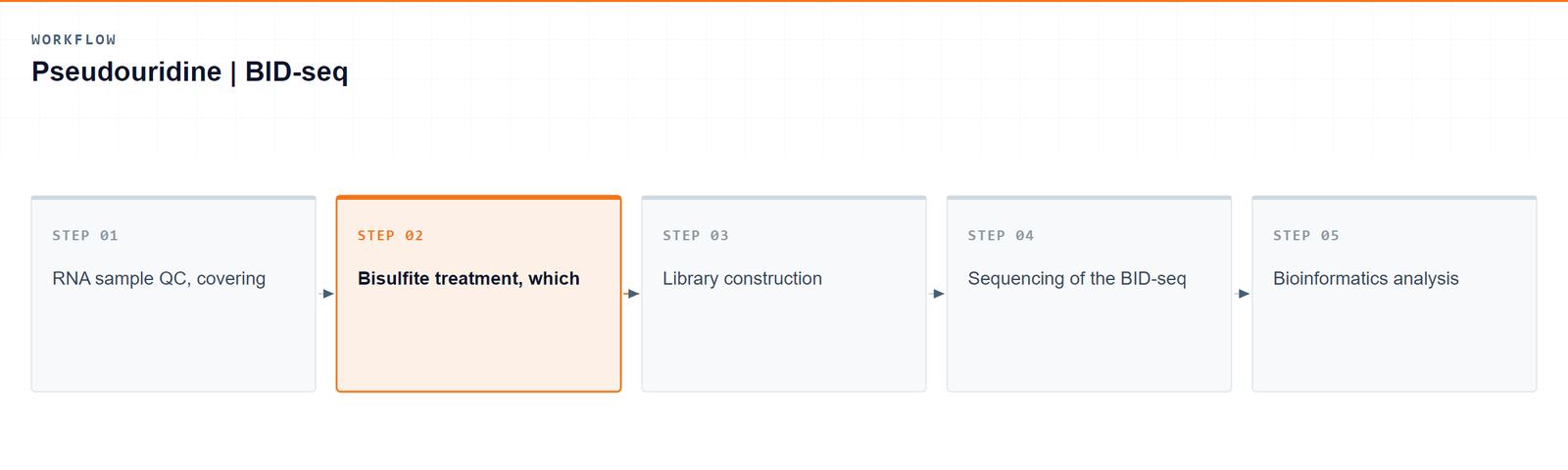
Arraystar runs BID-seq as a complete laboratory workflow: RNA sample QC, bisulfite treatment, library construction, sequencing and bioinformatics. Sites are annotated to the reference transcriptome with genomic coordinates, host gene and functional region, and a study can be scoped to mRNA alone or to mRNA together with long non-coding RNA.
02Benefits
- A signature at the base: the position is read out of the alignment itself, so each pseudouridine call is a single base rather than a peak.
- A level as well as a position: the conversion-based readout reports how much of a site is modified.
- Antibody-free: there is no immunoprecipitation, so the readout does not depend on antibody cross-reactivity or on how efficiently a pull-down performed.
- Annotated output: sites are placed on the reference transcriptome with coordinates, host gene and functional region attribution.
- Fitted to downstream questions: site-level data serves work on translation control, transcript stability, coding-region function and gene regulation.
| Service Name | RNA Class | Price |
|---|---|---|
| Single-Nucleotide RNA Pseudouridine (Ψ) Modification Seq (BID-seq) | mRNA | |
| Single-Nucleotide RNA Pseudouridine (Ψ) Modification Seq (BID-seq) | mRNA and lncRNA | |
| Single-Nucleotide RNA Pseudouridine (Ψ) Modification Seq (BID-seq) | rRNA |
03Background and detection principle
Pseudouridine shapes the structure of an mRNA and how readily that transcript is translated, so a map is most useful when it resolves individual positions. Region-level enrichment leaves both the position and the level of a site open, and it folds the preferences of the capture reagent into the signal.
BID-seq rests on a chemical difference instead. Pseudouridine resists bisulfite deamination, so it stays unconverted while unmodified positions react; when the treated RNA is reverse transcribed, the resistant base produces a deletion signature. Because that signature sits exactly at the modified position, the alignment places the site and the readout gives its level in the same pass.
The same workflow extends to long non-coding RNA, so coding and non-coding transcripts can be profiled together within one experiment.
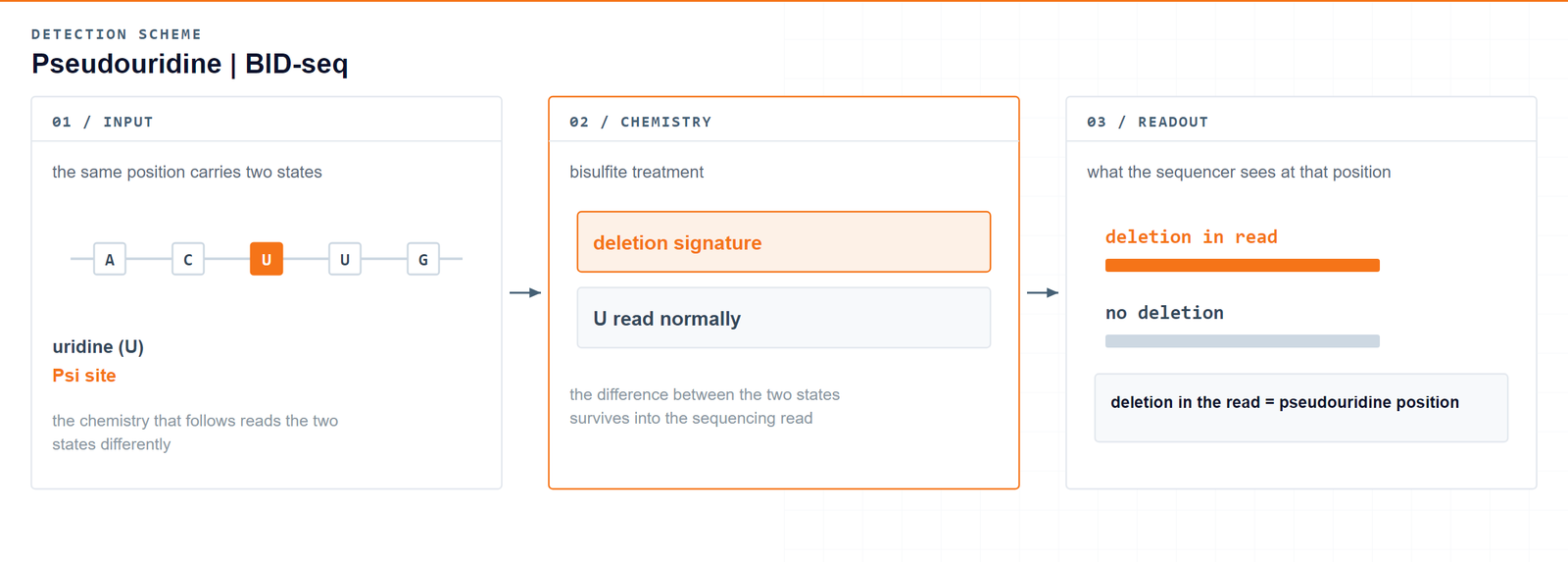
Pseudouridine resists the bisulfite reaction, so the base survives and reverse transcription writes a deletion at that position — the site and its level come out of the same signature.Dai Q. et al., Nature Biotechnology 2023 · DOI 10.1038/s41587-022-01505-w
04Workflow
Five steps take a sample from RNA to single-base pseudouridine data:
- RNA sample QC, covering integrity and purity before treatment.
- Bisulfite treatment, which converts unmodified positions while pseudouridine resists.
- Library construction from the treated RNA.
- Sequencing of the BID-seq library.
- Bioinformatics analysis to call the deletion signatures and quantify Ψ stoichiometry.
05Bioinformatics and deliverables
Reads are aligned to the reference transcriptome, bisulfite-induced deletion signatures are detected, and pseudouridine stoichiometry is quantified at single-nucleotide resolution. Motif characterization, transcript-feature distribution, differential modification, functional enrichment and genome-browser visualization are layered on top of the site calls.
Deliverables
- Raw pseudouridine mRNA sequencing data files (FASTQ), formatted for GEO/SRA submission.
- Sample and sequencing QC reports with sorted BAM alignment files and core mapping statistics.
- High-confidence single-base pseudouridine site tables (XLSX) listing coordinates, host genes and stoichiometry.
- Single-base pseudouridine transcript-feature distribution figures and consensus motif logos (PDF/PNG).
- Single-base differential pseudouridine tables (XLSX) with fold change and significance.
- GO enrichment reports for pseudouridine-modified genes (HTML/PDF/PNG).
- Genome-browser track files (bigWig/bedGraph) together with a structured project report.
06Research applications
- Transcriptome-wide maps: pseudouridine sites are resolved across protein-coding transcripts and, where the study is scoped that way, across lncRNAs as well.
- Translation and transcript stability: site-level data can be set against how efficiently an mRNA is translated and how long it persists.
- Coding-region and UTR function: sites are localized within CDS, UTR and splice-adjacent regions, so positional effects can be examined rather than assumed.
- Disease-oriented work: differentially modified mRNA sites can be carried forward as candidate biomarkers.
- Method cross-checks: because the readout is chemical rather than capture-based, the site list can be compared with results from other Ψ mapping routes without sharing their reagent bias.
07Sample requirements
Storage. Cells and tissues: preserve in TRIzol or an RNA stabilisation solution, snap freeze in liquid nitrogen and store at −80 °C. RNA: resuspend in ethanol or RNase-free ultrapure water, store at −80 °C and avoid repeated freeze–thaw cycles.
Shipping. Place the sample in a 1.5 mL RNase-free microcentrifuge tube, seal it with parafilm or a cap lock, and ship on dry ice with adequate insulation.
| Sample type | Notes |
|---|---|
| Whole blood | EDTA tubes only; heparin is not compatible with the downstream procedure. |
| Cultured cells | Cell pellets are preferred. |
| Tissue | Fresh or frozen specimens; avoid necrotic material. |
| Total RNA | OD 260/280 ≥ 1.8 and RIN ≥ 7, with no visible degradation. Submit at least 10 µg total RNA. |
08FAQ
What makes pseudouridine visible in this assay?
Its resistance to bisulfite. Unmodified positions react with the bisulfite and are read differently, while pseudouridine stays unconverted and leaves a deletion signature when the treated RNA is reverse transcribed.
Does a BID-seq call come with a modification level?
Yes. The signal is conversion-based, so a site returns a stoichiometry along with its position rather than serving only as evidence that the modification is present.
Is any antibody or capture step involved?
No. There is no immunoprecipitation anywhere in the workflow, so the calls are not shaped by the binding preference of an antibody or by how a particular pull-down behaved on the day.
How are the reported sites annotated?
Each call is placed on the reference transcriptome with genomic coordinates, its host gene and its functional region, so a site can be read in the context of the transcript that carries it.
Can lncRNA be included in the same project?
Yes. Two scopes are available: pseudouridine profiling on mRNA, or on mRNA together with long non-coding RNA. Both transcript types are analyzed within a single experiment.
09References
- Dai Q, Zhang LS, Sun HL, et al. Quantitative sequencing using BID-seq uncovers abundant pseudouridines in mammalian mRNA at base resolution. Nature Biotechnology 2023;41(3):344–354. DOI: 10.1038/s41587-022-01505-w