
RNA Pseudouridine (Ψ) Modification Profile (Ψ-RIP-Seq)
Antibody enrichment of pseudouridine-containing fragments, read as a transcript-level profile of where Ψ concentrates across a sample.
01What the service reports
RNA Pseudouridine (Ψ) Modification Profile (Ψ-RIP-Seq) is an antibody-based enrichment service for pseudouridine. Fragments containing Ψ are captured, sequenced and mapped, giving a profile of where Ψ is enriched across transcripts.
The report is a region-level profile. Captured fragments span stretches of a transcript, and the profile describes the abundance and distribution of those stretches relative to an input control. It answers questions about how much Ψ signal a transcript carries and how that changes between samples.
That is a different question from the one a chemical-conversion method answers. Conversion chemistry reads a Ψ-specific signature and places the modification at a nucleotide, so it resolves position rather than breadth. The enrichment route is stronger when the study needs coverage across many transcripts or many samples. Arraystar delivers the workflow from sample QC to the analyzed profile.
02Benefits
- Broad Ψ coverage: the profile surveys pseudouridine signal across transcripts instead of at chosen positions.
- Comparison across samples: enriched regions can be compared between conditions, treatments or cohorts.
- Well-suited to abundant Ψ sites: pseudouridine is common in structured and non-coding RNA, and the profile reports those signals across the transcriptome.
- Clear division of labour: the profile identifies transcripts of interest; a conversion-based method then resolves the sites within them.
- Managed end to end: RNA QC, capture, library construction, sequencing and analysis are delivered together.
| Service Name | RNA Class | Price |
|---|---|---|
| RNA Pseudouridine (Ψ) Modification Profile (Ψ-RIP-Seq) | mRNA | |
| RNA Pseudouridine (Ψ) Modification Profile (Ψ-RIP-Seq) | mRNA and lncRNA |
03Background and detection principle
The workflow fragments RNA, captures pseudouridine-containing fragments with an anti-pseudouridine antibody, and sequences the captured pool next to an input control. Regions enriched over input are reported and annotated to transcripts.
Pseudouridine is an isomer of uridine, and generating an antibody that reads it specifically is what makes this route possible. The boundaries are the usual ones for enrichment: signal is localised to a region rather than a base, and capture efficiency shapes what appears in the profile. For a modification as abundant as Ψ, the profile is most informative when read comparatively between conditions.
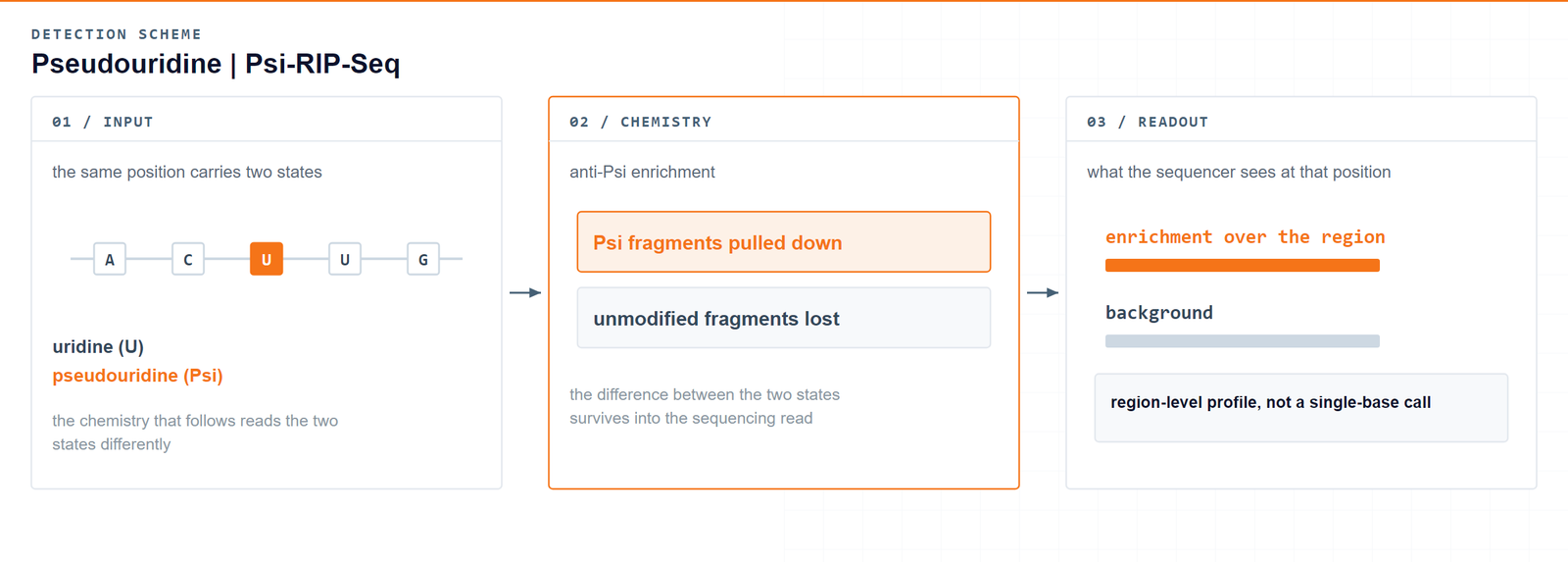
Ψ-RIP-Seq reports where pseudouridine concentrates; conversion chemistry reports which uridine it is.Carlile TM. et al., Nature 2014 · DOI 10.1038/nature13802
04Workflow
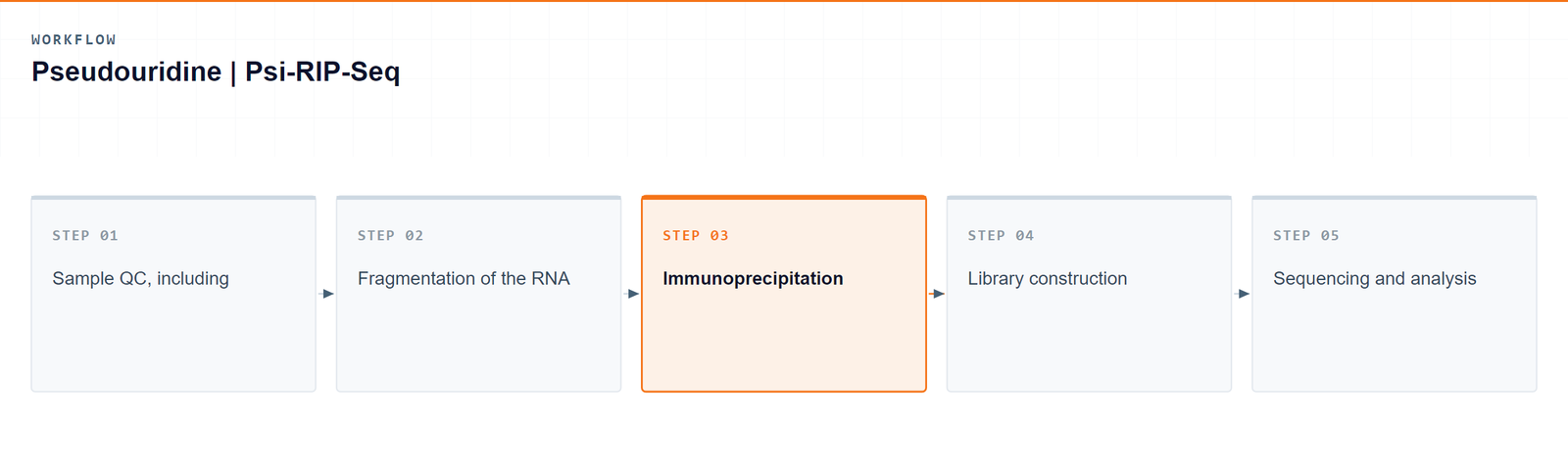
Five steps carry a sample from RNA to an analyzed Ψ profile:
- Sample QC, including checks on RNA integrity and purity.
- Fragmentation of the RNA for antibody capture.
- Immunoprecipitation with an anti-pseudouridine antibody, against an input control.
- Library construction from the enriched and input fractions.
- Sequencing and analysis to call enriched regions and compare samples.
05Bioinformatics and deliverables
Mapped reads are compared with input to call enriched regions, which are annotated to transcripts and features. The analysis set covers region calling and annotation, distribution across transcript features, differential enrichment and genome-browser visualization.
Deliverables
- Raw Ψ mRNA enrichment sequencing data files (FASTQ), formatted for GEO/SRA submission.
- QC reports and sorted, indexed BAM alignment files with core mapping statistics.
- Ψ enrichment region tables (XLSX) with genomic coordinates and annotated host genes.
- Region distribution plots over transcript features (PDF/PNG).
- Differential Ψ enrichment tables (XLSX) between sample groups.
- Genome-browser signal tracks (bigWig/bedGraph) and a structured project report.
06Research applications
- Pseudouridine synthase studies: samples with an enzyme perturbed can be compared to see how the Ψ profile shifts.
- Non-coding RNA work: Ψ is common in rRNA, tRNA and other structured RNAs, all of which the profile covers.
- mRNA therapeutic context: pseudouridine is central to modified-RNA therapeutics, and enrichment profiles offer a transcript-level view of Ψ content.
- Cancer research: tumour and normal samples can be compared for Ψ signal across transcripts.
- Survey before site-level work: transcripts that differ in the profile are the candidates for a conversion-based method.
07Sample requirements
Storage. Cells and tissues: preserve in TRIzol or an RNA stabilisation solution, snap freeze in liquid nitrogen and store at −80 °C. RNA: resuspend in ethanol or RNase-free ultrapure water, store at −80 °C and avoid repeated freeze–thaw cycles.
Shipping. Place the sample in an RNase-free microcentrifuge tube, seal it against leakage, and ship on dry ice with adequate insulation.
| Sample type | Notes |
|---|---|
| Whole blood | EDTA tubes only; heparin is not compatible with the downstream procedure. |
| Cultured cells | Cell pellets are preferred. |
| Tissue | Fresh or frozen specimens; avoid necrotic material. |
| Total RNA | OD 260/280 ≥ 1.8 and RIN ≥ 7, with no visible degradation. Submit more than 10 µg total RNA. |
08FAQ
What if the study needs the position rather than the profile?
Then the work moves to single-base resolution. Alongside this profile, Arraystar provides pseudouridine sequencing at single-base resolution (BID-seq, BACS-seq), which reads the modification at individual positions and reports how much of each transcript carries it, so enriched transcripts can be resolved on matched RNA.
Can the profile place a Ψ at a specific uridine?
No. Enrichment reports the region a captured fragment came from, not the individual nucleotide. A conversion-based method is what provides site-level pseudouridine calls.
How does Ψ-RIP-Seq relate to BID-seq or BACS-seq?
They answer different questions. Ψ-RIP-Seq reports where pseudouridine is enriched across transcripts; BID-seq and BACS-seq use bisulfite-based chemistry to read the modification at individual positions.
Does abundant Ψ in non-coding RNA affect the profile?
It can, and it is worth planning for. rRNA and tRNA carry substantial pseudouridine, so the enrichment step and the analysis should be set up to handle the transcript types the study cares about.
What is the effect of the antibody on interpretation?
Capture depends on antibody binding, so the profile reflects both the Ψ content of the sample and how well the antibody captured it. Comparison across samples is the most reliable reading.
Which samples are accepted?
Total RNA, cultured cells, tissue or blood, subject to the quality thresholds listed on this page.
09References
- Carlile TM, Rojas-Duran MF, Zinshteyn B, Shin H, Bartoli KM, Gilbert WV. Pseudouridine profiling reveals regulated mRNA pseudouridylation in yeast and human cells. Nature 2014;515:143–146. DOI: 10.1038/nature13802