
RNA m1A Modification Profile (MeRIP-Seq)
Enrichment of m1A-carrying fragments into a transcript-level profile. The chemistry of m1A shapes what this route can report, and the page says so plainly.
01What the service reports
RNA m1A Modification Profile (MeRIP-Seq) is an antibody-based enrichment service for N1-methyladenosine. Fragments carrying m1A are captured, sequenced and mapped, and the result is a region-level profile of where m1A is enriched.
m1A has a property that matters for any sequencing-based readout: the methyl group sits on the Watson–Crick face of the base, so the modified nucleotide blocks reverse transcription and stalls the enzyme. Methods built on conversion or on read-through therefore do not report m1A the same way they report other marks. What remains robust is capture and enrichment.
Accordingly this service reports enrichment, not a resolved position. Signal is attributed to a region of a transcript, and comparisons between samples are the strength of the output. Where the position of an m1A site is the question, that is a matter for the single-base line rather than for this profile.
02Benefits
- Built for a stalled-template mark: because enrichment does not depend on reading through m1A, capture is a sound way to detect the modification.
- Region-level coverage: the profile reports m1A enrichment across transcripts rather than at a single preselected position.
- Comparison across samples: enriched regions can be compared between conditions, treatments or cohorts.
- Annotated results: enriched regions are linked to transcripts and features, so the profile reads at the gene level.
- Full workflow: RNA QC, enrichment, library construction, sequencing and analysis are delivered together.
| Service Name | RNA Class | Price |
|---|---|---|
| RNA m1A Modification Profile (MeRIP-Seq) | mRNA | |
| RNA m1A Modification Profile (MeRIP-Seq) | mRNA and lncRNA |
03Background and detection principle
The workflow fragments RNA and captures m1A-containing fragments with an anti-m1A antibody, sequencing the captured pool together with an input control. Regions enriched over input make up the profile, and their annotation links the signal to transcripts.
The unusual chemistry of m1A explains why the enrichment format is the right one here. Reverse transcriptase stalls at m1A rather than copying through it, so conversion-style readouts run into a signal that is dominated by the stall. Enrichment side-steps the problem by selecting fragments that carry the modification, which is why the profile is reported as a region-level enrichment rather than as a resolved position.
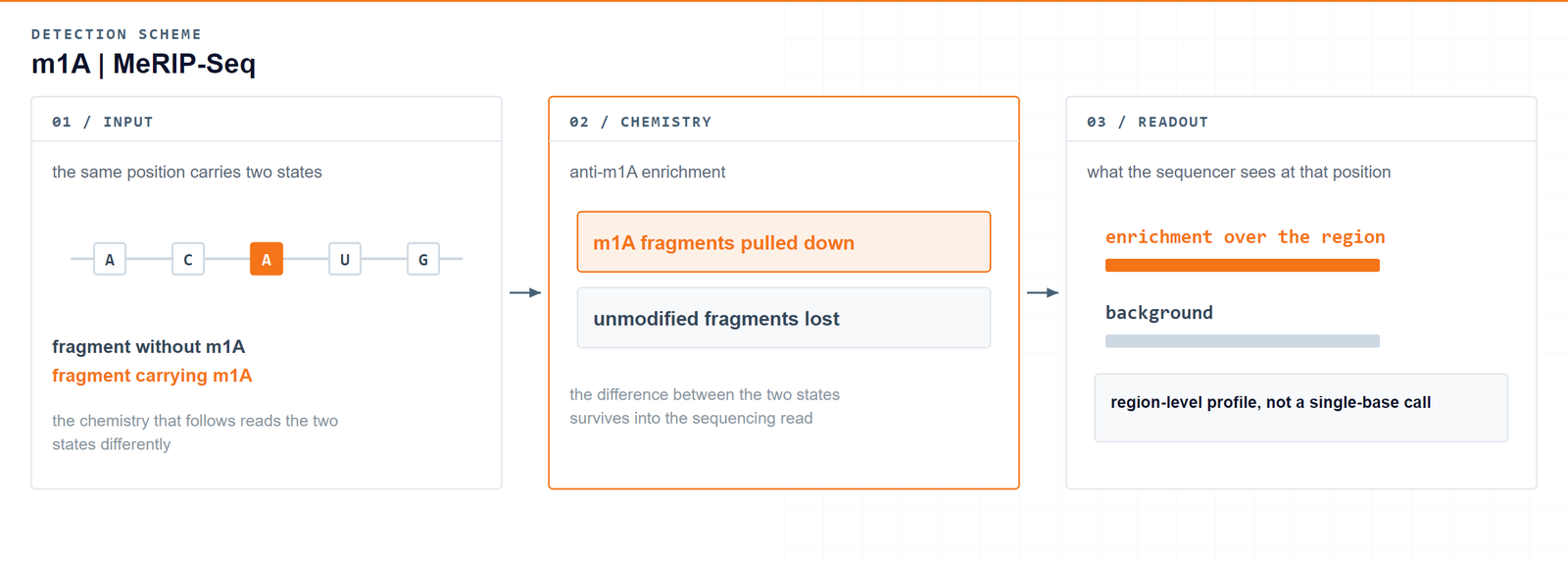
m1A stops the polymerase, so the reliable readout is which fragments carry it — and that is a region, not a base.Li X. et al., Nature Chemical Biology 2016 · DOI 10.1038/nchembio.2040
04Workflow
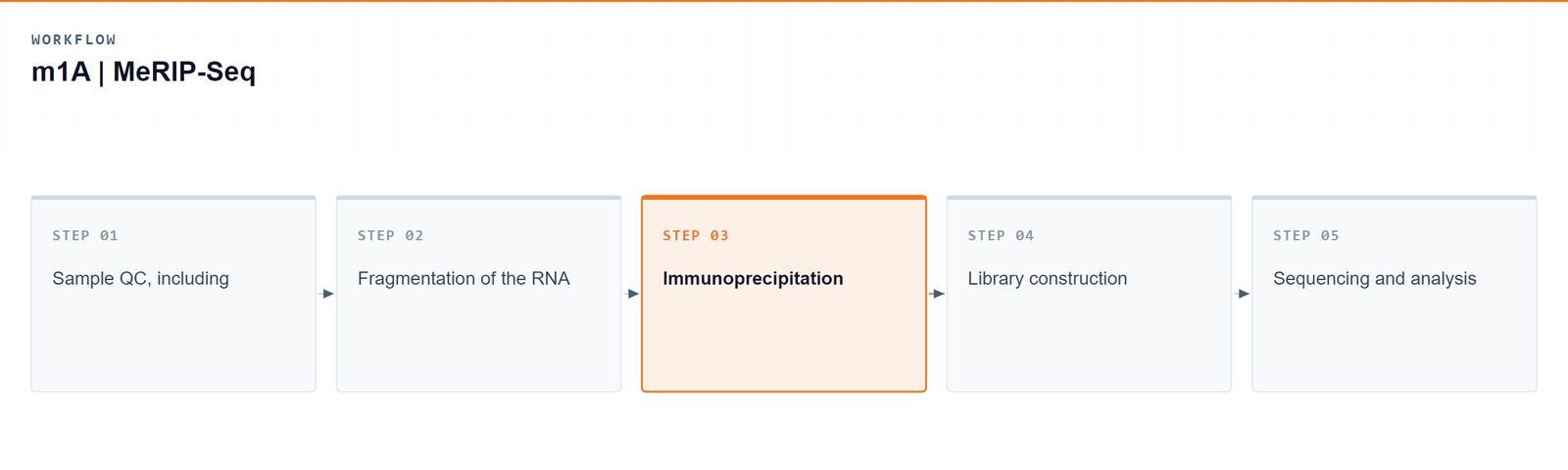
The service runs in five steps from sample to analyzed m1A profile:
- Sample QC, including integrity and purity checks.
- Fragmentation of the RNA for antibody capture.
- Immunoprecipitation with an anti-m1A antibody alongside an input control.
- Library construction from the enriched and input fractions.
- Sequencing and analysis to call enriched regions and compare samples.
05Bioinformatics and deliverables
Reads are mapped and enriched regions are called against input, then annotated to transcript features. The analysis set covers region calling and annotation, distribution across features, differential enrichment between groups and genome-browser visualization.
Deliverables
- Raw m1A mRNA enrichment sequencing data files (FASTQ), formatted for GEO/SRA submission.
- QC reports and sorted, indexed BAM alignment files with core mapping statistics.
- m1A enrichment region tables (XLSX) with genomic coordinates and annotated host genes.
- Region distribution plots over transcript features (PDF/PNG).
- Differential m1A enrichment tables (XLSX) between sample groups.
- Genome-browser signal tracks (bigWig/bedGraph) and a structured project report.
06Research applications
- tRNA and structured RNA studies: m1A is well known in tRNA, and enrichment profiles can survey it across samples.
- Mitochondrial and stress biology: m1A has been linked to stress responses, so treated and untreated samples are a common comparison.
- Cancer research: tumour and normal samples can be compared for m1A enrichment across transcripts.
- Enzyme perturbation: samples with a writer or eraser altered can be compared to see how the profile responds.
- Survey before site-level work: regions that differ become candidates for follow-up at the site level.
07Sample requirements
Storage. Cells and tissues: preserve in TRIzol or an RNA stabilisation solution, snap freeze in liquid nitrogen and store at −80 °C. RNA: resuspend in ethanol or RNase-free ultrapure water, store at −80 °C and avoid repeated freeze–thaw cycles.
Shipping. Place the sample in an RNase-free microcentrifuge tube, seal it against leakage, and ship on dry ice with adequate insulation.
| Sample type | Notes |
|---|---|
| Whole blood | EDTA tubes only; heparin is not compatible with the downstream procedure. |
| Cultured cells | Cell pellets are preferred. |
| Tissue | Fresh or frozen specimens; avoid necrotic material. |
| Total RNA | OD 260/280 ≥ 1.8 and RIN ≥ 7, with no visible degradation. Submit more than 10 µg total RNA. |
08FAQ
What if the study needs the position rather than the profile?
Then the work moves to single-base resolution. Alongside this profile, Arraystar provides m1A sequencing at single-base resolution (m1A-Quant-seq), which reads through the modified base and reports the position and stoichiometry of each site, so candidates from this profile can be resolved on matched RNA.
Why does m1A need an enrichment approach?
Because the methyl group blocks reverse transcription. Any readout that depends on copying through the position runs into a stall rather than a clean signal, so capture and enrichment is the more dependable route.
Does the profile resolve individual m1A positions?
No. Enrichment attributes signal to a region of a transcript. The profile is well suited to comparing samples and to choosing candidates, not to placing a base.
How do antibody preferences affect the result?
They shape which fragments are captured and therefore which regions appear in the profile. That belongs to the interpretation, as it does for every antibody-based method.
Is m1A reversible, and does that matter here?
m1A is reversible, and demethylases act on it. That is a biological reason to compare samples rather than to treat one sample as a fixed baseline, which is exactly what the enrichment profile is good at.
Which samples are accepted?
Total RNA, cultured cells, tissue or blood, subject to the quality thresholds listed on this page.
09References
- Li X, Xiong X, Wang K, et al. Transcriptome-wide mapping reveals reversible and dynamic N1-methyladenosine methylome. Nature Chemical Biology 2016;12:311–316. DOI: 10.1038/nchembio.2040