
RNA O8G Modification Profile (O8G-IP-Seq)
Immunoprecipitation of oxidised guanosine in RNA, reported as a region-level profile of where oxidative damage falls across transcripts.
01What the service reports
RNA O8G Modification Profile (O8G-IP-Seq) is an immunoprecipitation service for 8-oxoguanosine in RNA. Fragments carrying oxidised guanosine are captured with a specific antibody and sequenced, producing a profile of where oxidative modification is enriched.
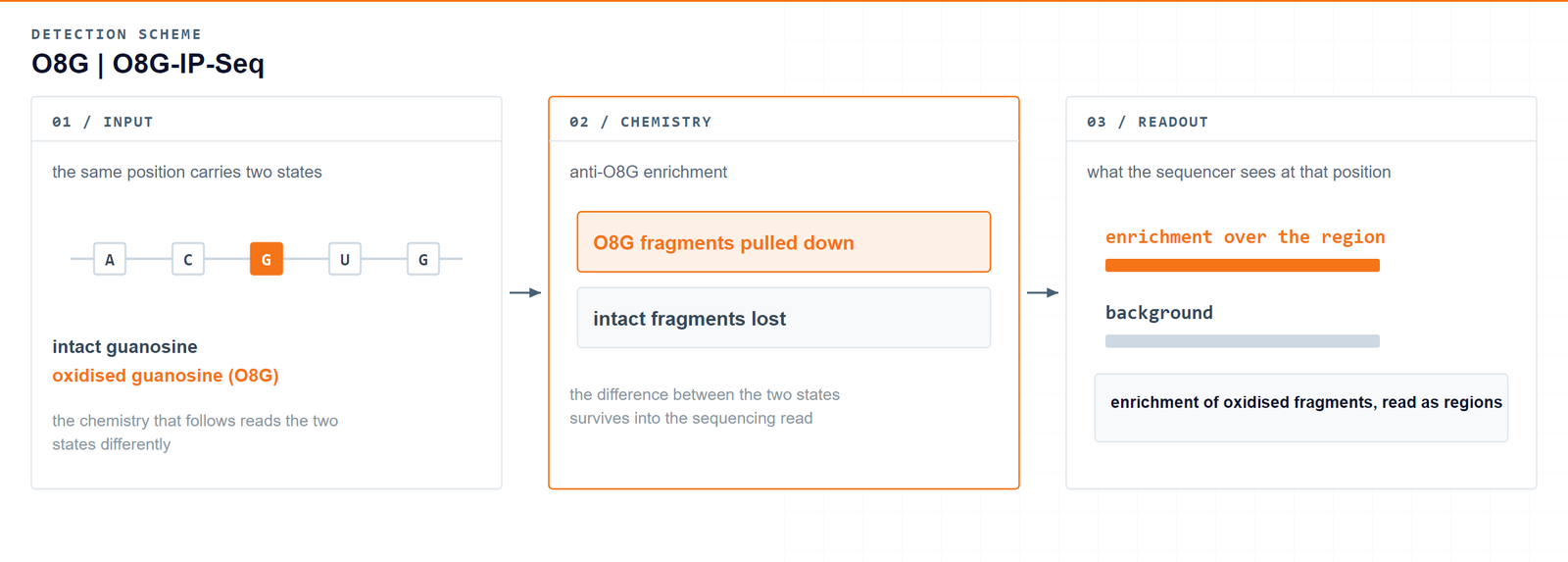
The readout is a region, not a position. Captured fragments map back to stretches of transcripts, and enrichment relative to input shows which of them carry more oxidised guanosine. The profile is therefore a map of oxidative burden across the transcriptome rather than a base-level record of each damaged guanosine.
That distinction is important for how the result is used. A region-level profile supports comparisons — treated against untreated, disease against control, one tissue against another — but it does not by itself establish that a particular guanosine in a particular codon is oxidised. Arraystar runs the workflow from sample QC through capture to the analyzed profile.
02Benefits
- Targets an oxidative lesion: the antibody recognises oxidised guanosine, so the profile reports oxidative burden rather than overall guanosine content.
- Transcriptome-wide view: enrichment is surveyed across transcripts instead of at preselected positions.
- Suits comparative designs: oxidised-guanosine signal is most informative when compared between conditions, which is what the profile is built for.
- Annotated output: enriched regions are linked to transcripts, giving a gene-level read on where oxidative signal concentrates.
- Complete service: RNA QC, capture, library construction, sequencing and analysis are delivered as one workflow.
| Service Name | RNA Class | Price |
|---|---|---|
| RNA O8G Modification Profile (O8G-IP-Seq) | mRNA | |
| RNA O8G Modification Profile (O8G-IP-Seq) | mRNA and lncRNA |
03Background and detection principle
Oxidative stress converts guanosine to 8-oxoguanosine, and the modified base can be detected with an antibody that distinguishes it from intact guanosine. In this workflow the RNA is fragmented, incubated with that antibody and the bound fragments are captured and sequenced next to an input control.
Because capture acts on fragments, the signal that comes out is enrichment over a region. Localising oxidation to a single guanosine would require a different, position-level readout. The strength of this route is that it measures oxidative burden across many transcripts at once, which makes it useful for comparing samples under different oxidative conditions.
An oxidised guanosine in a template is enough to disturb what the polymerase reads — which is why oxidative signal is profiled as burden across regions.Kim SK. et al., Nucleosides and Nucleotides 1999 · DOI 10.1080/07328319908044709
04Workflow
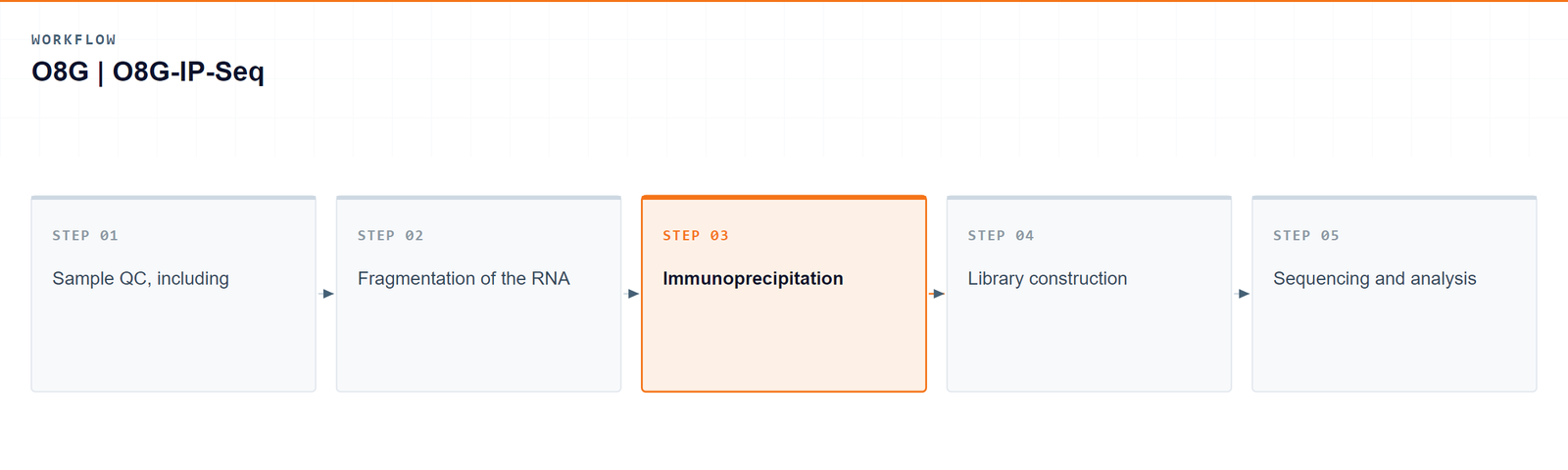
Five steps take a sample from RNA to an analyzed O8G profile:
- Sample QC, including checks on RNA integrity and purity.
- Fragmentation of the RNA for antibody capture.
- Immunoprecipitation with an anti-O8G antibody, against an input control.
- Library construction from the enriched and input fractions.
- Sequencing and analysis to call enriched regions and compare samples.
05Bioinformatics and deliverables
Mapped reads are compared with input to identify enriched regions, which are annotated to transcripts and features. The analysis set covers region calling and annotation, distribution across features, differential enrichment and genome-browser visualization.
Deliverables
- Raw O8G mRNA enrichment sequencing data files (FASTQ), formatted for GEO/SRA submission.
- QC reports and sorted, indexed BAM alignment files with core mapping statistics.
- O8G enrichment region tables (XLSX) with genomic coordinates and annotated host genes.
- Region distribution plots over transcript features (PDF/PNG).
- Differential O8G enrichment tables (XLSX) between sample groups.
- Genome-browser signal tracks (bigWig/bedGraph) and a structured project report.
06Research applications
- Oxidative stress research: treated and untreated samples can be compared to see which transcripts gain oxidative signal.
- Neurodegeneration: oxidative RNA damage is studied in neuronal tissue, where disease and control samples are natural comparisons.
- Aging studies: oxidative burden across ages can be surveyed at the transcript level.
- Mitochondrial biology: transcripts exposed to a high local oxidative load can be compared with nuclear-encoded ones.
- Environmental and chemical exposure: samples collected after an oxidative insult can be compared with baseline material.
07Sample requirements
Storage. Cells and tissues: preserve in TRIzol or an RNA stabilisation solution, snap freeze in liquid nitrogen and store at −80 °C. RNA: resuspend in ethanol or RNase-free ultrapure water, store at −80 °C and avoid repeated freeze–thaw cycles.
Shipping. Place the sample in an RNase-free microcentrifuge tube, seal it against leakage, and ship on dry ice with adequate insulation.
| Sample type | Notes |
|---|---|
| Whole blood | EDTA tubes only; heparin is not compatible with the downstream procedure. |
| Cultured cells | Cell pellets are preferred. |
| Tissue | Fresh or frozen specimens; avoid necrotic material. |
| Total RNA | OD 260/280 ≥ 1.8 and RIN ≥ 7, with no visible degradation. Submit 2–300 µg total RNA (more than 30 µg is recommended). |
08FAQ
What if the study needs the position rather than the profile?
Then the work moves to single-base resolution. Alongside this profile, Arraystar provides O8G sequencing at single-base resolution (O8G-miSeq), which calls oxidised guanosine at defined positions and reports its level, so the transcripts that shift here can be resolved position by position on the same samples.
Does O8G-IP-Seq give a base-level oxidative map?
No. Capture works on fragments, so the result is a region-level profile of oxidative enrichment. A position-level oxidative map would need a different readout.
Is oxidative RNA damage a stable modification or a lesion?
It is best treated as oxidative damage to the base rather than as a regulated epitranscriptomic mark. That is why the profile is usually read as a measure of oxidative burden across samples.
Why emphasise sample collection and handling?
Because oxidation accumulates after collection. Consistent handling and rapid stabilisation across the samples being compared keep the comparison meaningful.
How should the enriched regions be interpreted?
As transcripts and regions with more oxidised guanosine, relative to input and to the other samples in the study, rather than as a count of damaged bases.
Which sample types are accepted?
Total RNA, cultured cells, tissue or blood, subject to the quality thresholds listed on this page.
09References
- Kim SK, Kim JY, Yokoyama S, Takaku H. Misreading of RNA templates containing 8-oxo-7,8-dihydroguanosine or 8-oxo-2′-O-methylguanosine in cDNA synthesis by reverse transcriptases. Nucleosides and Nucleotides 1999;18:2421–2428. DOI: 10.1080/07328319908044709