
Single-Nucleotide RNA m6A Modification Seq (GLORI2-seq)
A one-pot chemical route to absolute m6A quantification: glyoxal, boric acid and sodium nitrite convert unmethylated adenosine to inosine while m6A stays intact, so every site is read from its own A-to-G signature at single-base resolution.
01What the service reports
Single-Nucleotide RNA m6A Modification Seq (GLORI2-seq) is an antibody-free chemical sequencing service that reports both where m6A sits along a transcript and what fraction of the RNA molecules carry it at each of those positions.
The conversion chemistry runs in a single pot. Glyoxal, boric acid and sodium nitrite turn unmethylated adenosine into inosine, and inosine is copied as guanosine during reverse transcription, while m6A survives the reaction and is copied as adenosine. Because the two outcomes are read from the same base, one experiment yields the coordinate of a site and its modification level together.
Arraystar runs GLORI2-seq as a complete sample-to-data service: RNA QC, the chemical treatment, library construction, sequencing and bioinformatics analysis. Two transcript scopes are offered, so a study can cover mRNA on its own or mRNA together with long non-coding RNA, and the workflow needs no dedicated guanosine-protection step to keep transcripts intact.
02Benefits
- Site-level calling: each m6A position is named by its own conversion signal rather than inferred from the edge of an enriched fragment.
- Absolute stoichiometry: the balance between converted and unconverted reads at a position gives the modification fraction directly.
- One-pot chemistry: the whole conversion takes place in a single reaction, so the workflow carries fewer handling steps than protection-based deamination.
- RNA-friendly: without a separate guanosine-protection step, transcripts stay intact from treatment through library construction.
- Reproducible and sensitive: modification fractions hold steady between replicates and site detection remains dependable.
| Service Name | RNA Class | Price |
|---|---|---|
| Single-Nucleotide RNA m6A Modification Seq (GLORI2-seq) | mRNA | |
| Single-Nucleotide RNA m6A Modification Seq (GLORI2-seq) | mRNA and lncRNA | |
| Single-Nucleotide RNA m6A Modification Seq (GLORI2-seq) | rRNA |
03Background and detection principle
Fragment-based m6A mapping answers how much RNA an antibody pulled down, not how much of a given position is modified: the signal is a peak, and it carries the binding preference of the antibody with it. The first generation of chemical deamination solved the resolution problem but brought a different one, because its dedicated guanosine-protection step was harsh on RNA and demanded a large amount of starting material.
GLORI2-seq was built around that bottleneck. Pairing glyoxal, boric acid and sodium nitrite in a single pot converts unmethylated adenosine to inosine while m6A resists the reaction, and leaving the protection step out keeps the RNA intact. The A/G ratio at a position then reports absolute m6A stoichiometry at single-base resolution.
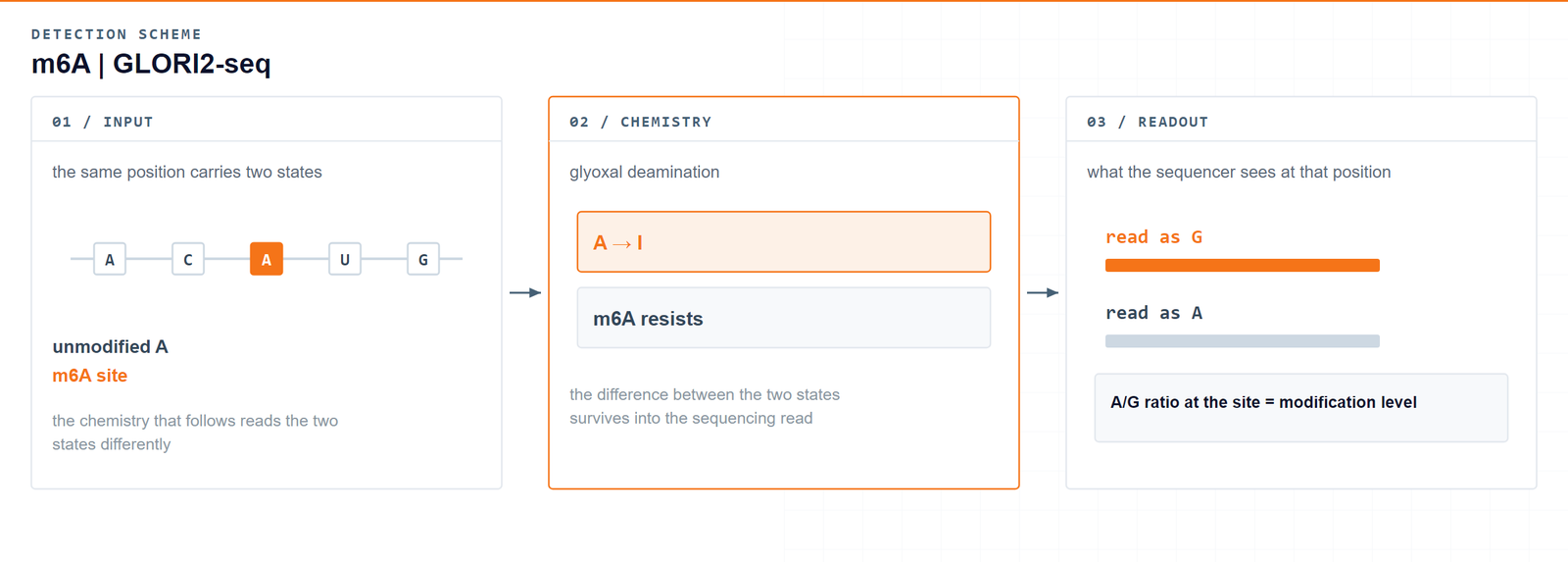
One pot, one conversion: unmethylated adenosine is rewritten while m6A is left alone, so the position of a modification and its level arrive in the same readout.Sun H. et al., Nature Methods 2025 · DOI 10.1038/s41592-025-02680-9
04Workflow
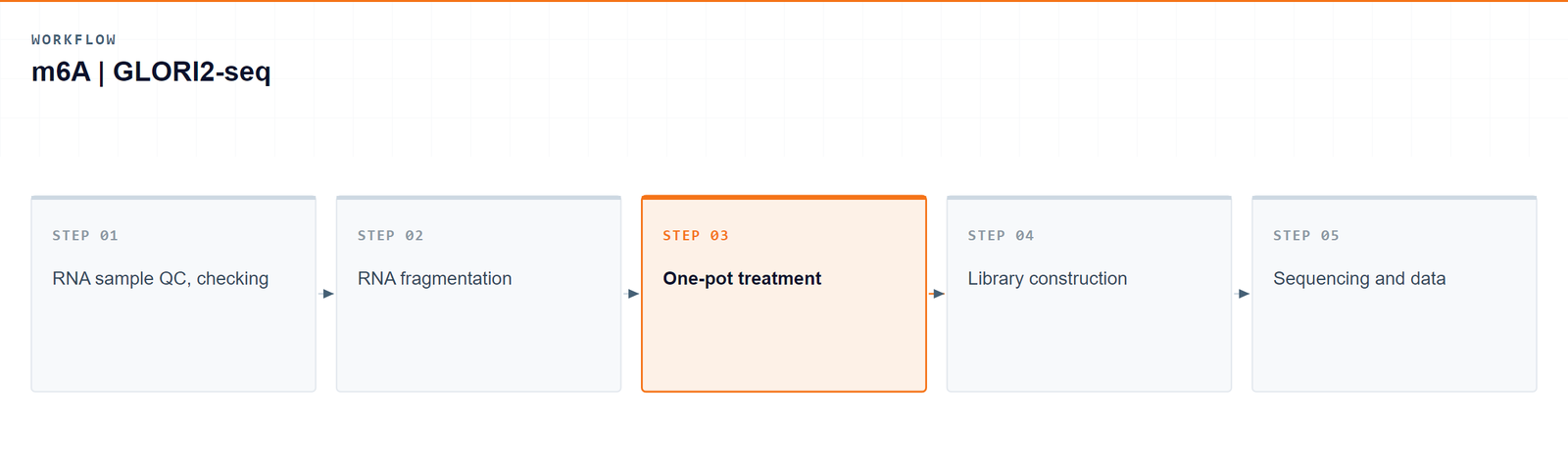
Five steps carry a sample from RNA to single-base m6A data:
- RNA sample QC, checking integrity and purity before the reaction.
- RNA fragmentation to the fragment size the library requires.
- One-pot treatment with glyoxal, boric acid and sodium nitrite.
- Library construction from the converted RNA.
- Sequencing and data analysis, ending in m6A site calling and absolute stoichiometry.
05Bioinformatics and deliverables
Reads are mapped against a reference in which A-to-G conversion is expected, unconverted adenosines are collected, and the absolute m6A fraction of every site is calculated at single-nucleotide resolution. Downstream work covers DRACH motif characterization, metagene distribution, differential methylation, gene-set enrichment and genome-browser visualization.
Deliverables
- Raw m6A mRNA sequencing data files (FASTQ), formatted for GEO/SRA submission.
- Sample and sequencing QC reports, together with sorted BAM alignments and core mapping statistics.
- High-confidence single-base m6A site annotation tables (XLSX) with coordinates, host genes and modification stoichiometry.
- Transcript feature distribution figures and consensus m6A motif logos (PDF/PNG).
- Differential m6A methylation tables (XLSX) with fold change and significance metrics.
- GO enrichment reports for m6A-modified genes (HTML/PDF/PNG).
- Genome-browser-compatible tracks (bigWig/bedGraph) and a structured m6A analysis project report.
06Research applications
- Neuroscience: single-base m6A maps of the mouse dorsal hippocampus resolve synaptic and cytoplasmic methylomes, where synapse-related genes carry higher m6A levels.
- Cancer drug-target research: profiling after METTL3 inhibitor (STM2457) treatment records m6A loss at about 99% of sites, giving a direct readout when writers are evaluated as therapeutic targets.
- Disease and clinical research: GLORI-Sanger and amplicon readouts quantify m6A absolutely at individual candidate loci that then need confirmation in clinical material.
- Immunology research: mapping single-base m6A across immune cell subsets supports work on how the modification shapes immune activation and inflammatory signaling.
- Functional epitranscriptomics: high-confidence maps with absolute modification fractions let m6A-dependent gene regulation be dissected site by site.
07Sample requirements
Storage. Cells and tissues: preserve in TRIzol or an RNA stabilisation solution, snap freeze in liquid nitrogen and store at −80 °C. RNA: resuspend in ethanol or RNase-free ultrapure water, store at −80 °C and avoid repeated freeze–thaw cycles.
Shipping. Place the sample in a 1.5 mL RNase-free microcentrifuge tube, seal it with parafilm or a cap lock, and ship on dry ice with adequate insulation.
| Sample type | Notes |
|---|---|
| Whole blood | EDTA tubes only; heparin is not compatible with the downstream procedure. |
| Cultured cells | Cell pellets are preferred. |
| Tissue | Fresh or frozen specimens; avoid necrotic material. |
| Total RNA | OD 260/280 ≥ 1.8 and RIN ≥ 7, with no visible degradation. Submit at least 3 µg total RNA. |
08FAQ
Which material can be submitted for a GLORI2-seq project?
Total RNA prepared from cells, tissue, blood or other biological sources. If the material you can obtain is unusual or limited, contact technical support before submission so the options can be discussed against your study.
Does the service measure absolute m6A levels instead of enrichment?
Yes. Unmethylated adenosine is deaminated and read as G, while m6A is read as A, so the converted-to-unconverted ratio at a position reports the modification fraction. Spike-in RNAs of known modification ratio have been used to confirm that quantification across a wide dynamic range.
How does GLORI2-seq differ from the original GLORI?
The original chemistry depended on a dedicated guanosine-protection step, which degraded RNA severely and required 50,000–100,000 cells as starting material. GLORI2-seq performs the conversion in one pot, keeps RNA integrity, and detects roughly 42% more m6A sites with high reproducibility.
Can long non-coding RNA be covered in the same project?
Two scopes are offered: modification profiling on mRNA, and on mRNA plus long non-coding RNA. Both transcript types are analyzed within one experiment, so a study does not have to be split across two projects.
Why does absolute m6A level matter for a study?
Stoichiometry turns a presence call into a quantity that can be compared across sites and conditions. That is what supports ranking candidates, linking level to phenotype and deciding which positions deserve follow-up on mRNA or long non-coding RNA.
09References
- Sun H, Lu B, Zhang Z, et al. Mild and ultrafast GLORI enables absolute quantification of m6A methylome from low-input samples. Nature Methods 2025;22(6):1226–1236. DOI: 10.1038/s41592-025-02680-9
- Liu C, Sun H, Yi C, et al. Absolute quantification of single-base m6A methylation in the mammalian transcriptome using GLORI. Nature Biotechnology 2023;41:355–366. DOI: 10.1038/s41587-022-01487-9