
RNA m6Am Modification Profile (m6Am-Exo-Seq)
An exonuclease-based route to the capped 5′ end: cap-proximal m6Am is read separately from internal m6A, without an antibody step and without converting the RNA.
01What the service reports
RNA m6Am Modification Profile (m6Am-Exo-Seq) is an exonuclease-based sequencing service that reports m6Am at the cap-proximal position of transcripts, resolved from the internal m6A signal that shares the same chemical mark.
The service sits at the capped 5′ end rather than across the whole transcript. An exonuclease step digests inward from the free end while the cap structure protects the few nucleotides behind it, so the reads that survive are the ones carrying information about the cap-proximal position. Internal m6A is depleted in the same reaction.
This is an enrichment-style readout: it reports the m6Am status of the capped end and how that status compares between samples, not a single-base call at every adenosine in the transcript. Where a position-level m6A map is the goal, the single-base line is the suitable tool. Arraystar runs the workflow end to end, from RNA QC to the analyzed cap-proximal profile.
02Benefits
- Targets the cap directly: the readout is anchored on the cap-proximal position instead of being inferred from a peak over the transcript body.
- Separates cap from internal signal: the exonuclease step depletes internal positions, so internal m6A does not blur the cap-proximal measurement.
- No antibody step: nothing in the workflow depends on antibody binding, so the profile does not carry an antibody’s binding preference.
- Built for comparisons: the profile is well suited to comparing cap-proximal m6Am status across conditions, treatments or sample groups.
- One sample-to-data service: RNA QC, the enzymatic step, library construction, sequencing and analysis are delivered together.
| Service Name | RNA Class | Price |
|---|---|---|
| RNA m6Am Modification Profile (m6Am-Exo-Seq) | mRNA | |
| RNA m6Am Modification Profile (m6Am-Exo-Seq) | mRNA and lncRNA |
03Background and detection principle
m6Am and m6A are close chemical relatives: both are methylated adenosines, and an m6Am at the cap sits on top of a transcript-wide pool of internal m6A. A method that simply reads the mark therefore has to explain how it knows which of the two it is looking at.
m6Am-Exo-Seq answers that with an enzymatic step rather than an antibody. The capped end is protected while exonuclease activity removes the unprotected positions behind it, so cap-proximal reads are kept and internal positions are depleted. The comparison that follows is a comparison of cap-proximal signal against a background with very little internal contribution, which is what makes the cap-proximal call interpretable.
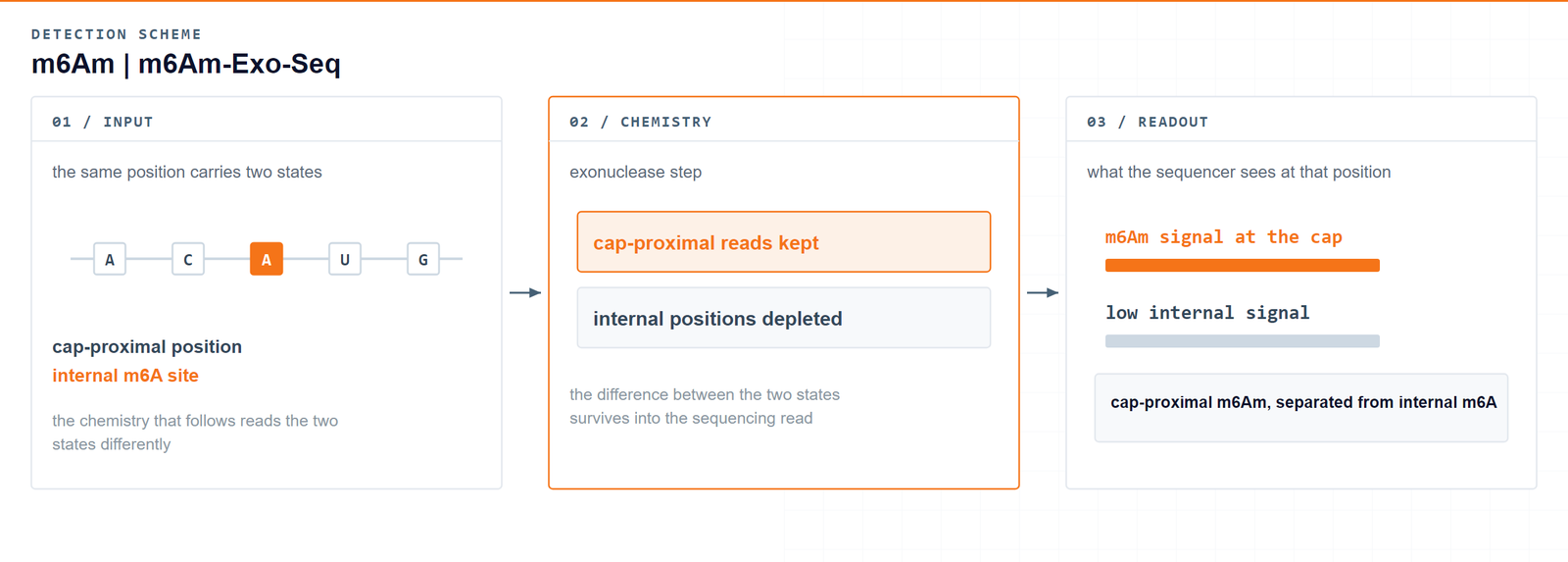
The cap and the transcript body carry related marks — the exonuclease step is what makes the cap-proximal one readable on its own.Boulias K. et al., Molecular Cell 2019 · DOI 10.1016/j.molcel.2019.06.006
04Workflow
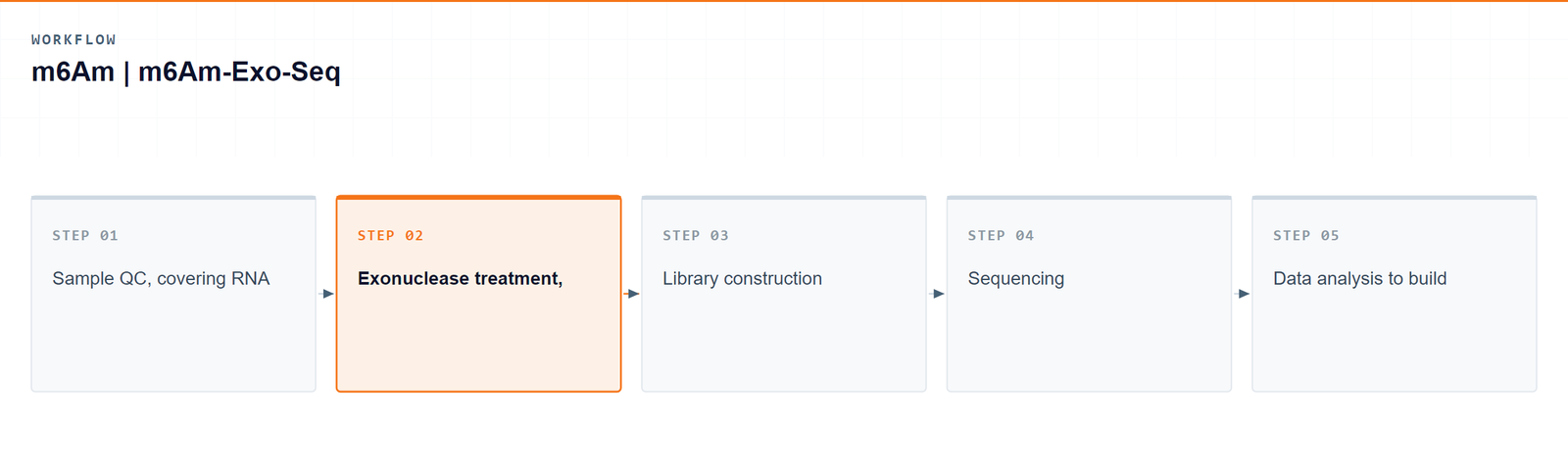
The service runs in five steps from sample to analyzed cap-proximal profile:
- Sample QC, covering RNA integrity and purity before the enzymatic step.
- Exonuclease treatment, in which cap-proximal reads are kept and internal positions are depleted.
- Library construction from the retained fragments.
- Sequencing of the m6Am-Exo-Seq library.
- Data analysis to build the cap-proximal m6Am profile.
05Bioinformatics and deliverables
Reads are mapped and the cap-proximal signal is quantified and compared against the internal background. The analysis set covers signal distribution across transcripts, enrichment at the capped end, sample-level comparison and genome-browser visualization.
Deliverables
- Raw m6Am sequencing data files (FASTQ), formatted for GEO/SRA submission.
- QC reports and sorted, indexed BAM alignment files with core mapping statistics.
- Cap-proximal m6Am signal tables (XLSX) with transcript coordinates and signal values.
- Signal distribution plots across transcript features (PDF/PNG).
- Differential cap-proximal m6Am tables (XLSX) between sample groups.
- Genome-browser signal tracks (bigWig/bedGraph) and a structured project report.
06Research applications
- mRNA stability and turnover: cap-proximal m6Am status compared between conditions adds a cap-level readout to studies of transcript lifetime.
- Cap methyltransferase biology: work on the enzymes that write m6Am uses the cap-proximal profile to check whether the capped end changes as expected.
- Signal response: samples collected across a treatment or time course can be compared at the capped end, where m6Am is expected to respond.
- Developmental and tissue studies: comparing cap-proximal m6Am across tissues or stages adds a cap-level layer to transcriptome work.
- Method pairing: the cap-proximal profile is often read alongside a transcript-wide m6A profile so that cap and internal marks are interpreted together.
07Sample requirements
Storage. Cells and tissues: preserve in TRIzol or an RNA stabilisation solution, snap freeze in liquid nitrogen and store at −80 °C. RNA: resuspend in ethanol or RNase-free ultrapure water, store at −80 °C and avoid repeated freeze–thaw cycles.
Shipping. Place the sample in an RNase-free microcentrifuge tube, seal it against leakage, and ship on dry ice with adequate insulation.
| Sample type | Notes |
|---|---|
| Whole blood | EDTA tubes only; heparin is not compatible with the downstream procedure. |
| Cultured cells | Cell pellets are preferred. |
| Tissue | Fresh or frozen specimens; avoid necrotic material. |
| Total RNA | OD 260/280 ≥ 1.8 and RIN ≥ 7, with no visible degradation. Submit at least 10 µg total RNA. |
08FAQ
What if the study needs the position rather than the profile?
Not on this line. Arraystar reads m6Am as a cap-proximal profile rather than a resolved nucleotide, and the single-base line covers the marks listed on the modification types page, where m6Am does not appear. A study that needs a resolved m6A position in the transcript body should use the single-base m6A services.
Does m6Am-Exo-Seq give a single-base call?
No. The readout is built from retained cap-proximal reads, so it reports the m6Am status of the capped end rather than a resolved nucleotide at every position. A single-base method is the right next step when individual sites are the goal.
Why is an exonuclease step used instead of an antibody?
The point of the step is discrimination. Internal m6A would otherwise dominate the signal, so the exonuclease step depletes internal positions and leaves the cap-proximal reads behind. That is also why this is the one method on the RIP line that is antibody-free.
How is this different from a transcript-wide m6A profile?
A transcript-wide profile reports where m6A is enriched over transcript regions. m6Am-Exo-Seq narrows the question to the capped 5′ end and separates that signal from internal m6A, so the two answer different questions.
What sample types can be submitted?
Total RNA, cultured cells, tissue or blood. Quality indicators are checked before the enzymatic step, and preparation notes are listed above.
Can the cap-proximal profile be compared with an internal m6A dataset?
Yes, and the comparison is usually informative because both marks are on the same base. Planning both analyses on the same sample material keeps the comparison clean.
09References
- Boulias K, Toczydłowska-Socha D, Hawley BR, et al. Identification of the m6Am methyltransferase PCIF1 reveals the location and functions of m6Am in the transcriptome. Molecular Cell 2019;75:631–643. DOI: 10.1016/j.molcel.2019.06.006
- Mauer J, Luo X, Blanjoie A, et al. Reversible methylation of m6Am in the 5′ cap controls mRNA stability. Nature 2016;541:371–375. DOI: 10.1038/nature21022