
Single-Nucleotide rRNA 2'-O-Methylation Modification Seq (RiboMeth-Seq)
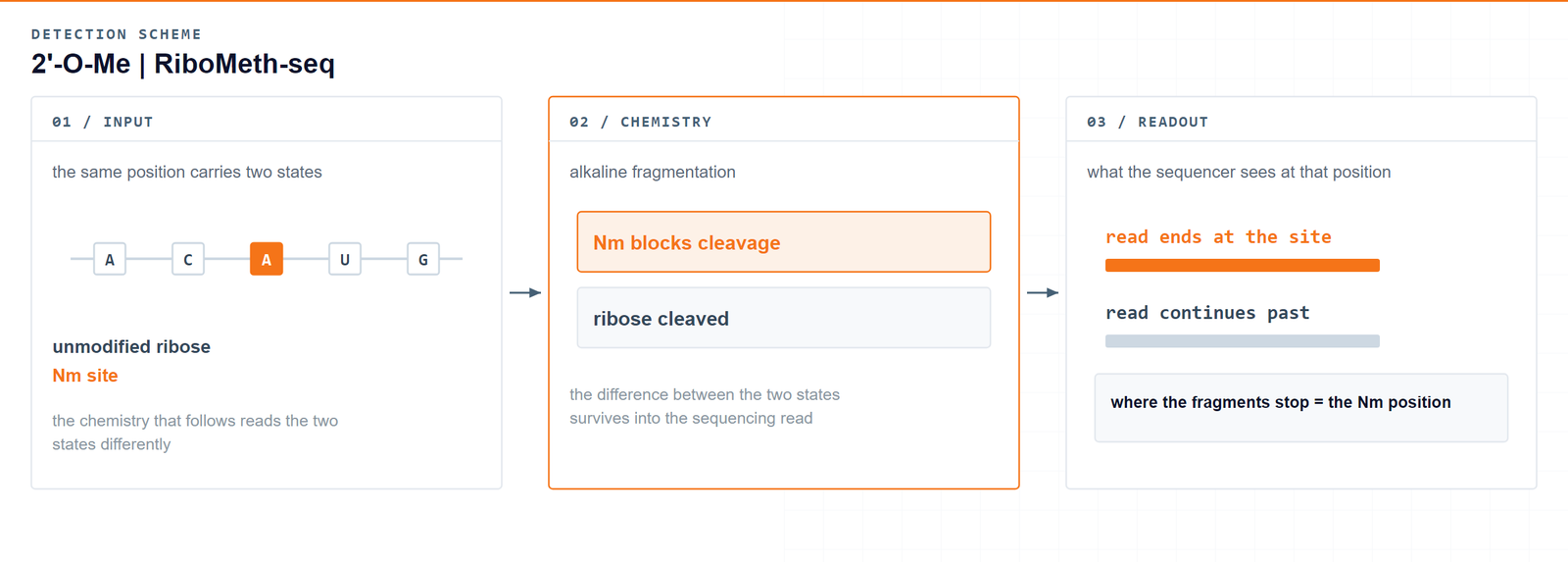
Ribosomal RNA carries the densest set of 2'-O-methylations in the cell. Alkaline fragmentation turns them into a countable signal: a methylated ribose blocks cleavage, and each surviving fragment end reports one Nm position along 18S, 28S and 5.8S rRNA.
01What the service reports
Single-Nucleotide rRNA 2'-O-Methylation Modification Seq (RiboMeth-Seq) is a sequencing method that maps 2'-O-methylation (Nm) on ribosomal RNA at single-nucleotide resolution: alkaline conditions cut the RNA at random, a 2'-O-methylated ribose resists cleavage, and each surviving fragment end reports one Nm position.
The readout covers 18S, 28S and 5.8S rRNA and gives a level per site rather than a presence call, so a position methylated on only part of the rRNA pool keeps its intermediate value. Every site is reported on standard rRNA coordinates and placed in its structural context.
Arraystar runs the route end to end, from RNA QC and random fragmentation through library construction and sequencing to bioinformatics, and returns the rRNA Nm landscape as per-site tables for the sample set that was submitted.
02Benefits
- Single-base resolution: the surviving fragment end fixes each Nm position to one nucleotide on the rRNA.
- A level per site: partially methylated positions stay visible instead of being rounded to yes or no.
- rRNA as the natural target: the guide-snoRNA and fibrillarin system places Nm at defined positions, so the signal is dense and reads back to a known guide.
- Core and periphery in one map: positions in the functional centers are read alongside the outer, more variable ones.
- Chemistry rather than affinity: the call follows how the backbone behaves under alkaline conditions, not how tightly an antibody binds.
- Annotated output: sites are reported on standard 18S, 28S and 5.8S rRNA coordinates with their rRNA region and structural context.
| Service Name | RNA Class | Price |
|---|---|---|
| Single-Nucleotide rRNA 2'-O-Methylation Modification Seq (RiboMeth-Seq) | rRNA |
03Background and detection principle
2'-O-methylation is the most abundant modification of the RNA ribose, and on ribosomal RNA it is written by fibrillarin inside box C/D snoRNPs. Each guide snoRNA pairs with the position it selects, which is why the rRNA pattern follows the guide repertoire of the cell rather than the sequence alone, and why the methyl groups land where the ribosome is assembled and where it reads mRNA.
The chemistry is what makes the modification readable. A methyl group on the 2'-hydroxyl leaves the two neighbouring phosphodiester bonds resistant to alkaline hydrolysis. RiboMeth-seq fragments the RNA at random and sequences what is left, so the positions that were methylated show up as positions where the backbone was not cut. An Nm position therefore shows up as a local gap in the fragment-end profile, and the depth of the gap gives the methylation level of that site.
The sites are not equivalent. Positions in the decoding center, the peptidyl transferase center and at the subunit interfaces are almost always methylated, while outer positions vary between cells, tissues and conditions. That split is the basis of ribosome heterogeneity, and it is the reason the assay reports a level rather than a binary call.
Where the ribosome does its work, methylation is written almost every time; at the periphery it can be left off, and that difference is what makes ribosomes non-identical.Sharma S. et al., Scientific Reports 2017 · DOI 10.1038/s41598-017-09734-9
04Workflow
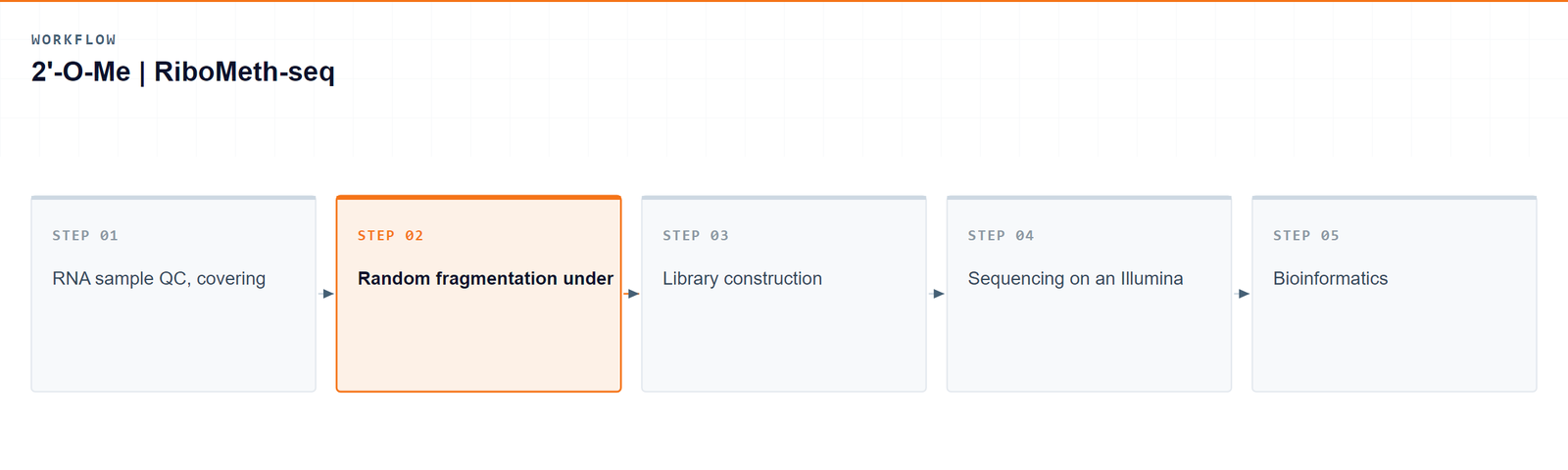
Five steps take a sample from RNA to single-base rRNA 2'-O-methylation data:
- RNA sample QC, covering integrity, purity and visible degradation before fragmentation.
- Random fragmentation under alkaline conditions, so unmodified positions are cut while methylated positions are held.
- Library construction from the fragments that survived cleavage.
- Sequencing on an Illumina platform at a depth suited to rRNA Nm calling.
- Bioinformatics: reads are aligned to the rRNA reference and every position is scored and annotated.
05Bioinformatics and deliverables
Reads are aligned to the rRNA reference, fragment ends are counted at every position, and the surviving fraction is converted into a methylation level for that site. Analysis adds the structural context of each position, site-level comparison between sample groups and genome-browser visualization.
Deliverables
- FASTQ data for every library, formatted ready for GEO/SRA submission.
- A QC report together with sorted BAM alignments and core mapping statistics.
- Single-base rRNA 2'-O-methylation site tables (XLSX) with rRNA coordinates and methylation level.
- Nm distribution figures across 18S, 28S and 5.8S rRNA (PDF/PNG).
- Differential Nm modification tables (XLSX) with fold change and significance.
- Annotation tables linking each Nm position to its rRNA region.
- Genome-browser track files (bigWig/bedGraph) and a structured project report.
06Research applications
- Ribosome heterogeneity: compare Nm levels site by site to describe ribosomes of different composition within and between samples.
- Translation control: relate site-specific methylation to how particular sets of mRNAs are translated.
- Signaling and oncogenes: follow how rRNA methylation responds to upstream signaling programs.
- Development and differentiation: track Nm dynamics as cells move between states and lineages.
- Cancer research: profile Nm across patient samples and test whether it tracks subtype, grade or treatment response.
- Enzyme and guide studies: read out how fibrillarin levels or guide-snoRNA changes shift methylation at individual sites.
07Sample requirements
Storage. Cells and tissues: preserve in TRIzol or an RNA stabilisation solution, snap freeze in liquid nitrogen and store at −80 °C. RNA: resuspend in ethanol or RNase-free ultrapure water, store at −80 °C and avoid repeated freeze–thaw cycles.
Shipping. Place the sample in a 1.5 mL RNase-free microcentrifuge tube, seal it with parafilm or a cap lock, and ship on dry ice with adequate insulation.
| Sample type | Notes |
|---|---|
| Whole blood | EDTA tubes only; heparin is not compatible with the downstream procedure. |
| Cultured cells | Cell pellets are preferred. |
| Tissue | Fresh or frozen specimens; avoid necrotic material. |
| Total RNA | OD 260/280 ≥ 1.8 and RIN ≥ 7, with no visible degradation. Submit at least 10 µg total RNA. |
08FAQ
Where does rRNA 2'-O-methylation come from?
Fibrillarin deposits it inside box C/D snoRNPs. Each guide snoRNA pairs with the position it selects, so the pattern tracks the guide repertoire of the cell, and the methyl groups concentrate at the decoding center, the peptidyl transferase center and the subunit interfaces.
How does the assay separate a methylated position from an unmethylated one?
Alkaline conditions cut the backbone wherever the ribose carries a free 2'-hydroxyl. At a 2'-O-methylated position that hydroxyl is occupied, the neighbouring bonds survive fragmentation, and the reads that end there mark the site; unmethylated positions are simply cut.
Why report a level instead of a yes or no call?
Because methylation on rRNA is often partial. A site can be modified on some rRNA molecules and not others in the same sample, and it is exactly those variable positions that distinguish ribosome populations. The assay therefore returns a value between zero and one for every position.
Which positions tend to change between samples?
The stable set sits in the functional centers and is methylated in essentially every sample, while outer positions vary with cell type, treatment and disease state. Studies in cell lines, in development and in tumour cohorts all report this split between an invariant core and a variable periphery.
How does this relate to Nm work on mRNA?
Both read the same modification by different chemistry. RiboMeth-seq cuts at random under alkaline conditions and scores what resists, which suits abundant and highly structured rRNA, while periodate-based enrichment is used when the target is transcript-level RNA such as mRNA or lncRNA.
09References
- Birkedal U, Christensen-Dalsgaard M, Krogh N, et al. Profiling of ribose methylations in RNA by high-throughput sequencing. Angewandte Chemie International Edition 2015;54(2):451-455. DOI: 10.1002/anie.201408362
- Marchand V, Blanloeil-Oillo F, Helm M, Motorin Y. Illumina-based RiboMethSeq approach for mapping of 2'-O-Me residues in RNA. Nucleic Acids Research 2016;44(16):e135. DOI: 10.1093/nar/gkw547
- Sharma S, Marchand V, Motorin Y, Lafontaine DLJ. Identification of sites of 2'-O-methylation vulnerability in human ribosomal RNAs by systematic mapping. Scientific Reports 2017;7:11490. DOI: 10.1038/s41598-017-09734-9
- Motorin Y, Quinternet M, Belmas E, et al. Constitutive and variable 2'-O-methylation (Nm) in human ribosomal RNA. RNA Biology 2021;18(sup2):1-9. DOI: 10.1080/15476286.2021.1974750
- Jansson MD, Hafner SJ, Altinel K, et al. Regulation of translation by site-specific ribosomal RNA methylation. Nature Structural & Molecular Biology 2021;28(11):889-899. DOI: 10.1038/s41594-021-00669-4
- Hafner SJ, Jansson MD, Altinel K, et al. Ribosomal RNA 2'-O-methylation dynamics impact cell fate decisions. Developmental Cell 2023;58(15):1364-1380. DOI: 10.1016/j.devcel.2023.06.007
- Marcel V, Kielbassa J, Marchand V, et al. Ribosomal RNA 2'O-methylation as a novel layer of inter-tumour heterogeneity in breast cancer. NAR Cancer 2020;2(3):zcaa036. DOI: 10.1093/narcan/zcaa036