
Single-Nucleotide RNA hm5C Sequencing (WO-Seq)
A methyl group and a hydroxymethyl group differ by one oxygen. WO-Seq reads that difference: peroxotungstate converts the hydroxymethylated base into a thymine-like residue, reverse transcription turns that residue into a T, and the cytosine that carried it appears as a C-to-T change. The other two cytosine states are mostly left unchanged.
01Reading one oxygen
WO-Seq — peroxotungstate oxidation sequencing — maps 5-hydroxymethylcytidine in RNA at single-nucleotide resolution. The reagent acts on the hydroxymethyl group rather than on base pairing, so the readout is a substitution at the cytosine that carried the group.
A report is a table of candidate cytosines. Each row names the transcript and coordinate, counts the reads that support a T at that position, gives the local coverage, and divides one by the other. Candidate positions come from the alignment; the value comes from the reads, not from a peak shape or a fragment boundary.
That value is a within-assay ratio. Neither the oxidation nor the reverse transcription runs to completion, so it is comparable across libraries run under one protocol rather than a fraction of all hm5C molecules. Its practical advantage is resolution of mixtures: a position hydroxymethylated on part of the pool keeps a value between background and the assay ceiling.
02Benefits
The design pays off where the mark is rare and an enrichment peak cannot resolve it.
- Single-base resolution: the signal is a substitution at one base, so a call does not depend on peak shape or on where a fragment ended.
- hm5C-selective oxidation: the reagent acts on the hydroxymethyl group; a methylated or plain cytosine is mostly left unchanged.
- Site-level quantification: T-supporting reads divided by local coverage, with intermediate values kept instead of collapsed into a presence call.
- Antibody-free chemistry: no affinity step precedes the reaction. This avoids antibody-dependent enrichment and its binding bias; other sources of bias remain.
- Annotated output: every candidate is tied to a transcript and a transcript region.
- Delivered end to end: the chemistry, library, sequencing run and analysis stay inside one project.
| Service Name | Price |
|---|---|
| Single-Nucleotide RNA hm5C Sequencing (WO-Seq) — mRNA | |
| Single-Nucleotide RNA hm5C Sequencing (WO-Seq) — mRNA and lncRNA |
03Two cytosines, one oxidation step apart
m5C carries a methyl group on carbon 5 of the ring. TET enzymes add a hydroxyl to that methyl and leave hm5C behind. The mark has drawn interest in translation, neuronal biology and development. How it is distributed and what it does are still open questions, and mammalian samples carry much less of it.
Conventional bisulfite sequencing does not reliably distinguish the pair. It deaminates an unmodified cytosine to uracil, which is read as T, but both m5C and hm5C can survive the treatment and are read as C. The two marks therefore collapse into one signal. Acid and alkali cycling also fragments RNA, and double-stranded stretches convert incompletely, which is a familiar source of false positives.
WO-Seq avoids the conversion entirely. A peroxotungstate species oxidizes the hydroxymethyl group to a trihydroxylated thymine, a base that no longer behaves like cytosine. The reaction works on single-stranded nucleic acid and is inefficient on double-stranded DNA, but RNA is not uniformly single-stranded; secondary and tertiary structure can reduce oxidation efficiency at some positions. TGIRT then incorporates an A opposite the altered base, so the cDNA carries a T where the RNA had a hydroxymethylcytosine. The other two cytosine states are mostly left unchanged.
The reaction and the polymerase both stop short of a complete conversion, and a T read can also come from a mismatch. The number attached to a position is therefore an index of hm5C-associated signal, not a fraction of molecules. Keep the comparison within one batch, or between libraries run under one protocol. Read depth at the position decides whether it is reported; abundance, structure and conversion efficiency also set sensitivity.
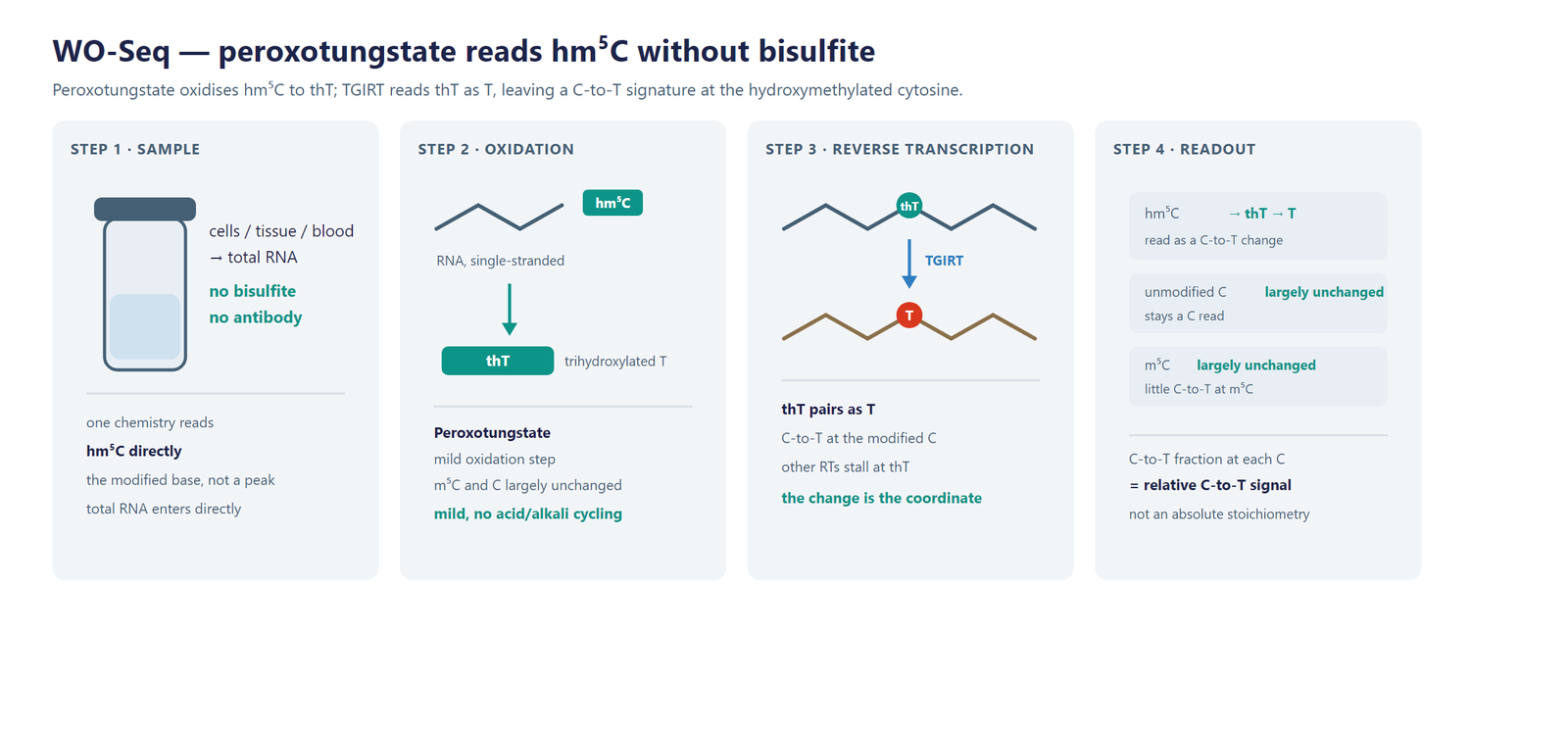
The oxidation product of hm5C (thT) is converted to T during cDNA synthesis, thus can be used for base-resolution sequencing of hm5C in RNA.Yuan F. et al., Chemical Communications 2019 · DOI 10.1039/C9CC00274J
04Workflow
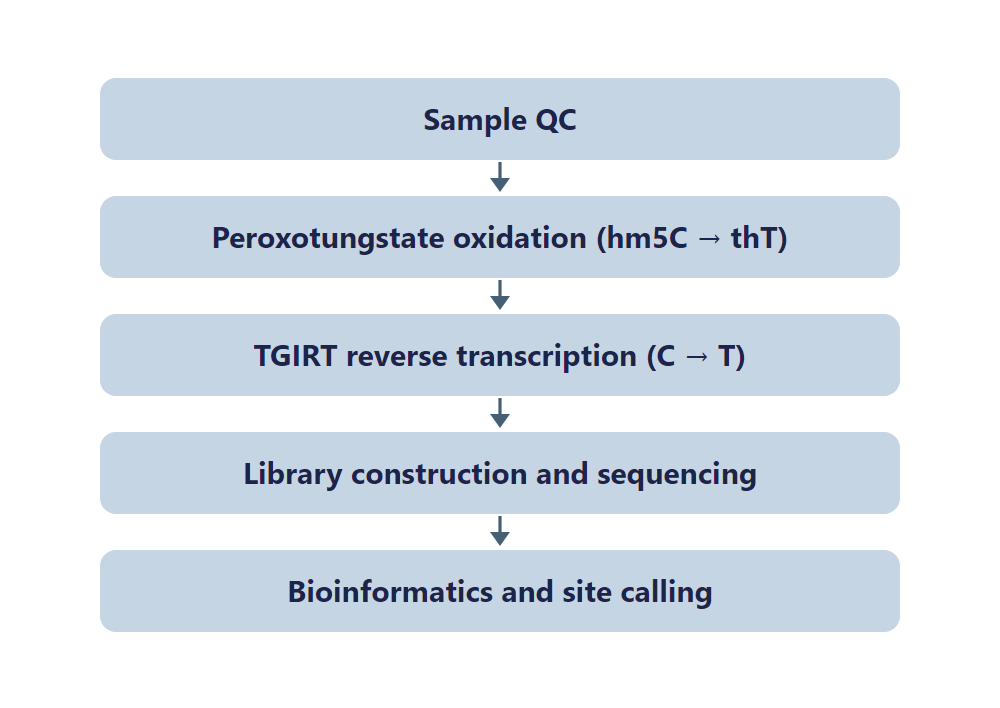
Five operations connect an RNA sample to a table of hm5C positions:
- Check RNA integrity and purity.
- Oxidize with peroxotungstate; hm5C becomes thT.
- Reverse transcribe with TGIRT, which reads thT as T and records the change in the cDNA.
- Build and sequence the library on an Illumina instrument.
- Align, score each cytosine for T support, call sites, annotate them and compute relative values.
05Bioinformatics and deliverables
The first pass is a substitution count. After alignment, T support is counted at every cytosine. Candidates pass coverage and local-background filters; we do not treat other positions as known controls. Thresholds are written into the project report. Group comparison accounts for depth and background, and statistical testing needs biological replicates. Annotation adds the transcript and transcript region; a browser track follows.
Deliverables
- FASTQ files for each library, ready for GEO/SRA submission.
- QC report, sorted BAM alignments and mapping statistics.
- hm5C site tables (XLSX): coordinate, transcript and relative C-to-T signal.
- Per-position read support and depth tables (XLSX) for independent review.
- Substitution profiles and site-distribution figures by transcript region (PDF/PNG).
- Between-group difference tables for the hm5C-associated signal (XLSX).
- Genome-browser tracks (bigWig/bedGraph) and a project report.
06Research applications
- TET perturbation: ask which positions appear or disappear when TET activity is removed, raised or blocked.
- Translation: pair a site-level change with ribosome occupancy on the same transcript.
- Neural development: follow the mark through differentiation and in models where it has been studied.
- Difficult samples: read the mark without an affinity step when material is limited or enrichment background is high.
- Orthogonal comparison: place the chemical call beside hMeRIP-seq or a bisulfite map from the same preparation.
07Sample requirements
Storage. Cells and tissues: TRIzol or an RNA stabilization solution, snap-frozen in liquid nitrogen, −80 °C. RNA: ethanol or RNase-free ultrapure water at −80 °C, with freeze–thaw cycles kept to a minimum.
Shipping. A 1.5 mL RNase-free tube, sealed with parafilm or a cap lock, on dry ice with enough insulation for the journey.
| Sample type | Notes |
|---|---|
| Whole blood | EDTA collection; heparin interferes with the procedure. |
| Cultured cells | Pellets are preferred. |
| Tissue | Fresh or frozen; exclude necrotic material. |
| Total RNA | OD 260/280 ≥ 1.8, RIN ≥ 7, no visible degradation; at least 10 µg total RNA. |
08FAQ
What exactly does the reagent recognize?
The hydroxymethyl group on carbon 5 of the cytosine ring. A methylated or plain cytosine is mostly left unchanged, so the reaction separates hm5C from the other two cytosine states in the same sample. That is where the selectivity comes from.
Why is the readout a C-to-T change rather than a C-to-U change?
Because the oxidized base is not deaminated. It is read through reverse transcription: TGIRT places an A opposite the thymine-like residue, and the cDNA therefore carries a T where the modified cytosine sat. The change is written by the polymerase, not by the chemical treatment.
Can the ratio be compared between batches?
Within a batch and between libraries run in one batch, yes. Across laboratories or protocols, no: oxidation and reverse transcription are not necessarily complete, and T reads include background mismatches, so the value is a relative index rather than a calibrated fraction. Keep the protocol fixed and report the same index for every sample.
What separates a real site from background?
Two filters matter: enough reads at the position, and a T signal above the local background. Cytosines elsewhere on the transcript are not treated as known controls. Thresholds are written into the report, and a candidate can be checked by an independent assay. Depth decides how firm each call is.
What can a site-level hm5C map be used for?
It can compare positions after TET perturbation, between normal and disease material, or alongside a translation readout. The signal sits at one cytosine, so a study can follow a specific position instead of an enriched region. Depth sets how many of those positions reach a confident call.
09References
- Yuan F, Bi Y, Siejka-Zielinska P, et al. Bisulfite-free and base-resolution analysis of 5-methylcytidine and 5-hydroxymethylcytidine in RNA with peroxotungstate. Chemical Communications 2019;55:2328-2331. DOI: 10.1039/C9CC00274J
- Delatte B, Wang F, Ngoc LV, et al. Transcriptome-wide distribution and function of RNA hydroxymethylcytosine. Science 2016;351:282-285. DOI: 10.1126/science.aac5253
- Fu L, Guerrero CR, Zhong N, et al. Tet-mediated formation of 5-hydroxymethylcytosine in RNA. Journal of the American Chemical Society 2014;136:11582-11585. DOI: 10.1021/ja505305z
- Okamoto A, Sugizaki K, Nakamura A, et al. 5-Hydroxymethylcytosine-selective oxidation with peroxotungstate. Chemical Communications 2011;47:11231-11233. DOI: 10.1039/c1cc14782j
- Hayashi G, Koyama K, Shiota H, et al. Base-resolution analysis of 5-hydroxymethylcytosine by one-pot bisulfite-free chemical conversion with peroxotungstate. Journal of the American Chemical Society 2016;138:14178-14181. DOI: 10.1021/jacs.6b06428