
Single-Nucleotide RNA Pseudouridine (Ψ) Modification Seq (BACS-seq)
Controlled bisulfite chemistry protects pseudouridine and reads it as a signature of its own while the unmodified bases are converted — which is what puts the quantification on an absolute scale.
01What the service reports
Single-Nucleotide RNA Pseudouridine (Ψ) Modification Seq (BACS-seq) is an antibody-free, base-resolution method. Under controlled bisulfite chemistry pseudouridine is protected and read as a distinct signature while unmodified bases are converted, so the modification is quantified in absolute terms at base resolution.
A run returns a position and an absolute level for every pseudouridine site. Because the measurement is carried by the conversion chemistry rather than by capture, the signal is not scaled by how much material an antibody happened to pull down, and one library supports site-by-site comparison across transcripts.
Arraystar runs BACS-seq as a complete sample-to-data service: RNA sample QC, controlled bisulfite treatment, library construction, sequencing and bioinformatics. Sites are annotated to the reference transcriptome with genomic coordinates, host gene and functional region, and two scopes are offered — mRNA, and mRNA together with long non-coding RNA.
02Benefits
- Absolute rather than relative: the conversion chemistry returns an absolute modification level for each site instead of an enrichment ratio.
- Base resolution: controlled bisulfite treatment reads pseudouridine as a signature of its own, so every site lands on an individual nucleotide.
- No antibody in the measurement: with no capture step, antibody cross-reactivity and pull-down variability are not sources of variation in this assay.
- Annotated output: each site is placed on the reference transcriptome with genomic coordinates, host gene and functional region.
- Ready for functional work: absolute site-level output supports translation control, transcript stability, coding-region function and gene-regulation studies.
| Service Name | RNA Class | Price |
|---|---|---|
| Single-Nucleotide RNA Pseudouridine (Ψ) Modification Seq (BACS-seq) | mRNA | |
| Single-Nucleotide RNA Pseudouridine (Ψ) Modification Seq (BACS-seq) | mRNA and lncRNA | |
| Single-Nucleotide RNA Pseudouridine (Ψ) Modification Seq (BACS-seq) | rRNA |
03Background and detection principle
Pseudouridine changes how an mRNA folds and how well it is translated, so the question most studies actually need answered is quantitative: where does the mark sit, and how much of that position carries it. Enrichment-based profiling answers neither part cleanly, because it reports regions and measures capture rather than conversion.
BACS-seq answers with controlled chemistry. Pseudouridine is protected under the bisulfite conditions while the unmodified bases are converted, so the protected base is read as a distinct signature and the fraction of molecules carrying it follows from that same signal. This is what places the readout on an absolute scale rather than a relative one.
The workflow reaches long non-coding RNA as well, so a study that spans coding and non-coding transcripts is run as a single experiment.
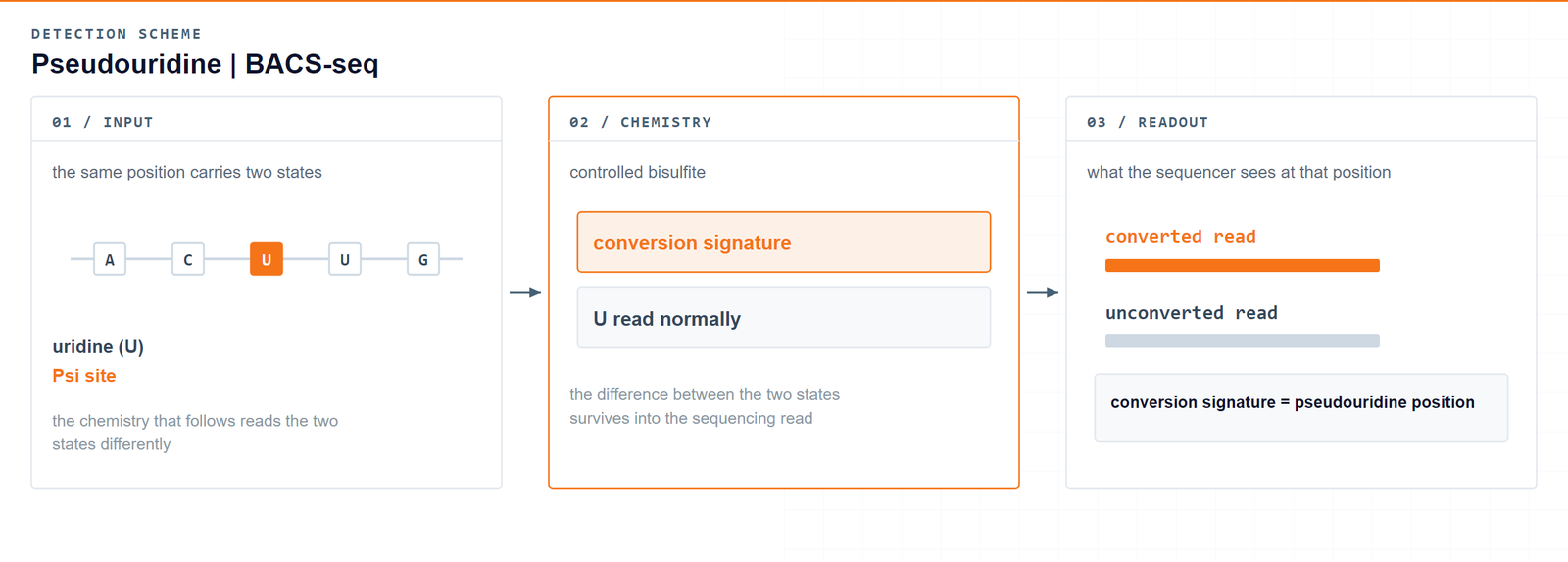
Protecting the base under controlled bisulfite conditions turns pseudouridine into a signature of its own, and that is what makes the level absolute rather than relative.Xu H. et al., Nature Methods 2024 · DOI 10.1038/s41592-024-02439-8
04Workflow
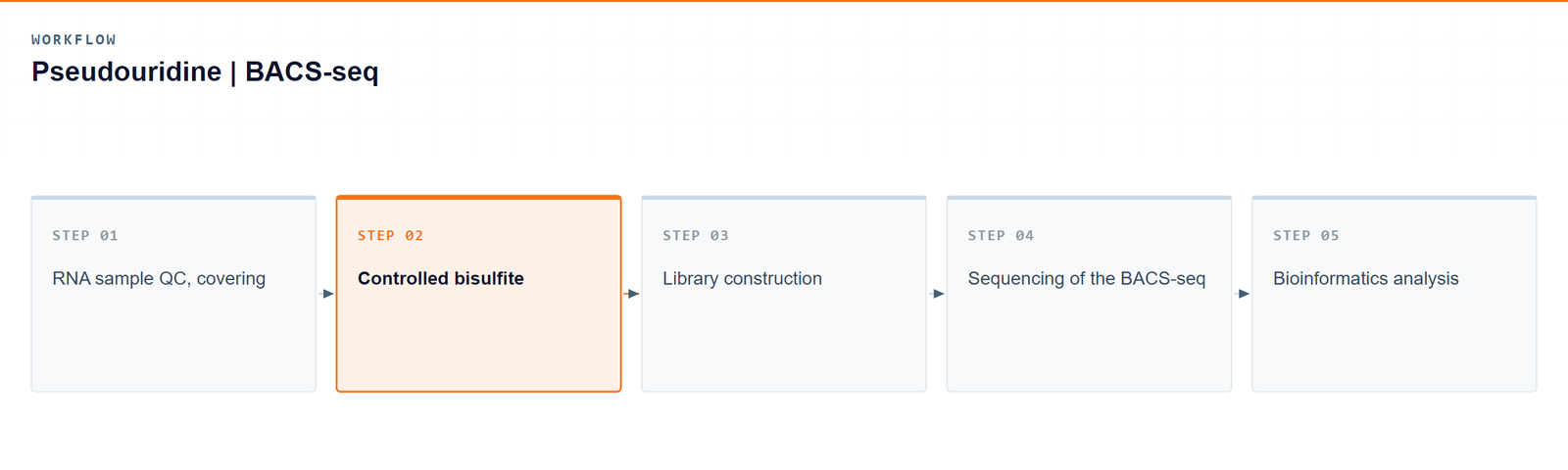
Five steps take a sample from RNA to single-base pseudouridine data:
- RNA sample QC, covering integrity and purity before treatment.
- Controlled bisulfite treatment, in which pseudouridine is protected while unmodified bases are converted.
- Library construction from the treated RNA.
- Sequencing of the BACS-seq library.
- Bioinformatics analysis to call the protected signature and quantify absolute pseudouridine stoichiometry.
05Bioinformatics and deliverables
Reads are mapped to the reference transcriptome, BACS-seq conversion signatures are recognized, and pseudouridine stoichiometry is quantified at single-nucleotide resolution on an absolute scale. Motif characterization, transcript-feature distribution, differential modification, functional enrichment and genome-browser visualization build on those calls.
Deliverables
- Raw pseudouridine mRNA sequencing data files (FASTQ), formatted for GEO/SRA submission.
- Sample and sequencing QC reports with sorted BAM alignment files and core mapping statistics.
- High-confidence single-base pseudouridine site tables (XLSX) listing coordinates, host genes and absolute stoichiometry.
- Single-base pseudouridine transcript-feature distribution figures and consensus motif logos (PDF/PNG).
- Single-base differential pseudouridine tables (XLSX) with fold change and significance.
- GO enrichment reports for pseudouridine-modified genes (HTML/PDF/PNG).
- Genome-browser track files (bigWig/bedGraph) together with a structured project report.
06Research applications
- Transcriptome-wide maps: pseudouridine sites are resolved across protein-coding transcripts and across lncRNAs.
- Absolute stoichiometry between groups: because each site carries an absolute level, modified fractions can be compared directly across conditions, tissues or time points.
- Translation and transcript stability: site-level data can be set against how efficiently an mRNA is translated and how long it persists.
- Coding-region and UTR function: sites are localized within CDS, UTR and splice-adjacent regions, so positional effects can be examined.
- Disease-oriented work: differentially modified mRNA sites can be carried forward as candidate biomarkers.
07Sample requirements
Storage. Cells and tissues: preserve in TRIzol or an RNA stabilisation solution, snap freeze in liquid nitrogen and store at −80 °C. RNA: resuspend in ethanol or RNase-free ultrapure water, store at −80 °C and avoid repeated freeze–thaw cycles.
Shipping. Place the sample in a 1.5 mL RNase-free microcentrifuge tube, seal it with parafilm or a cap lock, and ship on dry ice with adequate insulation.
| Sample type | Notes |
|---|---|
| Whole blood | EDTA tubes only; heparin is not compatible with the downstream procedure. |
| Cultured cells | Cell pellets are preferred. |
| Tissue | Fresh or frozen specimens; avoid necrotic material. |
| Total RNA | OD 260/280 ≥ 1.8 and RIN ≥ 7, with no visible degradation. Submit at least 10 µg total RNA. |
08FAQ
What does absolute quantification mean for pseudouridine here?
Each site is reported as a fraction of molecules carrying the modification, not as a relative enrichment score. That makes levels comparable between sites and between samples, which a capture-based assay cannot offer because its scale depends on how much material was pulled down.
How does the controlled bisulfite step protect pseudouridine?
Under the controlled conditions pseudouridine is protected from the conversion that acts on the unmodified bases. The protected base therefore reads as a distinct signature, and the proportion of molecules showing that signature is the modification level.
How is this different from enrichment-based pseudouridine profiling?
Enrichment works by collecting modified fragments, which limits resolution to the fragment and ties the signal to antibody performance. BACS-seq measures conversion instead, so calls are base-resolved and quantitative, and no antibody enters the measurement.
Which transcript scopes can be ordered?
Two: modification profiling on mRNA, or on mRNA together with long non-coding RNA. Both transcript types are analyzed in one experiment rather than split into two projects.
How are the sites annotated and reported?
Every call is annotated to the reference transcriptome with genomic coordinates, its host gene and its functional region, and the site tables carry absolute stoichiometry alongside those annotations.
09References
- Xu H, Kong L, Cheng J, et al. Absolute quantitative and base-resolution sequencing reveals comprehensive landscape of pseudouridine across the human transcriptome. Nature Methods 2024;21(11):2024–2033. DOI: 10.1038/s41592-024-02439-8