
Single-Nucleotide RNA m3C Modification Seq (HAC-seq)
HAC-seq reads m3C through cleavage rather than through enrichment: hydrazine-aniline chemistry cuts at modified cytidine, and the cut itself becomes the position signal.
01What the service reports
Single-Nucleotide RNA m3C Modification Seq (HAC-seq) is a base-resolution method in which hydrazine-aniline-mediated cleavage acts on cytidine, and the resulting cleavage signature pinpoints N3-methylcytidine at single-base resolution.
Because the readout comes from chemistry rather than from an antibody, the site list is not shaped by binding preference. Each entry carries a genomic coordinate, host gene, functional region and a modification ratio, so m3C can be compared between transcripts and between conditions.
Arraystar runs HAC-seq as a sample-to-data service: RNA QC, the cleavage treatment, library construction, sequencing and bioinformatics. Two transcript scopes are offered, so m3C can be profiled on mRNA alone or on mRNA together with long non-coding RNA in one experiment.
02Benefits
- Cleavage-based readout: the cut at modified cytidine is the signal, which keeps the position call independent of any enrichment step.
- Single-base resolution: each m3C site is placed at an individual nucleotide.
- Site-level stoichiometry: a modification ratio is reported for every called site.
- Antibody-free: no antibody is used at any stage, so antibody cross-reactivity and pull-down bias are not sources of variation in this assay.
- Annotated output: sites are mapped to the reference transcriptome with coordinates, host gene and functional region.
| Service Name | RNA Class | Price |
|---|---|---|
| Single-Nucleotide RNA m3C Modification Seq (HAC-seq) | mRNA | |
| Single-Nucleotide RNA m3C Modification Seq (HAC-seq) | mRNA and lncRNA |
03Background and detection principle
m3C sits on a base that is otherwise unmodified in the same transcript, so a method that treats all cytidines alike cannot see it. What is needed is a reaction that behaves differently at the methylated position and leaves a mark which survives into the read.
HAC-seq uses hydrazine-aniline-mediated cleavage for that. The reaction acts at cytidine, and the cleavage event plus the reverse-transcription signature that follows from it locate N3-methylcytidine at single-base resolution. No antibody is involved, so the method does not inherit a binding preference, and the same workflow can be extended to lncRNA in the same experiment when the wider scope is selected.
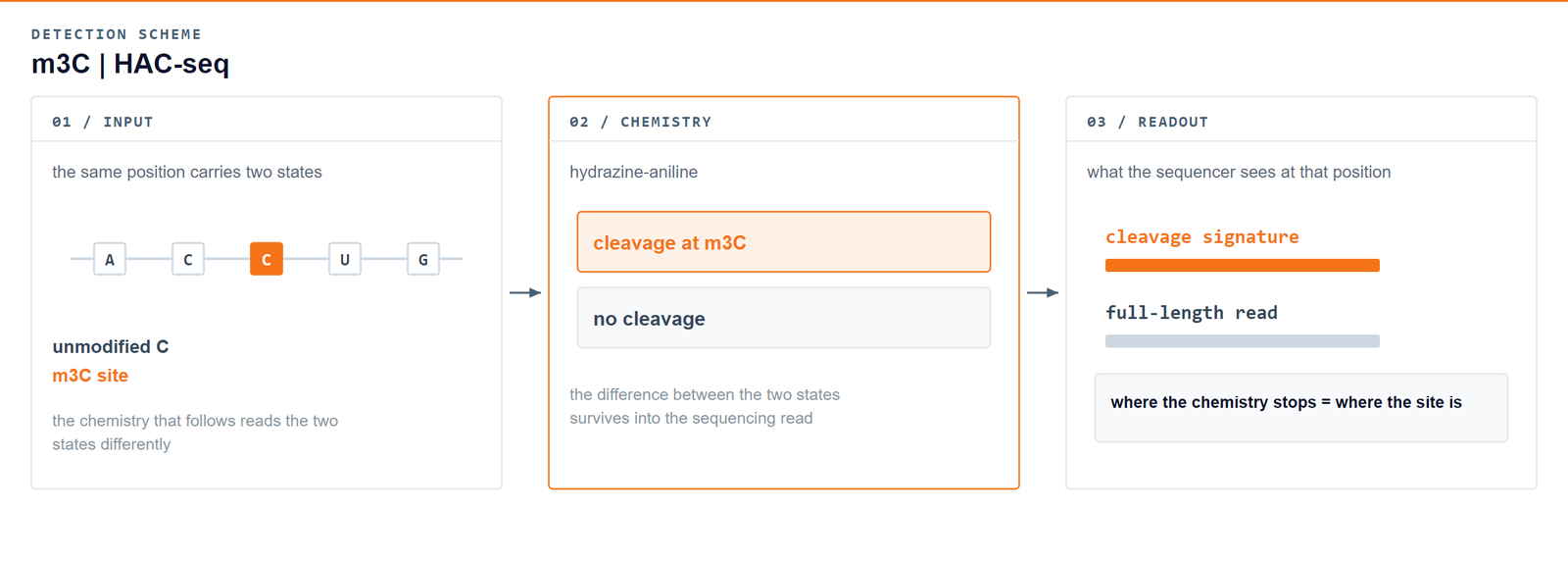
The cut is the measurement — position comes from where the chemistry stops, not from how much material was pulled down.Cui J. et al., Nucleic Acids Research 2021;49(5):e27 · DOI 10.1093/nar/gkaa1186
04Workflow
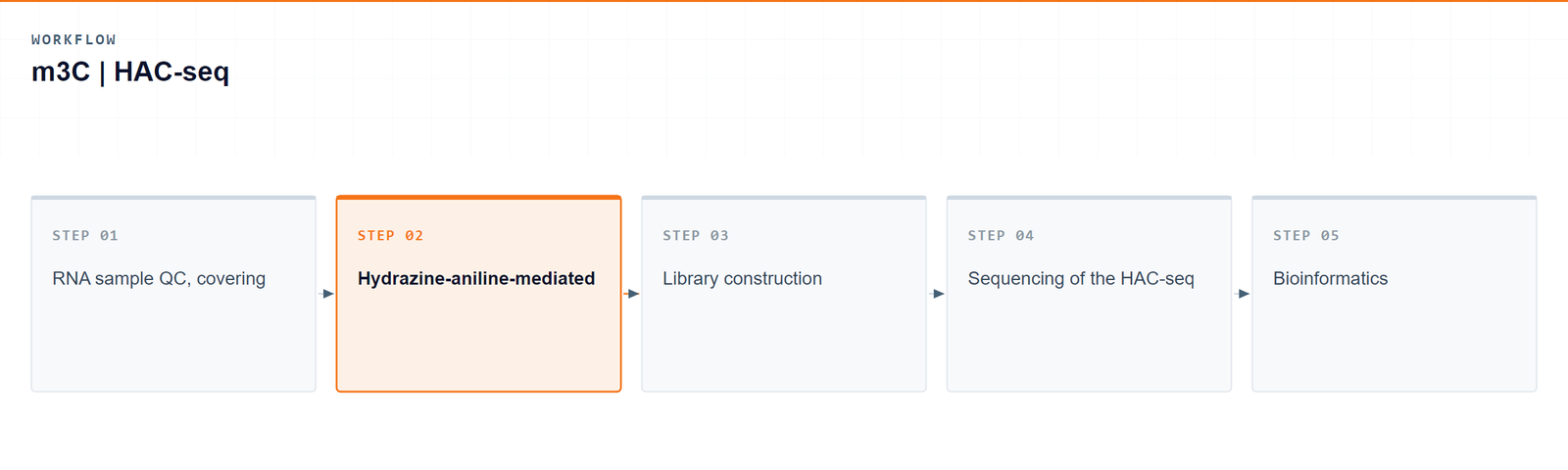
Five steps take a sample from RNA to a single-base m3C table:
- RNA sample QC, covering integrity and purity.
- Hydrazine-aniline-mediated cleavage treatment.
- Library construction from the treated material.
- Sequencing of the HAC-seq library.
- Bioinformatics: cleavage signature calling, site annotation and stoichiometry estimation.
05Bioinformatics and deliverables
Reads are aligned to the reference transcriptome, HAC-seq cleavage signatures are recognized, and m3C stoichiometry is estimated per site. The analysis set covers motif characterisation, differential modification, functional enrichment and genome-browser visualization.
Deliverables
- Raw m3C mRNA sequencing data files (FASTQ), formatted for GEO/SRA submission.
- Sample and sequencing QC reports, sorted BAM alignment files and core mapping statistics.
- High-confidence single-base m3C site tables (XLSX) with coordinates, host gene and stoichiometry.
- Single-base m3C transcript feature distribution figures and consensus motif logos (PDF/PNG).
- Single-base differential m3C tables (XLSX) with fold change and significance.
- GO enrichment reports for m3C-modified genes (HTML/PDF/PNG).
- Genome-browser track files (bigWig/bedGraph) and a structured project report.
06Research applications
- Transcriptome-wide mapping: resolves m3C sites across protein-coding transcripts and, when the lncRNA scope is selected, across lncRNA as well.
- Transcript stability: connects a resolved site to how the transcript behaves.
- Coding-region function: localises sites within CDS, UTR and splice-adjacent regions.
- Disease-oriented studies: identifies differentially modified sites as candidate biomarkers.
- Method comparison: gives a cleavage-based reference when a result obtained by enrichment needs to be checked against an antibody-independent route.
07Sample requirements
Storage. Cells and tissues: preserve in TRIzol or an RNA stabilisation solution, snap freeze in liquid nitrogen and store at −80 °C. RNA: resuspend in ethanol or RNase-free ultrapure water, store at −80 °C and avoid repeated freeze–thaw cycles.
Shipping. Place the sample in a 1.5 mL RNase-free microcentrifuge tube, seal it with parafilm or a cap lock, and ship on dry ice with adequate insulation.
| Sample type | Notes |
|---|---|
| Whole blood | EDTA tubes only; heparin is not compatible with the downstream procedure. |
| Cultured cells | Cell pellets are preferred. |
| Tissue | Fresh or frozen specimens; avoid necrotic material. |
| Total RNA | OD 260/280 ≥ 1.8 and RIN ≥ 7, with no visible degradation. Submit 5–10 µg total RNA. |
08FAQ
What makes HAC-seq different from an antibody-based m3C method?
HAC-seq does not use an antibody. The position call comes from where the cleavage chemistry acts, so the result is not limited by how well an antibody binds a particular sequence context.
How is the position read out of a cleavage event?
The treated RNA produces a characteristic cleavage and reverse-transcription signature at modified cytidines. Recognising that signature in the aligned reads is what places each site.
What is reported for each site?
A genomic coordinate, the host gene, the functional region and a modification ratio.
Can lncRNA be profiled in the same experiment?
Yes. mRNA alone, or mRNA together with long non-coding RNA, in a single run.
When would this be paired with an enrichment-based method?
Where a region-level profile has already flagged a transcript, a cleavage-based call gives an antibody-independent position for the sites inside it.
09References
- Cui J, Liu Q, Sendinc E, Shi Y, Gregory RI. Nucleotide resolution profiling of m3C RNA modification by HAC-seq. Nucleic Acids Research 2021;49(5):e27. DOI: 10.1093/nar/gkaa1186