
Single-Nucleotide RNA m3C Modification Seq (m3C-IP-seq)
An m3C-specific antibody concentrates the modified fragments and reverse-transcription misincorporation places each site on a single base — with an AlkB-demethylated arm confirming every call.
01What the service reports
Single-Nucleotide RNA m3C Modification Seq (m3C-IP-seq) is an antibody-based service. An m3C-specific antibody immunoprecipitates m3C-containing fragments, and reverse-transcription misincorporation at the modified cytidine is resolved to a single base.
Calls are confirmed rather than assumed. The IP eluate is split in two: one arm is treated with the AlkB demethylase (Dm), which removes m3C, and the other is left untreated (non-Dm). A genuine site shows misincorporation in the non-Dm arm and loses that signal once the mark is removed, so positions that persist in both arms are dropped as background.
Arraystar runs the service end to end: RNA sample QC, immunoprecipitation, the Dm and non-Dm split, reverse transcription, library construction, sequencing and bioinformatics. Sites are annotated to the reference transcriptome with genomic coordinates, host gene and functional region, and a study can be scoped to mRNA alone or to mRNA together with long non-coding RNA.
02Benefits
- Single-base m3C calls: misincorporation at the modified cytidine is resolved to one base, so a site is located rather than inferred from a peak.
- A ratio at each site: the misincorporation readout returns a modification ratio alongside the position, not only a presence call.
- Antibody enrichment for sensitivity: an m3C-specific antibody concentrates modified fragments, which lifts low-stoichiometry sites above the unmodified background.
- Checked by demethylation: the matched AlkB (Dm) arm removes m3C, so every candidate is tested against a signal that should disappear.
- Annotated output: sites arrive on the reference transcriptome with genomic coordinates, host gene and functional region attribution.
| Service Name | RNA Class | Price |
|---|---|---|
| Single-Nucleotide RNA m3C Modification Seq (m3C-IP-seq) | mRNA | |
| Single-Nucleotide RNA m3C Modification Seq (m3C-IP-seq) | mRNA and lncRNA |
03Background and detection principle
m3C can influence how an mRNA behaves, and where the mark sits matters as much as whether it is present. Enrichment that reports peaks leaves both the position and the level of a site unresolved, and the binding preference of the reagent ends up folded into the signal.
m3C-IP-seq pairs enrichment with a base-level readout. An m3C-specific antibody immunoprecipitates m3C-containing fragments, and reverse transcription records the modified cytidine as misincorporation, which resolves the site to a single base.
The specificity check is built into the same workflow. One arm of the IP eluate is demethylated with AlkB (Dm) and the other is left untreated (non-Dm), so a real m3C site shows misincorporation only in the non-Dm arm and reads back as an unmodified C after demethylation. The same workflow extends to long non-coding RNA, so coding and non-coding transcripts are profiled within a single assay.
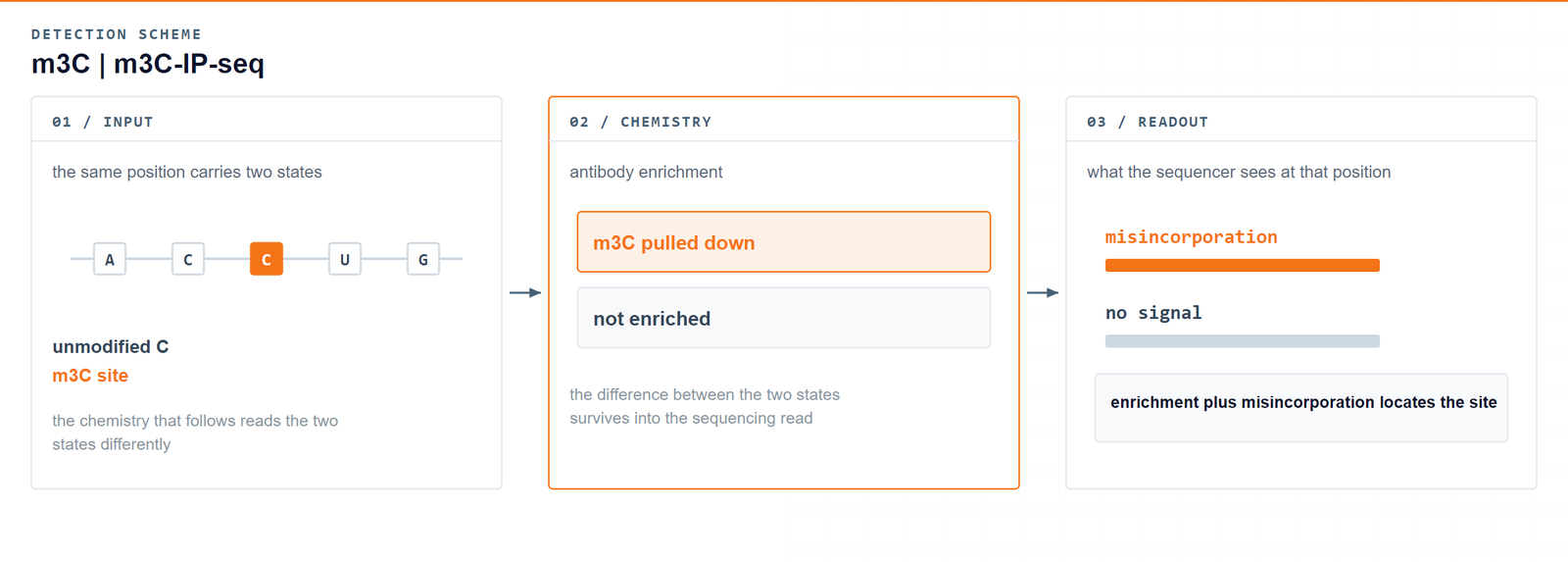
Enrichment supplies the sensitivity and misincorporation supplies the position; the AlkB-demethylated arm then removes any site whose signal fails to disappear.Gao Y. et al., Nucleic Acids Research 2025 · DOI 10.1093/nar/gkaf153
04Workflow
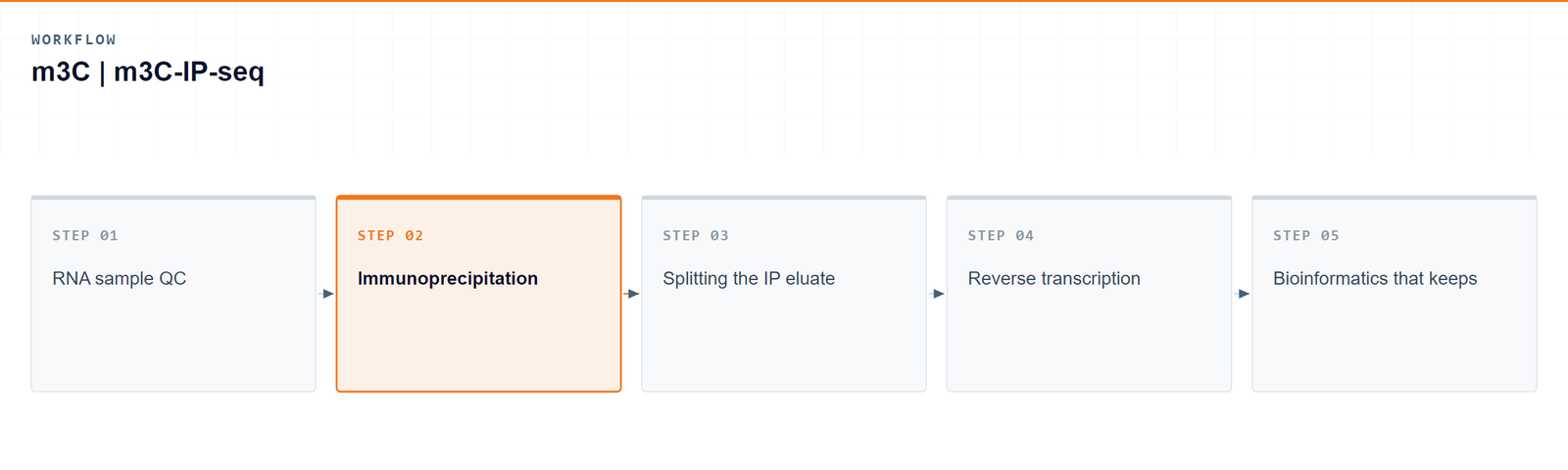
Five steps carry a sample from RNA to single-base N3-methylcytidine data:
- RNA sample QC and treatment ahead of immunoprecipitation.
- Immunoprecipitation with an m3C-specific antibody, which concentrates m3C-bearing fragments.
- Splitting the IP eluate into an AlkB-demethylated arm (Dm) and an untreated arm (non-Dm).
- Reverse transcription and library construction, followed by sequencing of both arms.
- Bioinformatics that keeps the sites whose misincorporation signal is lost after demethylation.
05Bioinformatics and deliverables
Reads are aligned, m3C-IP-seq misincorporation signatures are recognized in the non-Dm arm, sites that persist in the AlkB-demethylated arm are removed, and a m3C modification ratio is quantified at single-nucleotide resolution. Motif characterization, differential modification, functional enrichment and genome-browser visualization follow. The Dm-versus-non-Dm comparison is what turns raw misincorporation into high-confidence single-base calls.
Deliverables
- Raw m3C mRNA sequencing data files (FASTQ), formatted for GEO/SRA submission.
- Sample and sequencing QC reports with sorted BAM alignment files and core mapping statistics.
- High-confidence single-base m3C site annotation tables (XLSX) listing coordinates, host genes and stoichiometry.
- Single-base m3C transcript-feature distribution figures and consensus motif logos (PDF/PNG).
- Single-base differential m3C modification tables (XLSX) with fold change and significance.
- GO enrichment reports for m3C-modified genes (HTML/PDF/PNG).
- Genome-browser track files (bigWig/bedGraph) together with a structured project report.
06Research applications
- Transcriptome-wide mapping: m3C sites are resolved across protein-coding transcripts and across lncRNAs.
- Translational control: base-resolution calls can be related to mRNA translation and stability.
- Coding-region function: sites are localized within CDS, UTR and splice-adjacent regions, so positional effects can be examined.
- Disease-oriented work: differentially modified mRNA sites can be carried forward as candidate biomarkers.
- Orthogonal confirmation: the antibody route adds sensitivity, so running it beside an antibody-free m3C assay gives independent support for newly reported sites.
07Sample requirements
Storage. Cells and tissues: preserve in TRIzol or an RNA stabilisation solution, snap freeze in liquid nitrogen and store at −80 °C. RNA: resuspend in ethanol or RNase-free ultrapure water, store at −80 °C and avoid repeated freeze–thaw cycles.
Shipping. Place the sample in a 1.5 mL RNase-free microcentrifuge tube, seal it with parafilm or a cap lock, and ship on dry ice with adequate insulation.
| Sample type | Notes |
|---|---|
| Whole blood | EDTA tubes only; heparin is not compatible with the downstream procedure. |
| Cultured cells | Cell pellets are preferred. |
| Tissue | Fresh or frozen specimens; avoid necrotic material. |
| Total RNA | OD 260/280 ≥ 1.8 and RIN ≥ 7, with no visible degradation. Submit at least 200 µg total RNA. |
08FAQ
How do the antibody step and the single-base readout fit together?
The antibody concentrates m3C-bearing fragments so that sites present at low stoichiometry are not lost in the background, and reverse transcription then records the modified cytidine as misincorporation, which is what fixes the position to one base.
What does the AlkB (Dm) arm contribute?
It is a specificity test. One arm of the IP eluate is demethylated with AlkB, which removes m3C, while the other arm is left untreated. A true site shows misincorporation in the untreated arm and stops showing it after demethylation.
What happens to positions that stay positive in both arms?
They are treated as background rather than as calls. Sites whose signal does not disappear after demethylation are removed before reporting, which is where the confidence of the remaining single-base calls comes from.
Which transcript scopes can be ordered?
Two: m3C profiling on mRNA, or on mRNA together with long non-coding RNA. Both transcript types are analyzed within one experiment, so a project does not have to be split in two.
How does this compare with an antibody-free m3C assay?
Antibody-free chemical and signature-based assays read the modification directly, while antibody enrichment adds sensitivity for low-stoichiometry sites. The two routes complement each other, and running them side by side gives orthogonal support for sites reported for the first time.
09References
- Gao Y, Hou J, Wei S, et al. Transcriptome-wide mapping of N3-methylcytidine modification at single-base resolution. Nucleic Acids Research 2025;53(5). DOI: 10.1093/nar/gkaf153