
Single-Nucleotide RNA O8G Modification Seq (O8G-miSeq)
An O8G-specific antibody captures the modified fragments and a matched Input control sets the baseline; G>T mutation signatures then place each 8-oxoguanine site on miRNA at single-nucleotide resolution.
01What the service reports
Single-Nucleotide RNA O8G Modification Seq (O8G-miSeq) is a single-base, immunoprecipitation-based sequencing service that profiles 8-oxoguanine (O8G) on miRNA and pri-miRNA. An O8G-specific antibody enriches the modified RNA fragments, and high-depth Illumina sequencing combined with G>T mutation analysis localizes each O8G site at single-nucleotide resolution.
Enrichment and mutation calling work as a pair. The antibody raises the proportion of modified fragments in the library, while G>T signatures read directly out of the sequencing data and a matched Input control establish which positions carry O8G. What comes back is a site-level O8G map that can be set against miRNA targeting, stability and function.
Arraystar runs O8G-miSeq as a complete sample-to-data workflow: an O8G enrichment library together with a matched Input control, sequencing, and the bioinformatics analysis that follows.
02Benefits
- Single-base resolution: immunoprecipitation is combined with G>T mutation analysis, so an O8G site is pinned to an exact position rather than to an enriched region.
- Focused on miRNA: the assay profiles O8G across miRNA seeds, pri-miRNA and mature miRNA populations.
- A functional readout: O8G sites can be related to changes in miRNA–mRNA targeting and to the biological effect that follows.
- A matched baseline: an Input library accompanies the enriched one, which is what supports confident modification calling rather than enrichment alone.
- Enrichment built for sensitivity: an O8G-specific antibody captures modified fragments, so sites present at low abundance remain detectable.
| Service Name | RNA Class | Price |
|---|---|---|
| Single-Nucleotide RNA O8G Modification Seq (O8G-miSeq) | miRNA and pri-miRNA |
03Background and detection principle
O8G (8-oxoguanine) forms when reactive oxygen species oxidise guanine in RNA. The oxidised base pairs with adenine instead of its usual partner, which is why it surfaces in sequencing data as a G>T mutation signature, and it links RNA chemistry to redox-driven disease. O8G now sits alongside m6A as a focus of epitranscriptomic research.
A 2023 Nature Cell Biology study reported widespread O8G modification of miRNA seeds and showed that these sites differentially regulate redox-dependent cancer development, which is what makes a base-level map of miRNA O8G worth having.
O8G-miSeq reads the modification through enrichment and a mutation signature at once. An O8G-specific antibody captures the modified fragments, and G>T mutation analysis against a matched Input control then localizes each site at single-nucleotide resolution.
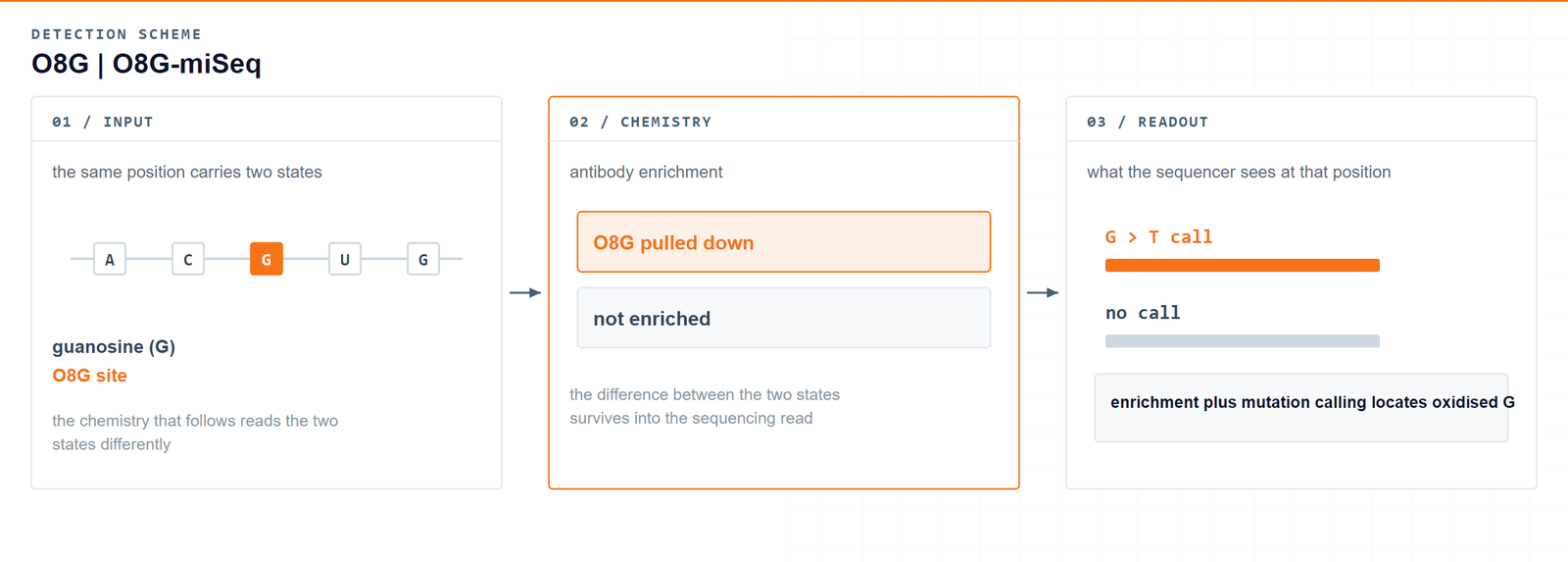
O8G pairs with adenine, so the oxidised base leaves a G>T signature — and with enrichment plus an Input control, that signature locates the site to a single nucleotide.Eom S. et al., Nature Cell Biology 2023 · DOI 10.1038/s41556-023-01209-6
04Workflow
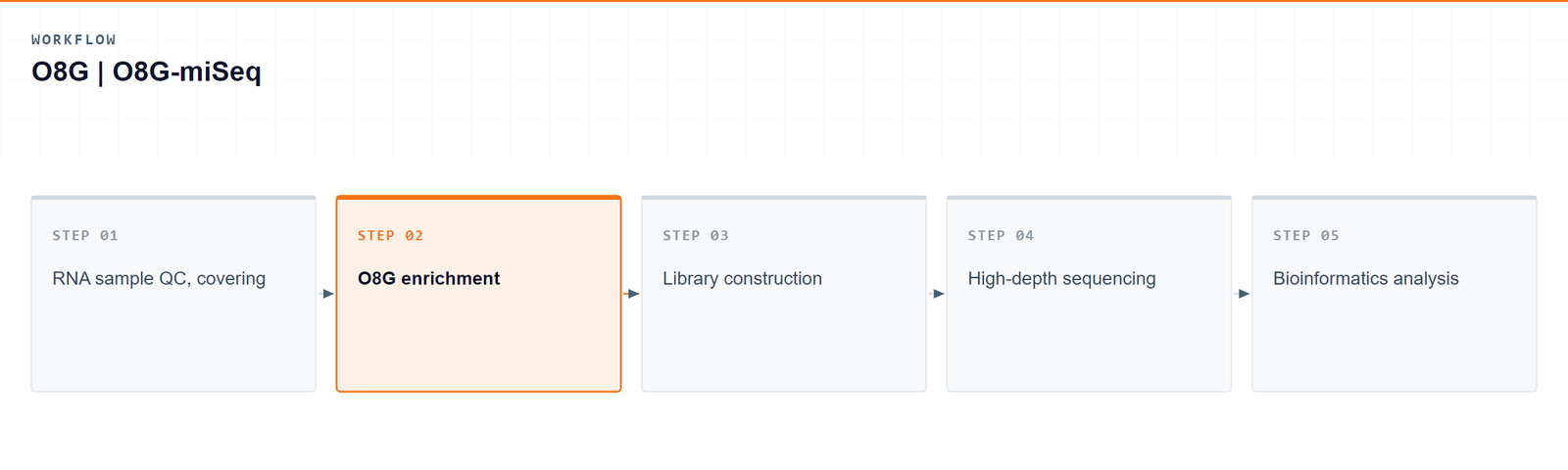
Five steps take a sample from RNA to single-base 8-oxoguanine data:
- RNA sample QC, covering integrity and confirming that small RNA is preserved.
- O8G enrichment: an O8G-specific antibody immunoprecipitates the modified RNA.
- Library construction: an O8G-IP library is built alongside a matched Input control library.
- High-depth sequencing on an Illumina platform, at a depth suited to O8G detection.
- Bioinformatics analysis: enrichment analysis together with G>T mutation calling localizes single-base O8G sites.
05Bioinformatics and deliverables
The pipeline screens the O8G-enriched signal against the Input control, calls G>T mutations to place O8G sites at single-nucleotide resolution, and reports target-gene analysis before and after modification. Site tables, motif and distribution plots, differential modification and genome-browser tracks complete the set.
Deliverables
- Raw FASTQ data for the O8G-IP and Input libraries, ready for GEO/SRA deposit.
- QC report with BAM alignment files and core mapping statistics.
- Single-base O8G site tables (XLSX) with coordinates, site scores and stoichiometry.
- O8G motif and distribution figures across miRNA and pri-miRNA (PDF/PNG).
- Differential O8G modification tables (XLSX) with fold change and significance.
- Target-gene and functional enrichment reports for O8G-bearing miRNAs.
- Genome-browser track files (bigWig/bedGraph) and a structured project report.
06Research applications
- Redox biology: profile O8G as a marker of oxidative stress within miRNA.
- Cancer research: relate O8G-modified miRNA seeds to tumour development and progression.
- miRNA function: connect O8G sites to changes in miRNA targeting and gene regulation.
- Biomarker discovery: identify differentially O8G-modified miRNAs in disease.
- Stem cell and development: track O8G dynamics as cells move between states.
- Drug-response studies: link O8G to therapy-induced oxidative signaling.
07Sample requirements
Storage. Cells and tissues: preserve in TRIzol or an RNA stabilisation solution, snap freeze in liquid nitrogen and store at −80 °C. RNA: resuspend in ethanol or RNase-free ultrapure water, store at −80 °C and avoid repeated freeze–thaw cycles.
Shipping. Place the sample in a 1.5 mL RNase-free microcentrifuge tube, seal it with parafilm or a cap lock, and ship on dry ice with adequate insulation.
| Sample type | Notes |
|---|---|
| Whole blood | EDTA tubes only; heparin is not compatible with the downstream procedure. |
| Cultured cells | Cell pellets are preferred. |
| Tissue | Fresh or frozen specimens; avoid necrotic material. |
| Total RNA | OD 260/280 ≥ 1.8 and RIN ≥ 7, with no visible degradation. Submit at least 2–300 µg total RNA. |
08FAQ
Which RNA species does O8G-miSeq profile?
miRNA and pri-miRNA. The assay is built around small RNA, and the matched Input control library is prepared alongside the enriched library so that single-base calls can be made against a baseline.
How does the method reach single-base resolution?
Two pieces of evidence are combined. An O8G-specific antibody raises the proportion of modified fragments in the library, and G>T mutation calling then reads the position of each modification out of the sequencing data, with the Input control holding the comparison steady.
What is the Input control for?
It records what the library looks like without enrichment at each position. Screening the enriched signal against that baseline is what separates a genuine O8G call from background, and it is why the workflow ships the two libraries together.
What does an O8G site mean biologically?
8-oxoguanine is a product of reactive oxygen species oxidising guanine in RNA. Because the oxidised base pairs with adenine, it is tied to redox-driven disease, and a 2023 Nature Cell Biology study linked widespread O8G in miRNA seeds to redox-dependent cancer development.
What comes with the data beyond the site list?
Enrichment analysis, G>T mutation site calling, and target-gene analysis run both before and after modification, so each O8G site can be read in the context of the miRNA targets it affects.
09References
- Eom S, Peak J, Park J, et al. Widespread 8-oxoguanine modifications of miRNA seeds differentially regulate redox-dependent cancer development. Nature Cell Biology 2023;25(9):1369–1383. DOI: 10.1038/s41556-023-01209-6
- Seok H, Lee H, Lee S, et al. Position-specific oxidation of miR-1 encodes cardiac hypertrophy. Nature 2020;584(7820):279–285. DOI: 10.1038/s41586-020-2586-0