
Single-Nucleotide RNA 2'-O-Methylation Modification Seq (NM-seq)
Periodate chemistry does the distinguishing: unmodified ribose is degraded through repeated oxidation-elimination-dephosphorylation cycles while a 2'-O-methylated position survives, so Nm is mapped at base precision.
01What the service reports
Single-Nucleotide RNA 2'-O-Methylation Modification Seq (NM-seq) is a chemical, antibody-free sequencing method built on the differential reactivity of periodate toward the 2'-hydroxyl and the 2'-O-methylated ribose. Repeated oxidation-elimination-dephosphorylation (OED) cycles strip away unmodified nucleotides, so fragments carrying Nm are enriched before sequencing.
What survives the cycles is what gets read. Each enriched fragment end reports an Nm position, so calls arrive at base precision rather than as an enriched region. Coverage runs across mRNA and lncRNA, and the same assay also detects Nm on pri-miRNA, tRNA and rRNA.
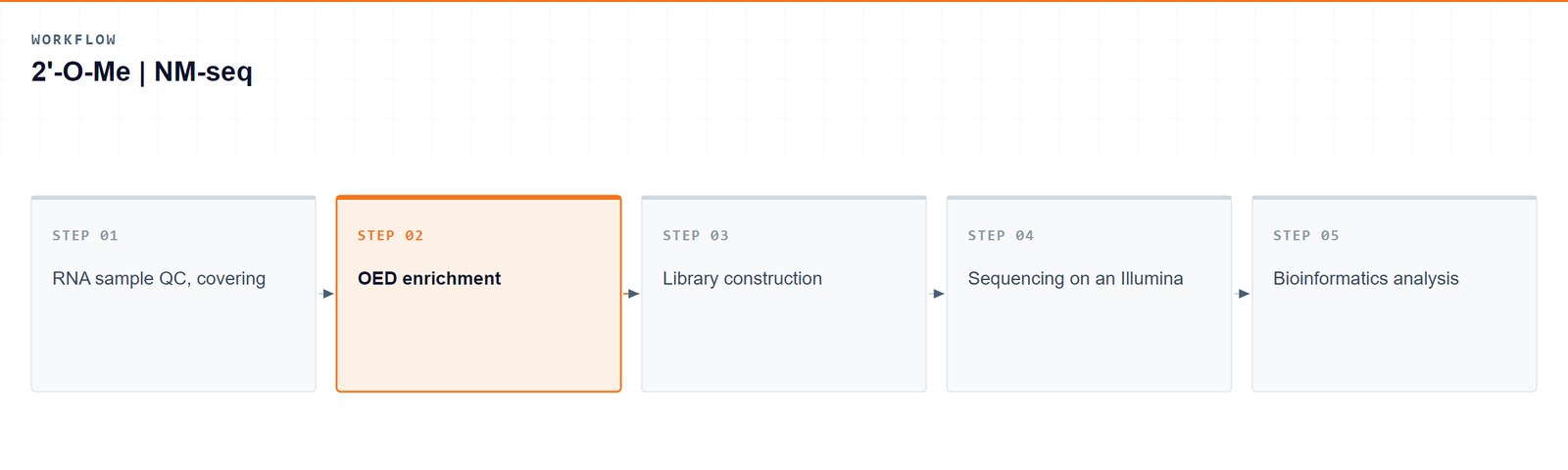
Arraystar delivers NM-seq as a complete sample-to-data workflow: RNA QC, OED enrichment, library construction, sequencing and bioinformatics. A project ends with an Nm landscape across the transcriptome rather than with raw reads alone.
02Benefits
- Single-base resolution: the chemistry resolves each 2'-O-methylation position at nucleotide precision instead of flagging an enriched window.
- Transcriptome-wide in one run: Nm is profiled across mRNA and lncRNA in parallel.
- Wider RNA reach: the same assay detects Nm on pri-miRNA, tRNA and rRNA as well as on the transcripts it was ordered for.
- No antibody needed: periodate chemistry removes the enrichment bias that antibody capture introduces.
- Enrichment that accumulates: repeated OED cycles concentrate methylated fragments, so sites present at low abundance remain visible.
| Service Name | RNA Class | Price |
|---|---|---|
| Single-Nucleotide RNA 2'-O-Methylation Modification Seq (NM-seq) | mRNA | |
| Single-Nucleotide RNA 2'-O-Methylation Modification Seq (NM-seq) | mRNA and lncRNA | |
| Single-Nucleotide RNA 2'-O-Methylation Modification Seq (NM-seq) | rRNA |
03Background and detection principle
2'-O-methylation (Nm) sits on the 2'-hydroxyl of the ribose and ranks among the more abundant RNA modifications. It is deposited by 2'-O-methyltransferases, the spoUT family among them, and by C/D-box snoRNPs. It occurs on rRNA, snRNA, mRNA, tRNA, snoRNA and siRNA, where it feeds into RNA stability, structure, biogenesis, splicing and translation.
In mammals the mark also helps distinguish self from non-self mRNA, which ties it to innate immune sensing.
NM-seq reads that chemistry instead of capturing it. Periodate reacts with the 2'-hydroxyl of unmodified ribose but leaves a 2'-O-methylated ribose untouched, and every oxidation-elimination-dephosphorylation cycle truncates the unprotected positions further. Methylated fragments survive to enter the library, and their ends mark where Nm sits.
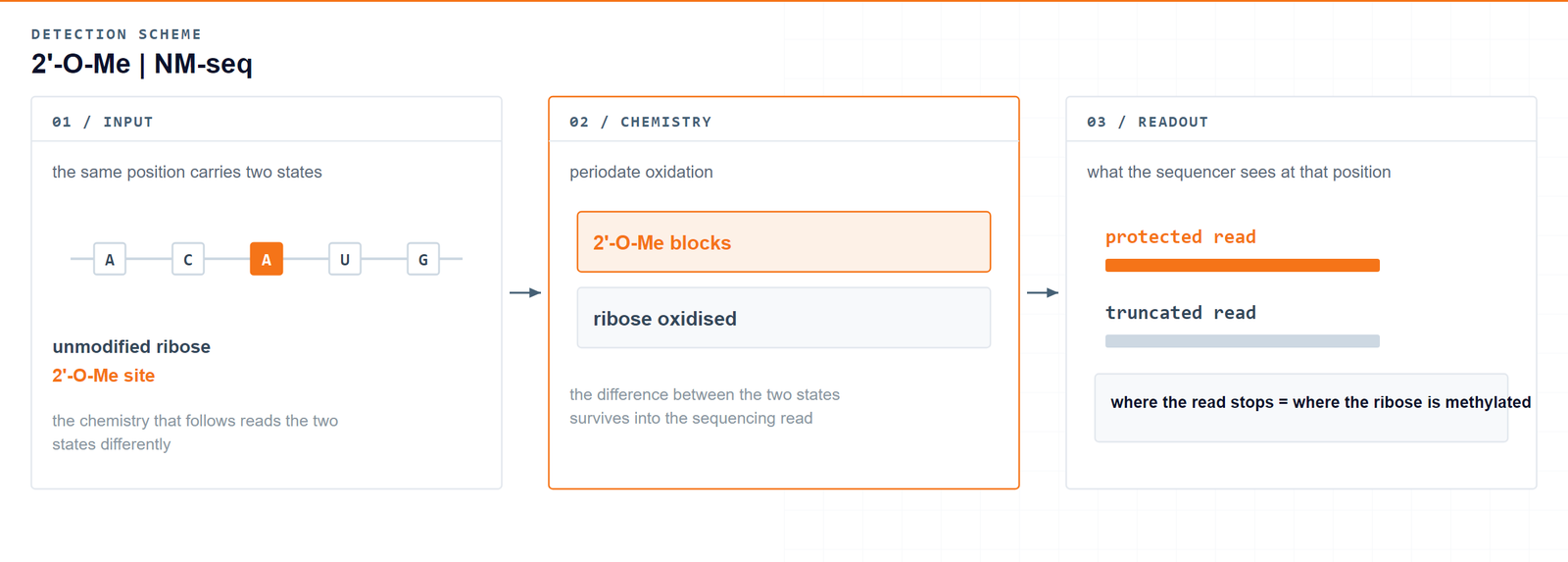
Periodate strips the unmodified ribose and leaves a 2'-O-methylated position intact — the fragments that outlast the cycles are the ones that mark where Nm sits.Dai Q. et al., Nature Methods 2017 · DOI 10.1038/nmeth.4294
04Workflow
Five steps take a sample from RNA to single-base 2'-O-methylation data:
- RNA sample QC, covering integrity and purity before the reaction.
- OED enrichment: repeated oxidation-elimination-dephosphorylation cycles remove the nucleotides that carry an unmodified ribose.
- Library construction: adapters are ligated at the exposed 3' end of the fragments that survived.
- Sequencing on an Illumina platform at a depth suited to Nm calling.
- Bioinformatics analysis: reads are aligned and Nm sites are quantified at single-base resolution.
05Bioinformatics and deliverables
Reads are mapped to the transcriptome and the positions are identified where 2'-O-methylation shielded a nucleotide from OED degradation, with Nm stoichiometry reported at base resolution. The analysis adds motif characterization, differential modification and genome-browser visualization.
Deliverables
- FASTQ data for every library, formatted ready for GEO/SRA submission.
- A QC report together with sorted BAM alignments and core mapping statistics.
- Single-base Nm site tables (XLSX) listing genomic coordinates alongside stoichiometry.
- Nm distribution and motif figures covering mRNA and lncRNA (PDF/PNG).
- Differential Nm modification tables (XLSX) with fold change and significance.
- Functional enrichment reports for the transcripts that carry Nm.
- Genome-browser track files (bigWig/bedGraph) and a structured project report.
06Research applications
- mRNA function: relate Nm sites to how a transcript is spliced, stabilized and translated.
- Immune response: examine Nm as a self-versus-non-self signal in innate immunity.
- Viral RNA: profile Nm on viral transcripts in the context of immune evasion.
- Development and differentiation: track how Nm changes as cells move between states.
- Disease research: identify differentially methylated Nm sites as candidate biomarkers.
- LncRNA biology: assess Nm on long non-coding RNAs and on the regulators that act on them.
07Sample requirements
Storage. Cells and tissues: preserve in TRIzol or an RNA stabilisation solution, snap freeze in liquid nitrogen and store at −80 °C. RNA: resuspend in ethanol or RNase-free ultrapure water, store at −80 °C and avoid repeated freeze–thaw cycles.
Shipping. Place the sample in a 1.5 mL RNase-free microcentrifuge tube, seal it with parafilm or a cap lock, and ship on dry ice with adequate insulation.
| Sample type | Notes |
|---|---|
| Whole blood | EDTA tubes only; heparin is not compatible with the downstream procedure. |
| Cultured cells | Cell pellets are preferred. |
| Tissue | Fresh or frozen specimens; avoid necrotic material. |
| Total RNA | OD 260/280 ≥ 1.8 and RIN ≥ 7, with no visible degradation. Submit at least 100–300 µg total RNA. |
08FAQ
What is 2'-O-methylation?
A modification on the 2'-hydroxyl of the ribose, written by 2'-O-methyltransferases and by C/D-box snoRNPs. It appears on rRNA, snRNA, mRNA, tRNA, snoRNA and siRNA, and it feeds into RNA stability, structure, biogenesis, splicing and translation.
How does NM-seq reach single-base resolution?
Periodate acts on the 2'-hydroxyl of unmodified ribose but not on a 2'-O-methylated one, so each round of oxidation-elimination-dephosphorylation shortens unprotected positions while methylated positions survive. Because the protected position itself limits where a fragment ends, the mapping lands at nucleotide precision.
Which RNA species can be profiled?
The service is ordered for mRNA and lncRNA primarily, and within the same assay it also detects Nm on pri-miRNA, tRNA and rRNA.
Why is an antibody-free method preferable here?
Antibody capture depends on how strongly an antibody binds its target, which folds a preference into the signal and leaves fragments rather than positions. NM-seq converts chemically, so detection rests on periodate reactivity and the readout stays quantitative.
What does the analysis add on top of the site list?
Site tables with stoichiometry, CDS and splice-site distribution, motif analysis, differential modification between groups, and functional enrichment for the transcripts that carry Nm.
09References
- Dai Q, Moshitch-Moshkovitz S, Han D, et al. Nm-seq maps 2'-O-methylation sites in human mRNA with base precision. Nature Methods 2017;14(7):695–698. DOI: 10.1038/nmeth.4294
- Ringeard M, Marchand V, Decroly E, et al. FTSJ3 is an RNA 2'-O-methyltransferase recruited by HIV to avoid innate immune sensing. Nature 2019;565(7740):500–504. DOI: 10.1038/s41586-018-0841-4