
Published with Arraystar
RNA modification is our main line of work rather than a service we added later. The studies below come from groups that brought their modification projects to a team that has been running them for years — single-base sequencing, RIP-sequencing and arrays.
Four ways to read a modification
Pick the route by the resolution your question needs: site-level sequencing for position and stoichiometry, RIP-based profiling for transcript-level enrichment, arrays for multiplexed screening across many targets, and a dedicated GlycoRNA line.
Single-Base RNA Modification Sequencing
Fourteen chemical and enzymatic workflows that report modification type, position and level site by site.
Site-levelposition & level GROUP_02RNA Modification RIP-Sequencing
Nine antibody-based enrichment workflows, from m6A MeRIP-Seq to Ψ-RIP-Seq and hMeRIP-Seq, for transcript-level modification profiles.
Transcriptenrichment GROUP_03GlycoRNA Solution
An integrated line for glycosylated RNA: array screening, sequencing of glycosylated small RNA, and blotting for direct detection of the glycoRNA population.
Dedicatedglyco line GROUP_04RNA Modification Arrays
Array formats that screen modification levels across many transcripts in parallel, for triage before site-level work.
MultiplexedscreeningFourteen marks, one place to start
Each entry states what the modification is chemically and which method reads it. Open a type to see the workflows, signal logic and what the result reports.
m6A — N6-methyladenosine
Methylation at the N6 position of adenosine. Position and level are read either by cooperative-catalysis deamination (CAM-seq) or glyoxal-based conversion (GLORI2-seq).
MOD_02m5C — 5-methylcytosine
Methylation at the C5 position of cytosine. Read from bisulfite conversion signatures, where unmethylated cytosine is converted and m5C is not.
MOD_03m1A — N1-methyladenosine
Methylation at the N1 position of adenosine. Absolute modification stoichiometry is read from engineered reverse transcriptase mutation signatures.
MOD_04ac4C — N4-acetylcytidine
Acetylation at the N4 position of cytidine. Read through reductive RedaC:T conversion, which marks modified cytidines as thymidine reads.
MOD_05m7G — N7-methylguanosine
Methylation at the N7 position of guanosine. Read by targeted chemical conversion that leaves a position-specific signature.
MOD_06m3C — 3-methylcytidine
Methylation at the C3 position of cytidine. Two routes: hydrazine-aniline cleavage (HAC-seq) or antibody enrichment with misincorporation readout (m3C-IP-seq).
MOD_07Ψ — Pseudouridine
Isomerisation of uridine. Detected either from bisulfite-induced deletion signatures (BID-seq) or from controlled bisulfite conversion (BACS-seq).
MOD_08Ψ & Inosine — profiled together
Pseudouridine and inosine in a single BACS-seq workflow, for studies that need both readouts from the same library.
MOD_092'-O-Me (Nm) — ribose methylation
Methylation at the 2'-O position of the ribose. Read by periodate oxidation–elimination–dephosphorylation chemistry (NM-seq).
MOD_10D — Dihydrouridine
Reduction of the uracil ring. Read from chemical conversion signatures that distinguish D from unmodified uridine.
MOD_11O8G — 8-oxoguanosine
Oxidation at the C8 position of guanosine. Read by antibody enrichment with G>T mutation calling (O8G-miSeq).
MOD_12m6Am — cap-proximal methylation
Methylation at the N6 position of the cap-proximal adenosine. An exonuclease step separates it from internal m6A (m6Am-Exo-Seq).
MOD_135hmC — 5-hydroxymethylcytosine
Hydroxymethylation of cytosine on RNA, profiled by antibody-based enrichment (hMeRIP-Seq).
MOD_14GlycoRNA — RNA glycosylation
Glycosylation of RNA at the sugar rather than at a base. Read through its own line — array screening, sequencing of glycosylated small RNA and lectin-based blotting — rather than by a base-level method.
Choosing marks by research context
Different research settings lead to different marks. The table maps the contexts we are asked about most often onto the marks that are usually worth starting with, and onto the solutions pages that take that kind of project further.
| Research context | Marks to start with | Solutions to start with |
|---|---|---|
| Oncology and metabolism | m6Aac4Cm5C | Biomarker discovery m6A and transcript fate |
| R-loop and G-quadruplex biology | m6Am5C | m5C, R-loops and DNA damage |
| Biomolecular condensates | m7Gm6A | m7G, translation and condensates |
| Canonical translational control | m6Am5Cm7Gac4Cm1A | Translational control and transcript fate ac4C and m1A in translation |
| Aberrant translation and tRNA-centred work | ΨA-to-I (inosine) | Pseudouridine and translation A-to-I editing and the proteome |
| Oxidative stress and ROS | O8G | Oxidative RNA damage Stress response and disease models |
| Early-stage exploration | 2′-O-Mem3CD | Emerging modifications Modification mapping |
One page per mark: what the mark is read against, which route reads it, and what is normally measured alongside it.
Mapping, writer and eraser work, biomarker screening, stress response, translational control and the GlycoRNA line.
One library or two routes, which arrangement suits which question, and what has to stay constant across the sample set.
What the workflow is built around
A defined reaction behind every signal
Each method pairs one chemical or enzymatic conversion with the sequencing readout, so a call traces back to a reaction that can be described in the methods.
Position and level, not just presence
Single-base workflows report where a modification sits and how much of it is present; LC-MS on isolated RNA gives an orthogonal readout of nucleoside content.
RNA input, from cells to blood
Workflows start from total RNA, cells, tissue or blood. The modification of interest and the sample type are reviewed before a route is fixed.
Where modification data usually gets used
Modification mapping and site-level profiling
Build a site-level map of a modification across transcripts in a model, a treatment series or a patient cohort.
Site-levelmap MECHANISMWriter, eraser and reader studies
Compare modification profiles after perturbing a modifying enzyme, to connect the enzyme to the sites it acts on.
Perturbationcomparison SCREENINGBiomarker discovery and clinical samples
Screen modification levels across many samples, then take the candidates forward to site-level or quantitative confirmation.
Cohortscreening RESPONSEStress response and disease models
Follow how modification patterns shift between conditions, stages or genotypes within a defined experimental system.
ConditionshiftBackground before you choose a method
Technical reviews
Method comparisons and application notes written around the questions the data is meant to answer.
CITEDPublications
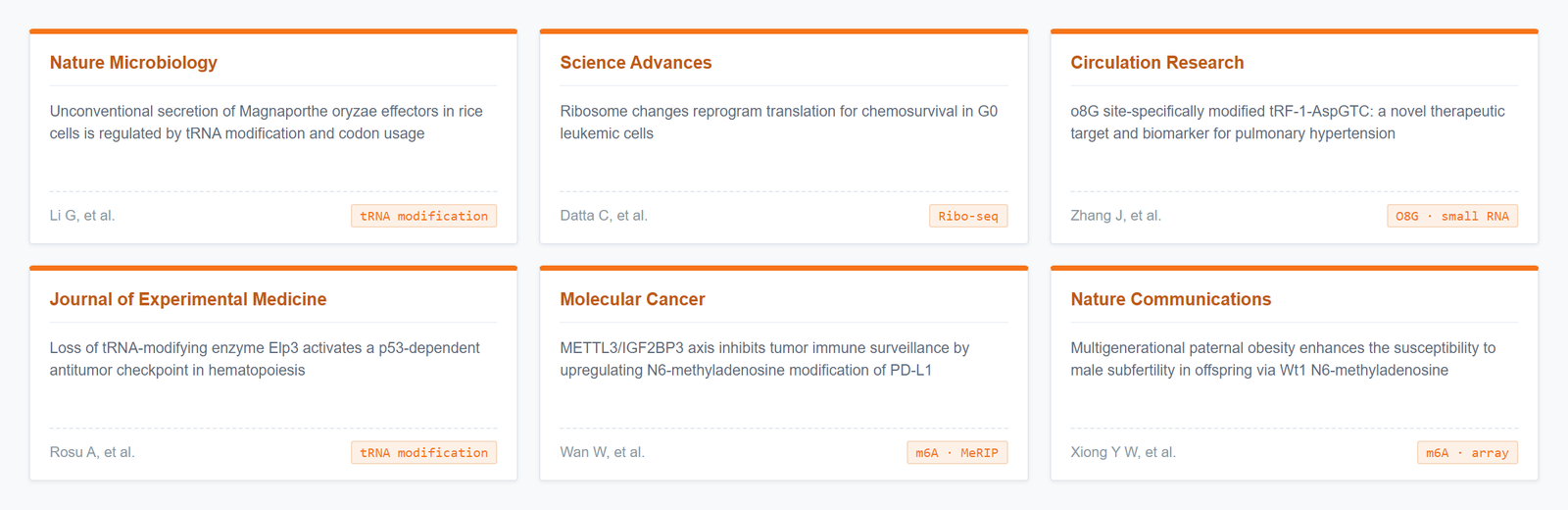
Peer-reviewed studies that used Arraystar modification profiling, listed with journal and year.
ASKFAQ
Sample types, workflow steps, how results are reported and what happens after an inquiry.