
RNA Blotting

Related Products
Related Services
Related Reviews

tRNA, tiRNA or tRF Northern Blotting Service

Arraystar tRNA, tiRNA or tRF Northern Blotting detects tRNAs, tiRNA, or tRFs in total RNA by denaturing gel electrophoresis, membrane transfer, and sequence-specific probe hybridization. A single blot reports relative abundance together with the approximate size of the detected target.

The service is designed for studies of tRNAs, tiRNA, or tRFs. Projects can compare signals across cells, tissues, treatment groups, or experimental models.

Benefits

Abundance and size in one readout: A single membrane reports the relative signal intensity and approximate size of the target RNA detected by the probe.

Target-specific probe design: Antisense probe design is matched to the requested RNA target and the expected transcript length.

Direct detection from total RNA: The requested RNA target is detected in separated total RNA without amplification, preserving a direct link between band position and the original RNA species.

tRNA, tiRNA or tRF coverage: Supports studies of tRNAs, tiRNA, or tRFs.

Loading-control normalization: A suitable loading control supports comparison of target signal across samples and experimental groups.

Orthogonal validation: The blot provides a size-resolved biochemical result that can complement qPCR, small RNA-seq, and other targeted measurements.

Service NamePrice
Arraystar tRNA, tiRNA or tRF Northern Blotting

Background

Northern blotting separates RNA by size under denaturing conditions, transfers the separated RNA to a membrane, and detects a target with a complementary probe [1,2]. Because the target is detected without amplification, band position and intensity remain connected to the requested RNA population.

Denaturation reduces secondary structure so that migration mainly reflects RNA length. After membrane immobilization, probe hybridization provides sequence specificity. Washes and signal detection then reveal target bands in the expected size range [3-6].

For tRNA-focused research, Northern blotting can provide a size-resolved view of intact tRNA, tiRNA or tRF signals across samples [6].

Key concept

A Northern blot detects a defined RNA target by sequence-specific hybridization after size separation. It reports both where the RNA migrates and how strong the signal is, making it useful for examining target identity, size, and relative abundance.
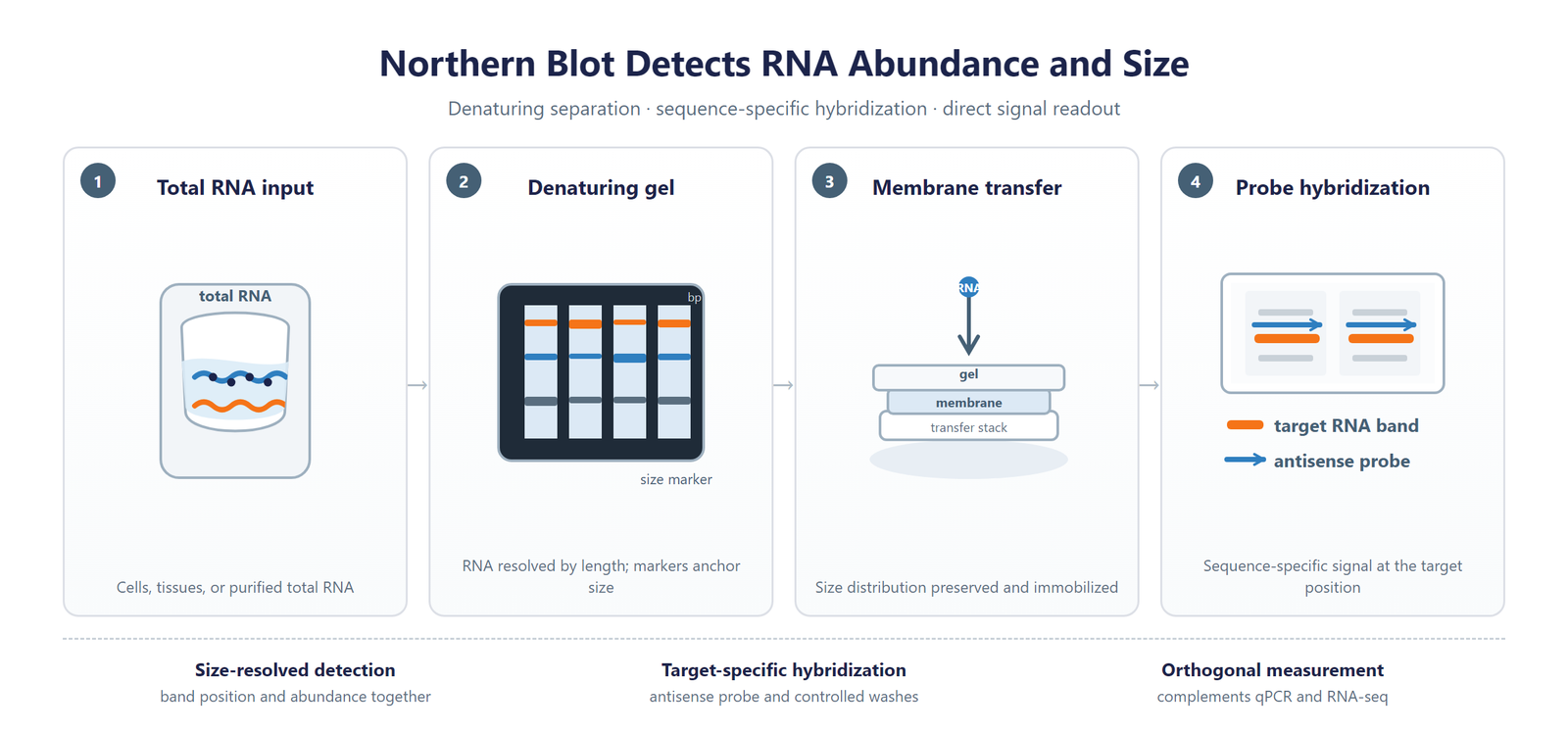
Principle of Northern blot analysis for tRNA research

Figure 1. Principle of Northern blot analysis for tRNA research. Total RNA is separated under denaturing conditions, transferred to a membrane, and detected with a target-specific antisense probe. The final blot retains both band position and relative signal information.

Workflow

The workflow connects target review and probe planning with RNA quality control, size separation, membrane transfer, hybridization, and signal analysis.
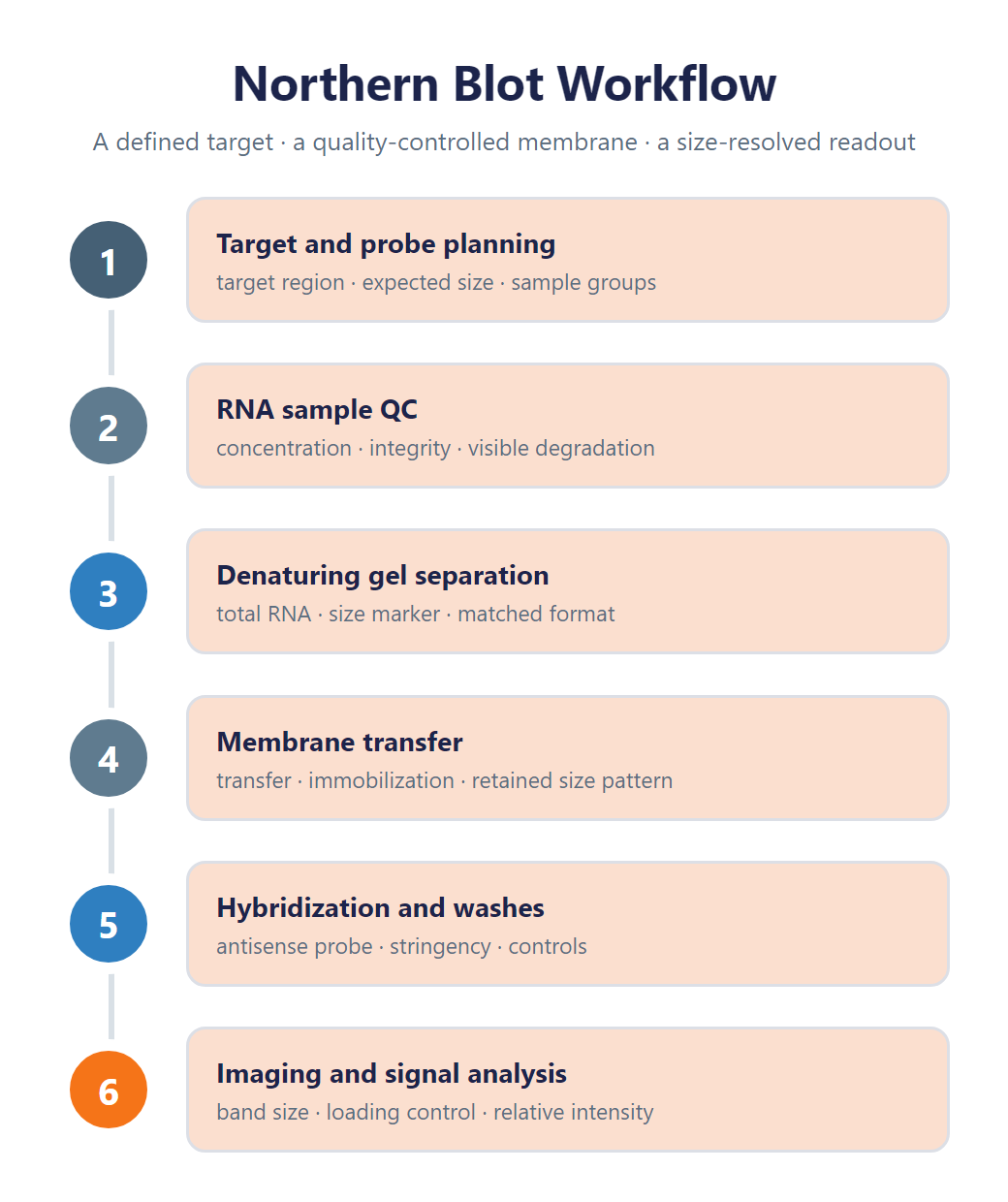
Northern blot analysis workflow for tRNA research

Figure 2. Northern blot workflow for tRNA research. The target and probe are defined first, followed by RNA QC, denaturing gel separation, membrane transfer, hybridization, and signal analysis against size markers and loading controls.

1. Target and probe planning: The requested RNA target, expected size, sample groups, and preferred detection format are reviewed before the probe and separation conditions are selected.

2. RNA sample QC: Submitted RNA is checked for concentration and integrity. Degradation and loading differences are assessed before electrophoresis.

3. Denaturing gel separation: The RNA target is separated under denaturing conditions. A size marker anchors the expected migration range of the target.

4. Membrane transfer and immobilization: Separated RNA is transferred to a membrane and immobilized so that its size distribution is retained for hybridization.

5. Hybridization and washes: A target-specific antisense probe is hybridized to the membrane. Washes remove non-specifically bound probe before signal detection.

6. Imaging and signal analysis: Target bands are imaged alongside size markers and loading controls. Signal intensities are summarized for comparison across samples.

Data Analysis & Deliverables

Northern blot data are reviewed as membrane images together with the size marker, loading control, and the target region selected for probe design. Band positions are compared with the expected target size, and relative signal intensities are summarized across samples.

Deliverables

  • RNA sample QC summary covering concentration and integrity.
  • Blot images with size-marker and loading-control information.
  • A relative band-intensity summary normalized to the selected loading control.
  • A project summary covering the workflow, observed bands, and interpretation notes.

Research Applications

Northern blot analysis supports studies of tRNAs, tiRNA, or tRFs in which target identity, molecular size, processing or relative abundance are central to the research question.

Target identity and size: Validate whether the detected tRNA, tiRNA or tRF target has the expected molecular size and signal pattern.

tRNA processing and length variation: Examine target-specific signals associated with intact tRNA, tiRNA or tRF forms and related length variants across experimental conditions.

tRNA, tiRNA or tRF analysis: Study the requested target across tRNA, tiRNA or tRF forms, supporting a size-resolved comparison across samples, treatments, genotypes, or experimental models.

Orthogonal validation: Complement small RNA-seq and qPCR with a direct, size-resolved readout for the requested RNA target.

Cross-system comparison: Compare target signals between cell lines, tissues, genotypes, or experimental models while retaining size information for each detected species.

Sample Requirements

Storage Guidelines

Total RNA: Store at -80 °C in RNase-free water or ethanol and avoid repeated freeze-thaw cycles.

Cells and Tissues: Snap freeze in liquid nitrogen or preserve in a suitable RNA stabilization solution, then store at -80 °C.

Use intact RNA with minimal degradation. A practical starting amount for routine total-RNA detection is 10 μg per sample; the final requirement depends on target abundance, probe sensitivity, blot number, and replicate design.

Shipping Instructions

Use RNase-free tubes and seal each tube securely before shipment.

Ship on dry ice with adequate insulation and include sample information for each tube.

Sample TypeNotes
Total RNAOD 260/280 ≥ 1.8, RIN ≥ 7, and no visible degradation. Submit at least 10 μg per sample as a starting amount; low-abundance targets may require more.
Cultured cellsSubmit cell pellets with sample identity and experimental group clearly recorded.
TissueProvide fresh-frozen tissue and avoid necrotic material.
Whole bloodUse EDTA tubes only; heparin is not compatible with subsequent RNA analysis.

Because the optimal RNA input depends on the target and experimental design, requirements should be confirmed before sample submission.

FAQ

What does a Northern blot measure?

A Northern blot measures both the relative abundance and approximate size of a requested tRNA, tiRNA or tRF target. RNA is separated under denaturing conditions, transferred to a membrane, and detected with a complementary probe. Band position indicates molecular size, while normalized band intensity indicates relative abundance across samples.

Why is size information useful for tRNA, tiRNA or tRF research?

Size information helps distinguish intact tRNA from tiRNA or tRF forms and from related length variants. A signal at the expected position supports interpretation of the requested target. Northern blotting therefore adds a direct molecular-size readout to expression measurements from qPCR or small RNA-seq.

How does Northern blotting complement qPCR and small RNA-seq?

qPCR is well suited to measuring the abundance of known small RNAs, while small RNA-seq profiles many targets across a sample. Northern blotting adds direct size information, helping researchers examine intact tRNA, tiRNA or tRF signals and processing-related forms. It is useful when RNA identity, size and molecular form are central to the research question.

How is target specificity achieved?

Specificity comes from hybridization between the target RNA and an antisense probe. The resulting bands are interpreted with size markers and loading controls, allowing target-related changes to be compared across samples and experimental conditions. This makes Northern blot useful for following a defined RNA in a focused study.

Can Northern blot results be compared quantitatively?

Relative comparison is possible when samples are loaded consistently and signals are normalized to a suitable loading control. Changes in band intensity can then be compared between conditions or genotypes. Absolute molecule numbers require calibrated standards and a dedicated quantitative design, so routine Northern blot results are usually reported as relative changes.

Which RNA targets can be studied?

Northern blotting supports studies of tRNAs, tiRNA, or tRFs. Individual targets can be planned around the expected size and sequence of the requested RNA. The target-specific signal can then be compared across cells, tissues, treatments, genotypes and experimental models while retaining molecular-size information for the detected species.

Why is Northern blotting particularly useful for tRNA, tiRNA or tRF research?

Northern blotting is particularly well suited to small, highly structured and heavily modified RNAs such as tRNAs, tiRNA, or tRFs. It provides direct size-resolved detection without reverse transcription or PCR amplification, allowing the requested target signal to be compared across samples and experimental conditions while complementing sequencing and targeted assays.

References

Alwine JC, Kemp DJ, Stark GR. Method for detection of specific RNAs in agarose gels by transfer to diazobenzyloxymethyl-paper and hybridization with DNA probes. Proceedings of the National Academy of Sciences, 1977;74(12):5350-5354. DOI: 10.1073/pnas.74.12.5350. PMID: 414220

Thomas PS. Hybridization of denatured RNA and small DNA fragments transferred to nitrocellulose. Proceedings of the National Academy of Sciences, 1980;77(9):5201-5205. DOI: 10.1073/pnas.77.9.5201. PMID: 6159641

Streit S, Michalski CW, Erkan M, Kleeff J, Friess H. Northern blot analysis for detection and quantification of RNA in pancreatic cancer cells and tissues. Nature Protocols, 2009;4(1):37-43. DOI: 10.1038/nprot.2008.216. PMID: 19131955

McKenney KM, Connacher RP, Dunshee EB, Goldstrohm AC. Chemi-Northern: a versatile chemiluminescent northern blot method for analysis and quantitation of RNA molecules. RNA, 2024;30(4):448-462. DOI: 10.1261/rna.079880.123. PMID: 38282416

Wery M, Foretek D, Andjus S, Verdys P, Morillon A. Northern Blotting: Protocols for Radioactive and Nonradioactive Detection of RNA. Methods in Molecular Biology, 2025;2863:13-28. DOI: 10.1007/978-1-0716-4176-7_2. PMID: 39535701

Pall GS, Hamilton AJ. Improved northern blot method for enhanced detection of small RNA. Nature Protocols, 2008;3(6):1077-1084. DOI: 10.1038/nprot.2008.67. PMID: 18536652