
Single-Base RNA Modification Sequencing

Related Products
Related Services
Related Reviews

Single-Nucleotide RNA m3C Modification Seq(m3C-IP-seq)

Single-Nucleotide RNA m3C Modification Seq(m3C-IP-Seq) is an antibody-based service. An m3C-specific antibody immunoprecipitates m3C-containing fragments, and reverse-transcription misincorporation at the modified cytidine is resolved to a single base.

Arraystar Single-Nucleotide RNA m3C Modification Seq(m3C-IP-Seq) is an end-to-end sample-to-data service for mRNA, from RNA sample QC and mRNA treatment through library construction, sequencing, and bioinformatics. Sites are annotated to the reference transcriptome with genomic coordinates, host gene, and functional region attribution.

Benefits

In mRNA, m3C can affect transcript behavior, so base-resolution mapping is informative. An antibody IP step enriches m3C-containing fragments and a reverse-transcription readout records each modified nucleotide at base resolution.

Single-base resolution: pinpoints m3C sites in mRNA.

Quantitative stoichiometry: misincorporation-based readouts give accurate modification ratios.

Antibody-based enrichment: an m3C-specific antibody concentrates m3C-bearing fragments, so low-stoichiometry mRNA sites stand out from the unmodified background.

Functional annotation: Sites are annotated to the reference transcriptome with genomic coordinates, host gene, and functional region attribution.

Application-ready: supports translation control, RNA stability, coding-region function, and gene-regulation studies across the mRNA transcriptome.

Service NameRNA ClassPrice
Single-Nucleotide RNA m3C Modification Seq(m3C-IP-Seq)mRNA
Single-Nucleotide RNA m3C Modification Seq(m3C-IP-Seq)mRNA & lncRNA

Background

In mRNA, the modification shapes transcript stability, translation, and gene regulation, so base-resolution mapping across coding and untranslated regions is what distinguishes it. An m3C-specific antibody immunoprecipitates m3C-containing fragments, and reverse-transcription misincorporation at the modified cytidine is resolved to a single base, giving sensitive single-base m3C mapping. This antibody-based read-out maps each m3C site at single-base resolution. The same workflow extends to long non-coding RNAs (lncRNAs), enabling researchers to profile this modification on lncRNA transcripts in parallel with mRNA in a single assay.

The method was validated for mRNA, sites are annotated to the reference transcriptome with genomic coordinates, host gene, and functional region attribution. (Gao Y, Hou J, Wei S, et al. Nucleic Acids Research 2025;53(5)., DOI: 10.1093/nar/gkaf153).

Key concept: Single-Nucleotide RNA m3C Modification Seq(m3C-IP-Seq) is a sequencing service in which an m3C-specific antibody immunoprecipitates m3C-containing fragments, and reverse-transcription misincorporation at the modified cytidine is called at single-base resolution.
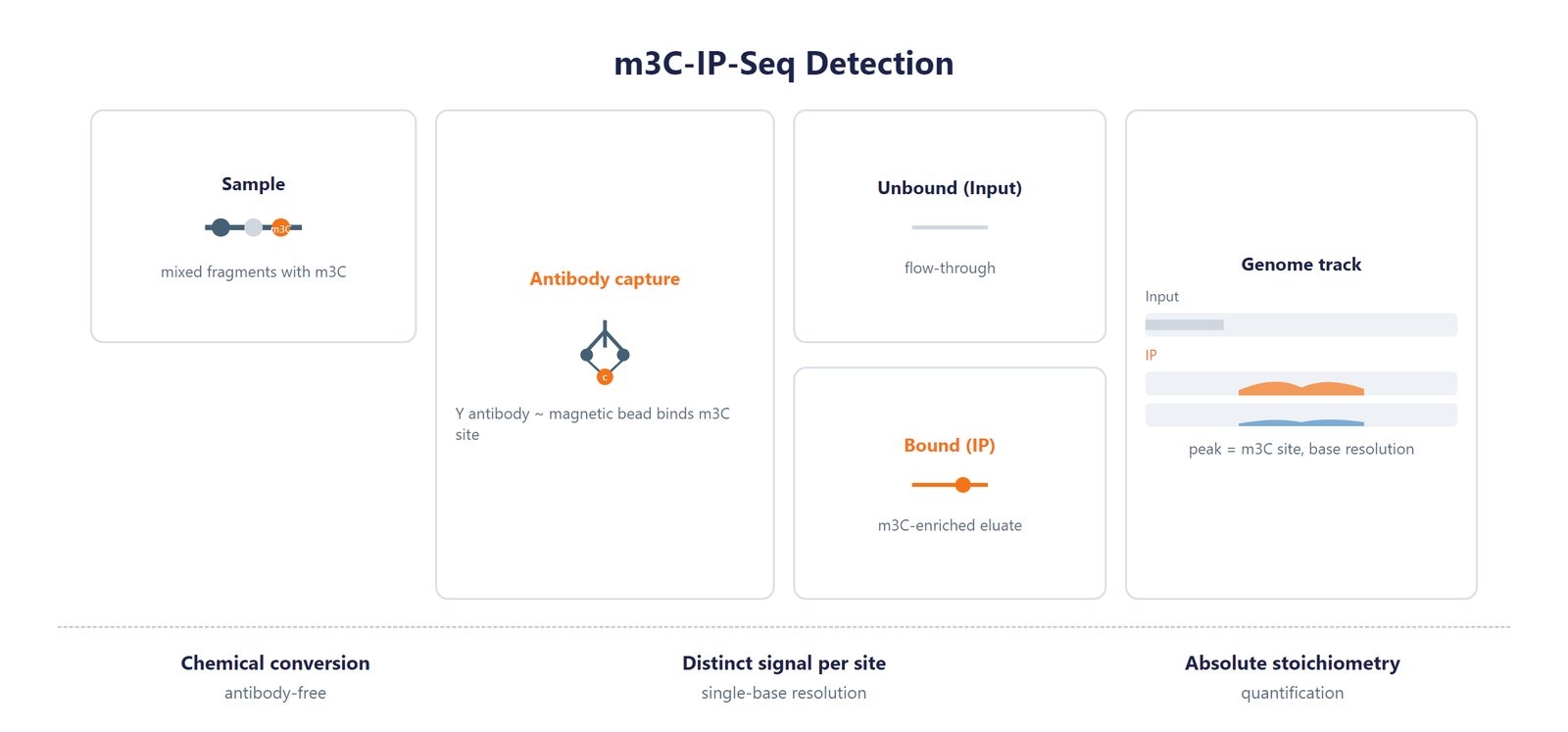
Single-Nucleotide RNA m3C Modification Seq scheme

Figure 1. m3C-IP-Seq detection scheme. An m3C-specific antibody immunoprecipitates m3C-containing fragments, and reverse-transcription misincorporation at the modified cytidine is resolved to a single base.

Workflow

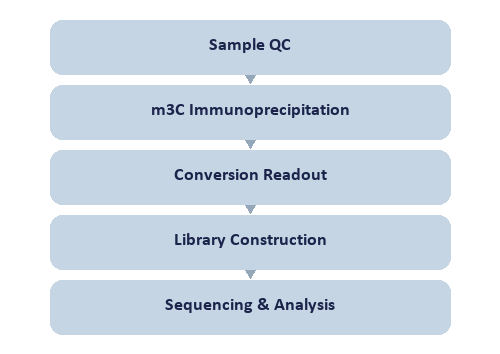
Five steps from RNA sample to single-base N3-methylcytidine (m³C) data:
Single-Nucleotide RNA m3C Modification Seq workflow

Figure 2. Single-Nucleotide RNA m3C Modification Seq workflow.

Bioinformatics

The bioinformatics pipeline aligns reads to the reference transcriptome, recognizes m3C-IP-Seq misincorporation signatures, and quantifies m3C stoichiometry at single-nucleotide resolution, with motif, differential, enrichment, and genome-browser analyses.

Deliverables

  • Raw m³C mRNA sequencing FASTQ data files, formatted for GEO/SRA public database submission.
  • Sample and sequencing QC reports with sorted BAM alignment files and core mapping statistics.
  • High-confidence single-base m³C site annotation tables (XLSX) with coordinates, genes, and stoichiometry.
  • Single-base m³C transcript feature distribution figures and consensus m³C motif logos (PDF/PNG format).
  • Single-base resolution differential m³C methylation tables (XLSX) with fold change and significance metrics.
  • Gene Ontology (GO) enrichment analysis reports for m³C-modified genes, provided in HTML/PDF/PNG formats.
  • Genome browser-compatible track files (bigWig/bedGraph) and a full structured m³C analysis project report.

Research Applications

  • Transcriptome-wide mapping of the modification across protein-coding transcripts and lncRNAs.
  • Translational control: relates base-resolution modification to mRNA translation and stability.
  • Coding-region function: localizes sites within CDS, UTR, and splice-adjacent regions.
  • Disease-oriented studies: finds differentially modified mRNA sites as biomarkers.

References

[1] Gao Y, Hou J, Wei S, et al. Transcriptome-wide mapping of N3-methylcytidine modification at single-base resolution. Nucleic Acids Research 2025;53(5). DOI: 10.1093/nar/gkaf153.

Sample Requirements

Storage Guidelines

Cells and Tissues: Preserve in TRIzol or an RNA stabilization solution; snap freeze in liquid nitrogen and store at –80 °C.

RNA: Resuspend in ethanol or RNase-free ultrapure water; store at –80 °C and avoid multiple freeze-thaw cycles.

Shipping Instructions

Place the sample in a 1.5 mL RNase-free microcentrifuge tube.

Seal the tube with parafilm or a cap lock to ensure sample integrity.

Ship the package on dry ice with adequate insulation to maintain the required temperature.

Sample TypeNotes
Whole bloodUse EDTA tubes only, as heparin is not compatible with subsequent analytical procedures.
Cultured cellsSubmission of cell pellets is preferred to ensure high-quality material for processing.
TissueProvide fresh or frozen specimens, ensuring that necrotic material is strictly avoided.
Total RNAMaintain an OD 260/280 ratio ≥ 1.8 and RIN ≥ 7 with no visible degradation. Submit at least 200 µg total RNA.

FAQ

Which mRNA features are annotated?

Sites are annotated to the reference transcriptome with genomic coordinates, host gene, and functional region attribution. This lets you interpret each site in the context of its host gene and mRNA functional region. The method supports both mRNA and tRNA workflows, so you can choose the readout that matches your study.

Can this method quantify the modification at single-base resolution?

Yes. An m3C-specific antibody immunoprecipitates m3C-containing fragments, and reverse-transcription misincorporation at the modified cytidine is resolved to a single base, giving sensitive single-base m3C mapping. This provides single-base resolution and per-site stoichiometry for each site in mRNA. An m3C-specific antibody drives the enrichment, and reverse-transcription misincorporation provides the single-base call, so the reported position and stoichiometry stay reliable for downstream functional analyses.

How does this method compare with antibody-free mRNA profiling?

Antibody-free chemical and signature assays read the modification directly, while antibody enrichment adds sensitivity for low-stoichiometry m3C sites. m3C-IP-Seq puts an m3C-specific antibody in front of the reverse-transcription read-out, so the same site is called at single-base resolution and with per-site stoichiometry. The two routes are complementary, and running m3C-IP-Seq alongside a cleavage-based m3C assay gives orthogonal confirmation for sites that are being reported for the first time.

How does this service support research on m3C modification?

By profiling m3C with high accuracy, the service helps researchers explore its biological significance, offering insight for studying RNA function and regulation.

Why is accurate m3C detection a valuable research asset?

Reliable m3C profiling strengthens research findings and supports advancement of understanding in RNA biology.

Does this service also profile lncRNA?

Yes. We provide two service options: mRNA modification, and mRNA plus long non-coding RNA (lncRNA) modification. Both transcript types can be analyzed together in a single experiment, so there is no need to split them into two projects, and the scope of your study opens up accordingly.