
Single-Base tRNA Modification Sequencing

Related Products
Related Services
Related Reviews

Single-Nucleotide tRNA 2′-O-Me Modification Seq(Ribometh-seq)

Single-Nucleotide tRNA 2′-O-Methylation Modification Seq(RiboMeth-Seq) is a service that reports where tRNA carries 2′-O-methylation (Nm) and how much of each position is modified. Samples are fragmented under alkaline conditions: riboses without the methyl group are cut, methylated ones survive, and the reads that stop at each nucleotide give that site its methylation score.

Arraystar runs the project end to end — RNA quality control, fragmentation, library construction, sequencing and bioinformatics — and returns site tables, distribution figures and differential modification tables.

Benefits

In tRNA, Nm stiffens the ribose at a few conserved positions, so a per-site map is informative.

Single-base resolution: pinpoints each Nm position on the mature tRNA.

Quantitative measurement: the fraction of fragments reporting protection gives the site level, so a partially modified position keeps its intermediate value.

No antibody dependence: the call follows the fragmentation chemistry, so no antibody capture step shapes the site list.

Functional annotation: sites are localized within mature tRNA transcripts with relative coordinates, tRNA gene attribution, anticodon and isotype, and structural-domain localization.

Application-ready: supports decoding fidelity, codon use, aminoacylation, and tRNA structural biology across tRNA isotypes.

One-stop service: sample QC, fragmentation, library construction, sequencing and analysis inside one project, with professional bioinformatics support.

Service NamePrice
Single-Nucleotide tRNA 2′-O-Methylation Modification Seq(RiboMeth-Seq)

Background

On tRNA, Nm occupies very few positions. One sits in the D loop, where it locks the two arms of the L-shaped fold together; two more flank the wobble position of the anticodon loop and limit how far that loop can move. None of them changes base pairing — what they change is the stiffness of the backbone, which is why their exact position matters for decoding.

Measuring them is awkward. tRNA is short and tightly folded, and the modifications crowd into the same few nucleotides. Alkaline fragmentation sidesteps base chemistry altogether: it does not care which base was altered, only how the sugar behaves when the chain is cut.

Key concept: Single-Nucleotide tRNA 2′-O-Methylation Modification Seq(RiboMeth-Seq) is a chemical sequencing service: alkaline treatment fragments RNA at random, methylated riboses survive that step, and the fraction of fragments stopping at each position is converted into a 0-1 methylation score at single-base resolution.
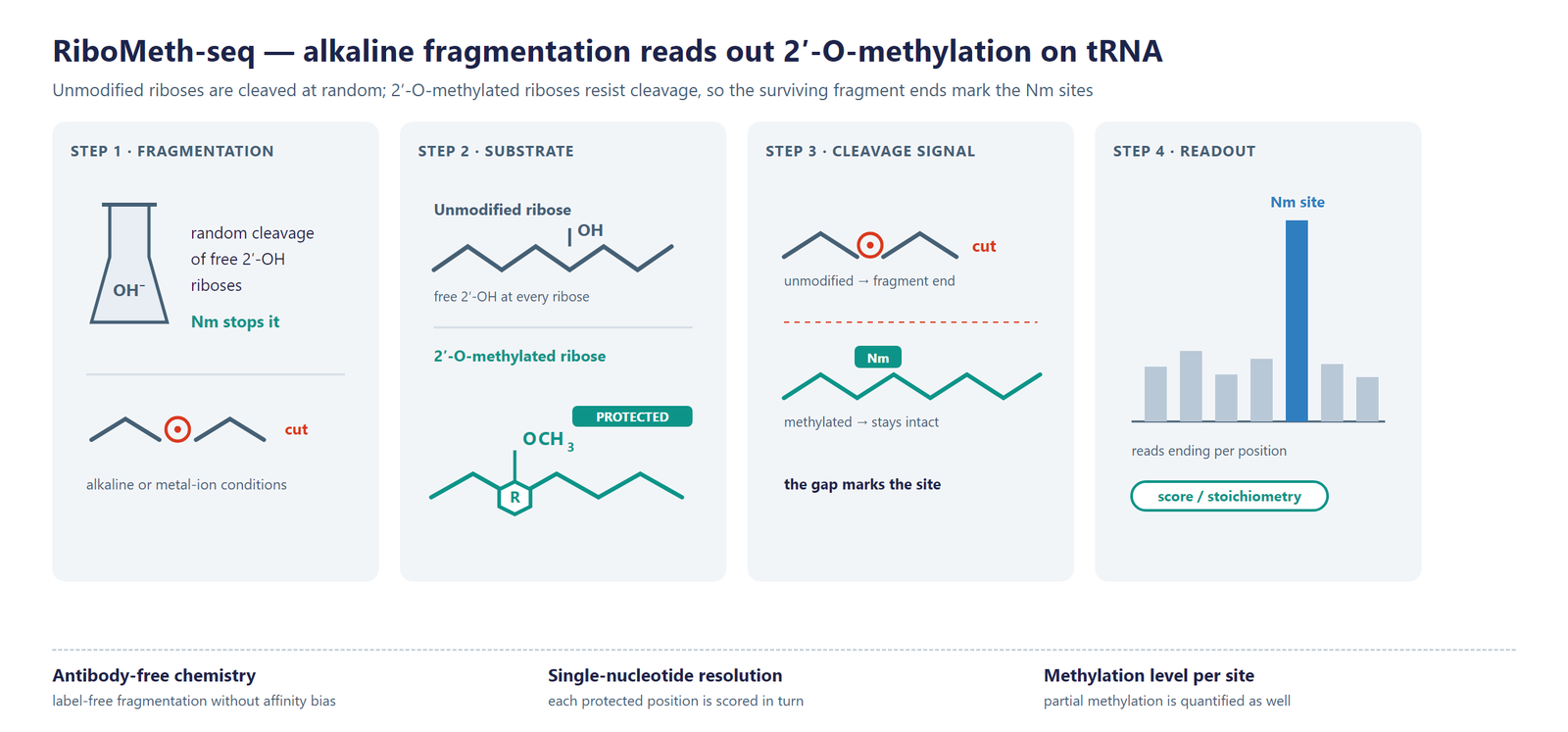
Single-Nucleotide tRNA 2'-O-Me Modification Seq(RiboMeth-Seq) scheme

Figure 1. Single-Nucleotide tRNA 2′-O-Me Modification Seq(RiboMeth-Seq) scheme.

Workflow

Five steps from tRNA sample to single-base 2′-O-methylation data:

Sample QC: confirm RNA integrity, purity and input.

Random fragmentation: alkaline treatment cuts at unmodified riboses.

Library construction: ligate adapters onto the surviving fragments.

Sequencing: Illumina reads at the depth the project needs.

Bioinformatics: score each position and assemble the site table.
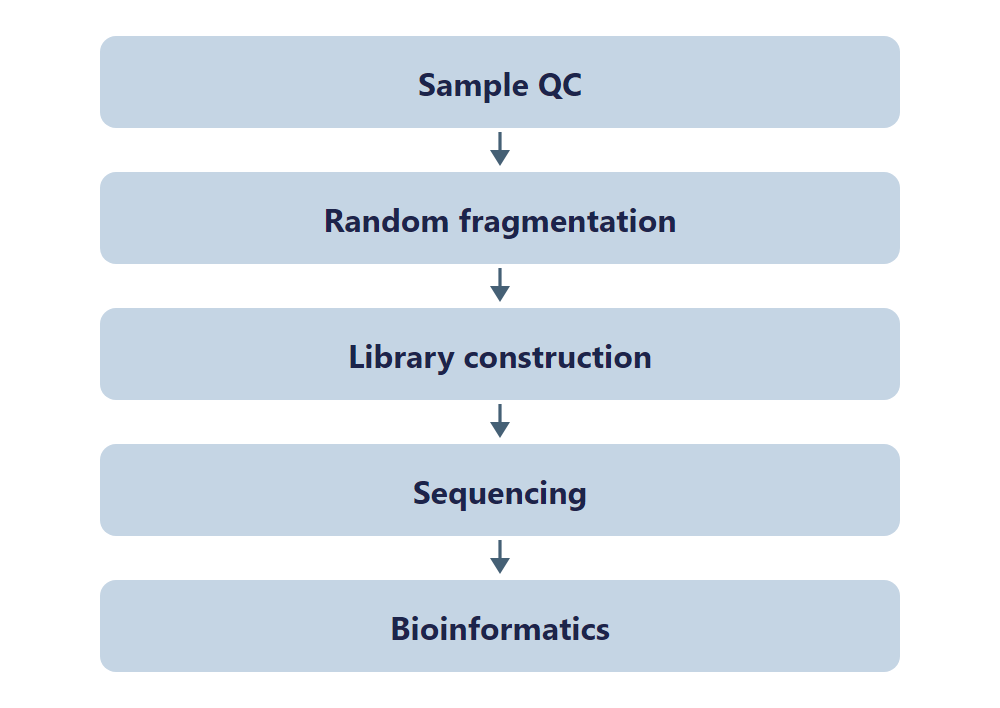
Single-Nucleotide tRNA 2'-O-Me Modification Seq(RiboMeth-Seq) workflow

Figure 2. Single-Nucleotide tRNA 2′-O-Me Modification Seq(RiboMeth-Seq) workflow.

Bioinformatics

Reads are aligned to a curated tRNA reference, then the fraction of fragments surviving at each position is converted into a methylation score and summarised by canonical tRNA number, anticodon, isoacceptor and structural domain. Between-group comparisons are reported in the differential table.

Deliverables

  • Sequencing reads (FASTQ) prepared in GEO/SRA submission format.
  • Quality report with BAM files and alignment statistics.
  • Site table (XLSX) listing one row per position, with canonical tRNA number and methylation score.
  • Distribution and motif figures (PDF/PNG).
  • Differential modification table (XLSX) with fold change and significance.
  • Gene Ontology (GO) enrichment report for genes linked to differential sites.
  • bigWig/bedGraph signal tracks and a closing project report.
  • Documentation of the fragmentation, library and analysis parameters used.

Research Applications

  • Enzyme validation: compare site scores between wild-type and methyltransferase knockdown or knockout models.
  • Condition comparison: sample a cell line across treatments or stress conditions and locate positions that shift.
  • Isodecoder screening: compare methylation scores across isodecoders to narrow down a target tRNA.
  • Disease cohorts: run case-control groups and screen for differential positions.
  • Cross-omics linking: read Nm changes alongside tRNA expression and tRF&tiRNA profiles.
  • Method comparison: place RiboMeth-seq beside other single-base tRNA assays on the same sample set.

References

[1] Birkedal U, et al. Profiling of ribose methylations in RNA by high-throughput sequencing. Angewandte Chemie International Edition 2015; DOI: 10.1002/anie.201408362. PMID: 25417815.

[2] Marchand V, et al. Illumina-based RiboMethSeq approach for mapping of 2′-O-Me residues in RNA. Nucleic Acids Research 2016; DOI: 10.1093/nar/gkw547. PMID: 27302133.

[3] Krogh N, Nielsen H. Sequencing-based methods for detection and quantitation of ribose methylations in RNA. Methods 2019; DOI: 10.1016/j.ymeth.2018.11.017. PMID: 30503826.

Sample Requirements

Storage Guidelines

Cells and Tissues: Preserve in TRIzol or an RNA stabilization solution; snap freeze in liquid nitrogen and store at -80 °C.

RNA: Resuspend in ethanol or RNase-free ultrapure water; store at -80 °C and avoid multiple freeze-thaw cycles.

Shipping Instructions

Place the sample in a 1.5 mL RNase-free microcentrifuge tube.

Seal the tube with parafilm or a cap lock to ensure sample integrity.

Ship the package on dry ice with adequate insulation to maintain the required temperature.

Sample TypeNotes
Whole bloodUse EDTA tubes only, as heparin is not compatible with subsequent analytical procedures.
Cultured cellsSubmission of cell pellets is preferred to ensure high-quality material for processing.
TissueProvide fresh or frozen specimens, ensuring that necrotic material is strictly avoided.
Total RNAMaintain an OD 260/280 ratio ≥ 1.8 and RIN ≥ 7 with no visible degradation. Submit at least 10 µg total RNA.

FAQ

What exactly does this service measure?

It reports 2′-O-methylation on tRNA: which positions carry the group and how much of each position is modified. Every site is listed with its canonical tRNA number, anticodon, isoacceptor and structural domain, so scores from different samples can be compared without re-annotating the tRNA reference each time.

Why use a chemical fragmentation route instead of a base-modification assay?

Nm sits on the ribose, so assays that read base chemistry produce no signal for it. Alkaline fragmentation reads how the sugar behaves instead, which is why the route resolves a ribose modification that base-conversion and mutation-signature methods are not able to report at all.

How is resolution achieved without an antibody?

No enrichment step is needed. Cleavage happens at unmodified riboses and stops where a methyl group blocks it, so fragment ends sit at every unmodified ribose and an Nm position appears as a local gap in that profile. The depth of the gap reports the level, and the antibody-free format also removes a common source of batch-to-batch variation when several projects are compared.

Are partially modified positions reported?

Yes. The score is a fraction rather than a yes or no call, so a position methylated in only part of the tRNA population is reported with an intermediate value. Low-occupancy positions stay visible instead of being filtered out of the final site table.

Can several groups be analyzed in one project?

Yes. All groups are aligned to the same curated tRNA reference and analyzed in one coordinate framework, and the differential table reports between-group results directly. Group design is best fixed at project set-up, so that every group is processed and compared under the same conditions.