
Translation & Ribosome Profiling

Related Products
Related Services
Related Reviews

Ribosome Profiling Service (Ribo-seq)

Arraystar Ribosome Profiling Service (Ribo-seq) accepts customer-prepared ribosome-protected RNA and carries it through library construction, sequencing and data analysis.

The resulting data provide a genome-scale map of ribosome positions and relative translation across samples. Matched RNA-seq can be added to estimate relative translation efficiency.

Benefits

Codon-scale footprint mapping: Ribosome-protected mRNA fragments are sequenced to reveal where ribosomes are positioned across translated transcripts.

Translatome-wide measurement: Gene-level ribosome occupancy provides a view of active translation beyond what steady-state RNA abundance alone can show.

Relative translation efficiency: With matched RNA-seq, footprint signal can be compared with transcript abundance to estimate changes in relative translation efficiency.

ORF and codon analysis: Footprint periodicity supports coding-region annotation, upstream ORF assessment and codon-level ribosome occupancy analysis.

Quality-controlled libraries: Footprint length, triplet periodicity, rRNA content, mapping distribution and replicate agreement are reviewed before biological comparison.

Sample-to-data support: Project planning, library preparation, sequencing, bioinformatics and result interpretation are coordinated through one workflow.

Service NamePrice
Ribosome Profiling Service (Ribo-seq)

Background

Ribo-seq captures the mRNA regions occupied by ribosomes at the moment of sample processing [1-3]. Controlled nuclease digestion removes unprotected RNA, and the remaining ribosome-protected fragments are converted into sequencing libraries.

Footprint density reflects ribosome occupancy rather than RNA abundance alone. With matched RNA-seq, footprint reads can be normalized to transcript reads to obtain a relative measure of translation efficiency.

A useful footprint library has a characteristic length distribution and a strong three-nucleotide periodicity after P-site assignment [2,4]. These features support codon-level analysis of ribosome pausing and provide a direct way to connect tRNA perturbations with translation outcomes [7,8].

Key concept

Ribo-seq measures ribosome-protected mRNA fragments. It shows where translation is occurring and how ribosome occupancy changes; it does not measure protein abundance or tRNA modification directly.
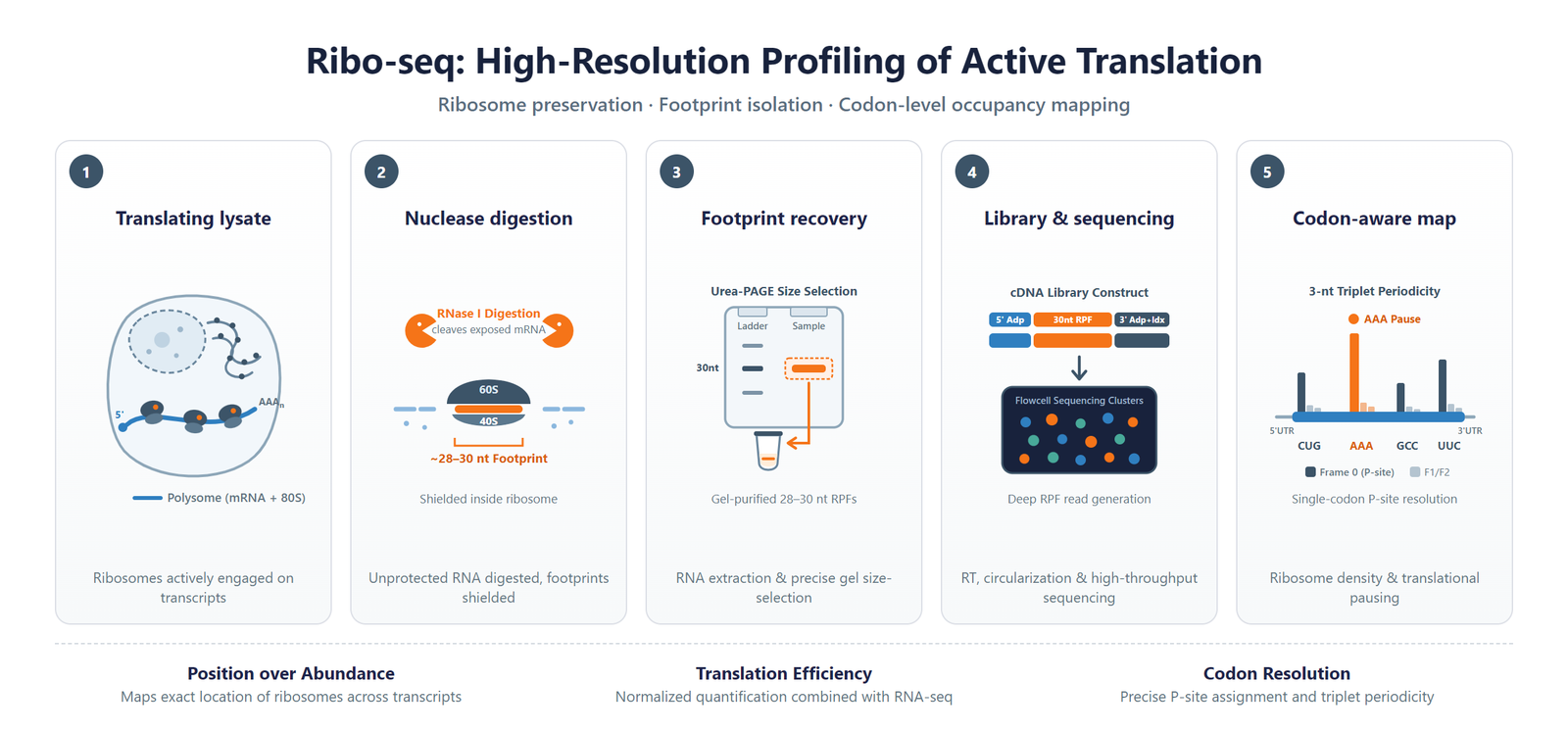
Principle of Ribo-seq ribosome footprint mapping

Figure 1. Principle of Ribo-seq. Ribosome-mRNA complexes are preserved, unprotected RNA is digested, ribosome-protected fragments are isolated and sequenced, and P-site assignment converts footprints into ribosome-position and codon-level information.

Workflow

Customer Ribo-seq RNA preparation is completed using the linked protocol before Arraystar performs library construction, sequencing and analysis.
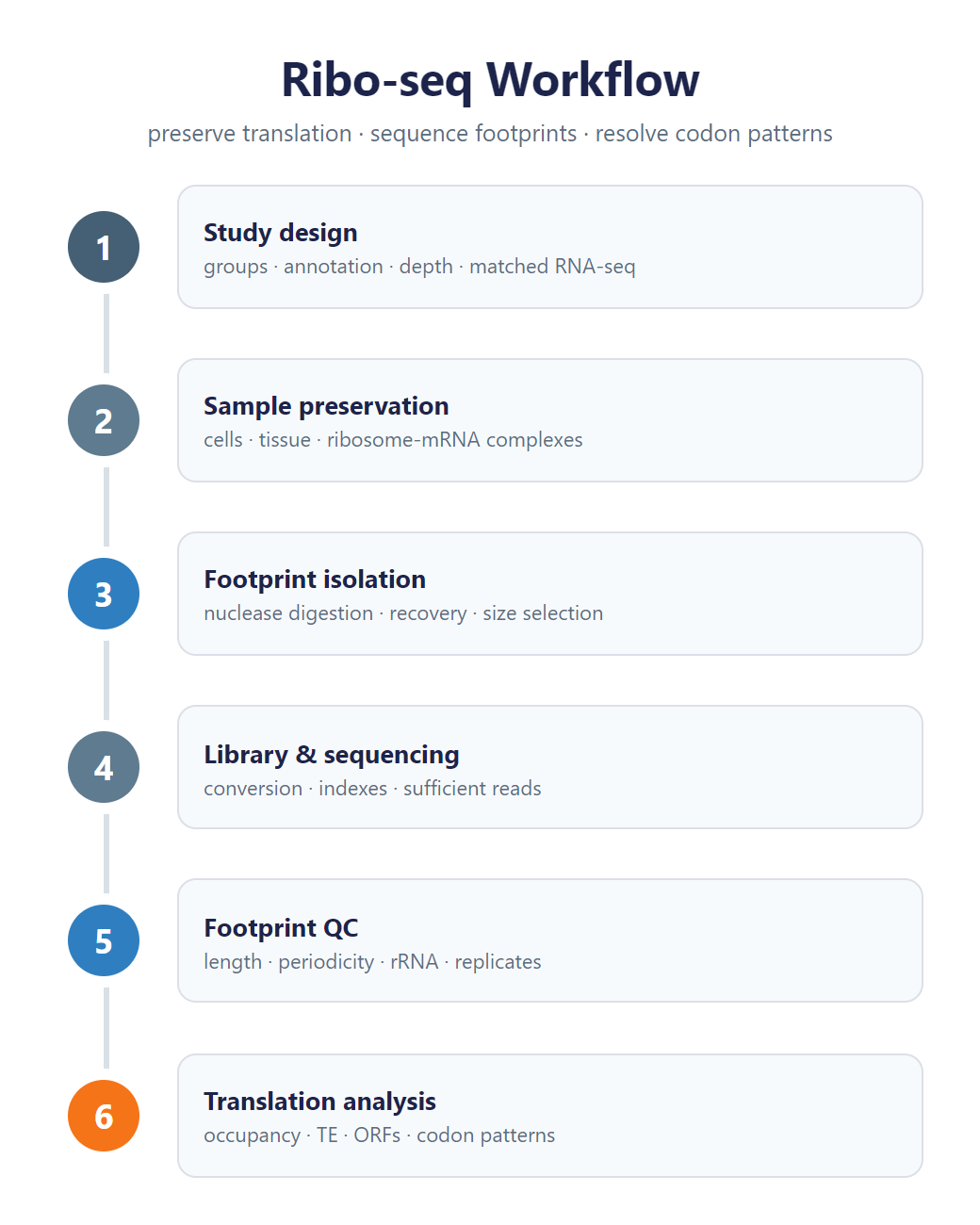
Ribo-seq sample-to-data workflow

Figure 2. Ribo-seq workflow. Customer-prepared ribosome-protected RNA enters library construction and sequencing, followed by footprint QC and translation analysis.

1. Study design and sample planning: The biological question, sample groups, annotation, sequencing depth and need for matched RNA-seq are defined before sample preparation.

2. Customer Ribo-seq RNA preparation: The customer prepares ribosome-protected RNA from 20 million cells using the linked protocol, including lysis, RNase I digestion, monosome isolation and RNA recovery.

3. Prepared RNA receipt: The recovered RNA is submitted to Arraystar in RNase-free water. No fixed concentration, volume or RIN threshold is required.

4. Library construction and sequencing: Ribosome-protected fragments are converted into an indexed sequencing library and run with appropriate controls.

5. Footprint and library QC: Footprint length, P-site periodicity, rRNA contamination, mapping distribution and replicate correlation are evaluated.

6. Quantification and interpretation: Ribosome occupancy, differential translation and optional translation-efficiency or codon-level analyses are summarized in the report.

Bioinformatics & Deliverables

Analysis starts with footprint read QC and alignment, followed by gene-level quantification, replicate assessment and differential ribosome occupancy. Matched RNA-seq enables a relative translation-efficiency comparison.

Standard analysis

  • Read QC, adapter handling, rRNA assessment and genome or transcript alignment.
  • Footprint length distribution, P-site assignment and three-nucleotide periodicity.
  • Gene-level ribosome-footprint counts, sample correlation and PCA.
  • Differential ribosome occupancy and gene feature summaries.
  • Codon occupancy and codon-level ribosome-density profiles when supported by library quality.
  • Gene Ontology enrichment of selected translated gene sets.

Deliverables

  • Raw sequencing data and processed footprint count tables.
  • Library and alignment QC reports, including footprint periodicity.
  • Differential ribosome occupancy results and annotated summaries.
  • Codons, ORFs, translation efficiency and analysis figures as scoped for the project.
  • A methods and results report organized for downstream review.

Research Applications

Ribo-seq is useful when changes in mRNA translation, rather than transcript level alone, are central to the biological question.

Translational control: Compare ribosome occupancy between treatments, genotypes or disease models when transcript levels alone do not explain the phenotype.

Codons and tRNA biology: Examine codon-associated ribosome density after changes in tRNA abundance, charging or modification, using matched tRNA data to support mechanism.

Upstream and alternative ORFs: Evaluate footprint-supported translated regions and candidate noncanonical ORFs alongside transcript annotation and initiation context.

Stress and drug response: Map rapid changes in active translation after environmental stress, pathway perturbation or compound treatment.

Target-mRNA prioritization: Use gene-level ribosome changes and codon profiles to prioritize transcripts for qPCR, Western blot or reporter validation.

Multi-omic interpretation: Integrate Ribo-seq with RNA-seq, proteomics, tRNA-seq or tRNA charging data to separate transcript, translation and protein-level effects.

Sample Requirements

Customer-prepared Ribo-seq RNA

Arraystar accepts the Ribo-seq RNA recovered by the customer. Begin with 20 million cells and follow the protocol for lysis, RNase I digestion, monosome isolation and RNA recovery.

Sample Requirement: Customer-prepared Ribo-seq RNA from 20 million cells, prepared with the protocol below.

PDFRibo-seq RNA Sample Preparation Protocol (PDF)

Storage & shipping

Store the recovered RNA at -80 °C and ship it on dry ice with the project form.

FAQ

What does Ribo-seq measure?

Ribo-seq sequences mRNA fragments protected by translating ribosomes. The footprints report ribosome positions and relative ribosome occupancy across transcripts, providing a transcriptome-wide view of active translation. It does not directly measure protein abundance, so results are interpreted alongside RNA-seq, proteomics or targeted validation when those questions are central.

Why combine Ribo-seq with RNA-seq?

Matched RNA-seq measures transcript levels in the same samples. Dividing ribosome-footprint signal by transcript abundance provides a relative translation-efficiency estimate, helping separate changed mRNA abundance from changed translation. The comparison depends on consistent library preparation, adequate sequencing depth, matched annotations and suitable biological replicates.

What can codon-level analysis show?

Ribosome footprints show position and density across coding sequences. After P-site assignment and three-nucleotide periodicity checks, codon occupancy can identify positions with increased ribosome density or pausing. These patterns support hypotheses about decoding and tRNA-related regulation, but they should be interpreted with matched tRNA or charging data when testing a specific amino acid.

How does Ribo-seq support tRNA research?

Ribo-seq reports how changes in tRNA abundance, charging or modification may alter ribosome distribution on mRNAs. Codon occupancy and gene-level ribosome changes can identify candidate transcripts linked to the affected tRNA. Because Ribo-seq does not measure tRNA itself, tRNA-seq, charging measurements or modification mapping provide the complementary direct evidence.

Which translated ORFs can be examined?

Ribo-seq can support annotation of translated regions such as main coding sequences and upstream or alternative ORFs when footprint coverage and periodicity support them. Evidence is annotation- and depth-dependent. Candidate ORFs should be interpreted with transcript models, initiation signals and independent validation rather than treated as automatic annotations.

How are Ribo-seq libraries quality controlled?

A useful library shows a clear footprint length distribution, three-nucleotide periodicity, strong mapping to annotated coding regions and limited rRNA contamination. Replicate correlation, read distribution and P-site assignment are reviewed before biological comparisons. Samples that fail these checks are flagged before differential analysis.

Which sample format should be submitted?

Arraystar accepts customer-prepared Ribo-seq RNA generated from 20 million cells with the linked protocol. The recovered RNA should be stored at -80 °C and shipped on dry ice. No fixed RNA concentration, volume or RIN requirement applies; preparation and handling follow the protocol before library construction.

References

Ingolia NT, Ghaemmaghami S, Newman JR, Weissman JS. Genome-wide analysis in vivo of translation with nucleotide resolution using ribosome profiling. Science, 2009;324(5924):218-223. DOI: 10.1126/science.1168978. PMID: 19213877

McGlincy NJ, Ingolia NT. Transcriptome-wide measurement of translation by ribosome profiling. Methods, 2017;126:112-129. DOI: 10.1016/j.ymeth.2017.05.028. PMID: 28579404

Brar GA, Weissman JS. Ribosome profiling reveals the what, when, where and how of protein synthesis. Nature Reviews Molecular Cell Biology, 2015;16(11):651-664. DOI: 10.1038/nrm4069. PMID: 26465719

Calviello L, Mukherjee N, Wyler E, et al. Detecting actively translated open reading frames in ribosome profiling data. Nature Methods, 2016;13(2):165-170. DOI: 10.1038/nmeth.3688. PMID: 26657557

Meindl A, Romberger M, Lehmann G, et al. A rapid protocol for ribosome profiling of low input samples. Nucleic Acids Research, 2023;51(13):e68. DOI: 10.1093/nar/gkad459. PMID: 37246712

Koubek J, Jetzinger K, Dror S, et al. A simple, fast, and cost-efficient protocol for ultra-sensitive ribosome profiling. Nucleic Acids Research, 2025;53(17):gkaf902. DOI: 10.1093/nar/gkaf902. PMID: 40966508

Nedialkova DD, Leidel SA. Optimization of codon translation rates via tRNA modifications maintains proteome integrity. Cell, 2015;161(7):1606-1618. DOI: 10.1016/j.cell.2015.05.022. PMID: 26052047

Behrens A, Rodschinka G, Nedialkova DD. High-resolution quantitative profiling of tRNA abundance and modification status in eukaryotes by mim-tRNAseq. Molecular Cell, 2021;81(8):1802-1815.e7. DOI: 10.1016/j.molcel.2021.01.028. PMID: 33581077