
On October 7, a team at Fred Hutchinson Cancer Center published a study in Nature showing that tRNA₁Arg(UCU) can act like a molecular switch that influences prostate cancer cell fate. When its abundance decreases, cells can acquire treatment resistance; restoring its levels can make tumors sensitive to therapy again. The study provides evidence that an individual tRNA species can actively reshape cancer cell identity.
Prostate Cancer Lineage Plasticity and the Potential Role of tRNA
The development and progression of prostate cancer depend heavily on androgen signaling, making androgen-deprivation therapy (ADT) a mainstay of treatment. However, tumor cells can escape therapeutic pressure through lineage plasticity: they become less dependent on androgen signaling and acquire neuroendocrine features, which can lead to treatment resistance. Although genetic mechanisms of resistance have been extensively studied, the contribution of translational regulation to this process has remained unclear.
Transfer RNAs (tRNAs) deliver amino acids to the ribosome during protein synthesis by recognizing codons in messenger RNA (mRNA). Hundreds of tRNA species exist in humans, and they have traditionally been viewed primarily as core components of translation. However, corresponding author Andrew C. Hsieh notes that tRNAs may do more than support protein synthesis: they can act as important regulators that actively shape cancer cell identity.
Selective Loss of tRNA₁Arg(UCU) During Treatment-Resistant Lineage Transition
tRNA sequencing (tRNA-seq) showed that, among dozens of tRNA species, tRNA₁Arg(UCU) was the only one whose abundance decreased significantly during prostate cancer lineage transition. This finding was validated in cell models, xenograft models, and tissue samples from 56 patients. Androgen-dependent tumors maintained relatively high levels of tRNA₁Arg(UCU), whereas its expression was nearly absent in treatment-resistant tumors that had undergone lineage transition.
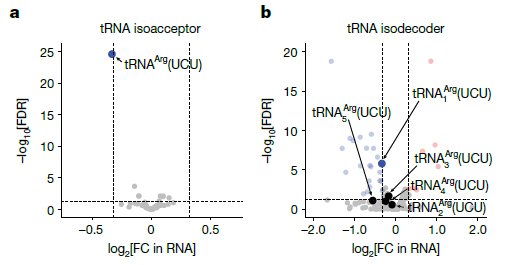
Figure 1. Volcano plots from tRNA sequencing show changes in the abundance of tRNA isoacceptors (a) and synonymous codon-decoding tRNAs (b) in LNCaP lineage-plasticity (LP) cells compared with prostate adenocarcinoma (AD) cells.
Bidirectional Regulation of Cell Phenotype and Drug Sensitivity by tRNA₁Arg(UCU)
Functional experiments showed that tRNA₁Arg(UCU) levels can have a decisive effect on cell phenotype. Reducing its abundance by 25–50% was sufficient to trigger a phenotypic transition: androgen signaling was shut down, neuroendocrine features were activated, and cells became resistant to three commonly used clinical drugs, including enzalutamide. In an animal model, loss of one allele led to severe precancerous lesions in 25% of mice after castration, whereas no such lesions were observed in the control group.
Conversely, restoring tRNA₁Arg(UCU) expression in resistant cells restored drug sensitivity, including in cell lines that were intrinsically resistant. Structural analyses showed that other synonymous-decoding tRNA species with only three nucleotide-pair differences did not have the same regulatory effect.
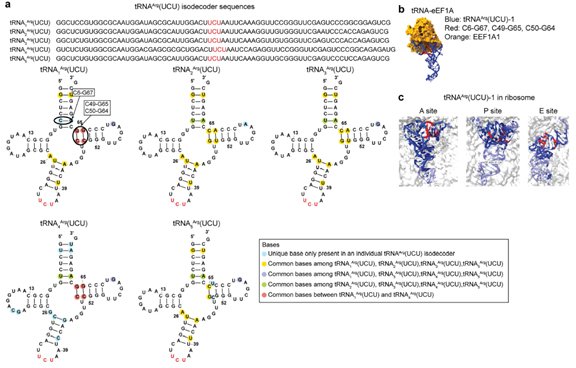
Figure 2. tRNA₁Arg(UCU) contains distinctive base pairs that are absent from other tRNAArg(UCU) synonymous-decoding isoacceptors. (a) Sequences of tRNAArg(UCU) isoacceptors are shown above, with the UCU anticodon highlighted in red. The structures below indicate unique and shared nucleotides; circles mark base pairs present in tRNA₁Arg(UCU) but absent from isoacceptors 2, 3, and 5. (b) Cryo-electron microscopy images show direct interactions involving the three base pairs that distinguish tRNA₁Arg(UCU) from isoacceptors 2, 3, and 5 in the eEF1A–tRNA complex. In the A site, C6–G67, C49–G65, and C50–G64 are highlighted in red (PDB: 8G60). (c) Cryo-EM images show these three base pairs in the ribosomal A site (left; PDB: 6Y0G), P site (middle; PDB: 8G60), and E site (right; PDB: 6QZP).
Molecular Mechanism: Translation Efficiency and Chromatin Remodeling
Mechanistic analyses revealed that the transcriptional regulators TARDBP and ZSCAN29 jointly maintain transcription of tRNA₁Arg(UCU). Loss of tRNA₁Arg(UCU) substantially reduces the efficiency of translation at AGA codons, leading to depletion of SMARCC2, a core subunit of the SWI/SNF chromatin-remodeling complex. This modest change in translational capacity is amplified through a downstream cascade, ultimately reprogramming cell fate.
Clinical Relevance and Potential Prognostic Value
Analysis of clinical samples from 35 patients with prostate cancer showed a significant inverse association between tRNA₁Arg(UCU) abundance and disease progression: lower levels were associated with earlier bone metastasis and shorter survival. Animal experiments further showed that reducing tRNA₁Arg(UCU) increased the tumor metastasis rate fourfold. These findings suggest that tRNA₁Arg(UCU) may have potential as a biomarker for treatment resistance and poor prognosis in prostate cancer.
Future Directions and Therapeutic Strategies
Previous studies in genetic disease models have demonstrated the feasibility of delivering tRNAs using viral vectors or lipid nanoparticles. In the future, delivery systems designed to restore the expression of tumor-suppressive tRNAs in cancer cells may offer a new therapeutic strategy. First author Yeon Soo Kim noted that although prostate cancer was used as the model in this study, the findings may have broader relevance. Further investigation is warranted in other malignancies characterized by lineage plasticity, including lung and breast cancers.
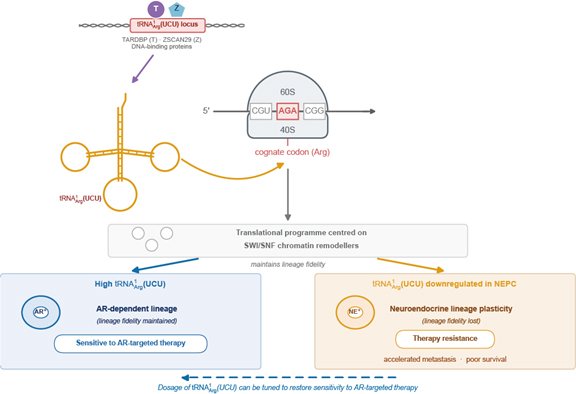
Figure 3. tRNA₁Arg(UCU) regulates lineage dependence and treatment resistance in prostate cancer. TARDBP and ZSCAN29 bind the TRR-TCT1-1 locus to maintain RNA polymerase III-mediated transcription of tRNA₁Arg(UCU); both factors are reduced in LP cells. The abundance of tRNA₁Arg(UCU) supports optimal translation of SMARCC2 at AGA codons, maintaining androgen receptor (AR) lineage fidelity through the SWI/SNF complex. Loss of this tRNA causes ribosome stalling at AGA codons, SMARCC2 protein depletion, and neuroendocrine reprogramming. Restoring tRNA₁Arg(UCU) levels through adeno-associated virus (AAV) or lipid nanoparticle delivery may resensitize tumors to androgen receptor pathway inhibitors.
Original Article
DOI: 10.1038/s41586-026-11153-8