
Arg-tRNA synthetase links inflammatory metabolism to RNA splicing and nuclear trafficking via SRRM2
Nat Cell Biol. 2023 Apr;25(4):592-603. [PMID: 37237245]
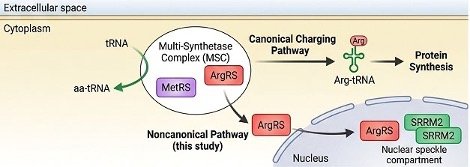
Cells respond to perturbations such as inflammation by sensing changes in metabolite levels. Especially prominent is arginine, which has known connections to the inflammatory response. Aminoacyl-tRNA synthetases, enzymes that catalyse the first step of protein synthesis, can also mediate cell signalling. Here we show that depletion of arginine during inflammation decreased levels of nuclear-localized arginyl-tRNA synthetase (ArgRS). Surprisingly, we found that nuclear ArgRS interacts and co-localizes with serine/arginine repetitive matrix protein 2 (SRRM2), a spliceosomal and nuclear speckle protein, and that decreased levels of nuclear ArgRS correlated with changes in condensate-like nuclear trafficking of SRRM2 and splice-site usage in certain genes. These splice-site usage changes cumulated in the synthesis of different protein isoforms that altered cellular metabolism and peptide presentation to immune cells. Our findings uncover a mechanism whereby an aminoacyl-tRNA synthetase cognate to a key amino acid that is metabolically controlled during inflammation modulates the splicing machinery.
Prolyl-tRNA synthetase inhibitor as a novel first-in-class keloid treatment: downregulation of de novo collagen synthesis and inflammatory cascade
Br J Dermatol. 2025 Jul 17;193(2):298-309. [PMID: 40233147]
Background: Keloids are severe dermal fibrotic disorders caused by excessive deposition of collagen. Current therapies have high recurrence rates, and there is a clinical need for a new, fundamental approach. We focused on inhibiting proline, an essential amino acid for collagen biosynthesis. We developed DWN12088, a drug that downregulates prolyl-tRNA synthetase (PRS), an enzyme involved in proline ligation.
Objectives: To investigate the antifibrotic activity of selective PRS inhibitors and elucidate the importance of DWN12088 as a first-in-class therapeutic agent for keloids.
Methods: Patient-derived keloid fibroblasts (KFs) and keloid tissues were obtained to observe PRS upregulation. In addition, the antifibrotic activity of selective PRS inhibitors was studied using KFs, and their treatment efficacy further validated in vivo using a KF xenograft severe combined immunodeficient (SCID) mouse model. Histological and immunohistochemistry analyses were performed with human-derived keloid tissues. Additional experiments included immunocytochemistry, cell viability analysis, migration analysis and Western blotting of KFs. Human KFs were injected into SCID mice to study nodule formation and histological characteristics.
Results: Compared with normal fibroblasts and healthy skin tissues, PRS was overexpressed in KFs and keloid tissues. A selective PRS inhibitor downregulated fibrotic markers, reduced migration capacity and lowered collagen production in KFs. In a KF xenograft SCID mouse model, a selective PRS inhibitor effectively suppressed keloid formation and mitigated inflammation and fibrosis.
Conclusions: DWN12088, a selective PRS inhibitor, may be a novel first-in-class treatment modality that effectively prevents keloid development. Further clinical trials are required to verify the safety and clinical efficacy of PRS inhibitors for keloids. We believe that our study has applicability across several fibrotic wound problems such as hypertrophic scars.
Lay Summary:
‘Keloids’ are caused by too much growth of scar tissue making scars appear raised. This can happen when cells in the body called ‘fibroblasts’ over-produce proteins and molecules like collagen. Although current treatments aim to reduce symptoms, keloids come back in more than half of cases. This highlights a need for new treatments.
This study was carried out in South Korea. We developed a new treatment called a ‘PRS inhibitor’ to treat keloids. ‘PRS’ stands for an enzyme called ‘prolyl-tRNA synthetase’. The PRS inhibitor reduces the ability of cells to produce collagen and also interferes with its structure. The PRS inhibitor also interferes with the activation of another type of cell involved in wound healing called ‘myofibroblasts’. The PRS inhibitor can help treat keloids, as a reduction in the amount of collagen results in less inflammation. This is important as collagen and inflammation are both involved in the development of keloids. We successfully confirmed the ability of the PRS inhibitor to reduce keloid formation by studying its effects in the lab and in mice.
Our findings could help develop treatments that reduce the recurrence of keloids and improve the treatment effects for people living with keloids. Clinical trials are needed to confirm our findings.
Glutamyl-prolyl-tRNA synthetase (EPRS1) drives tubulointerstitial nephritis-induced fibrosis by enhancing T cell proliferation and activity
Kidney Int. 2024 May;105(5):997-1019. [PMID: 38320721]
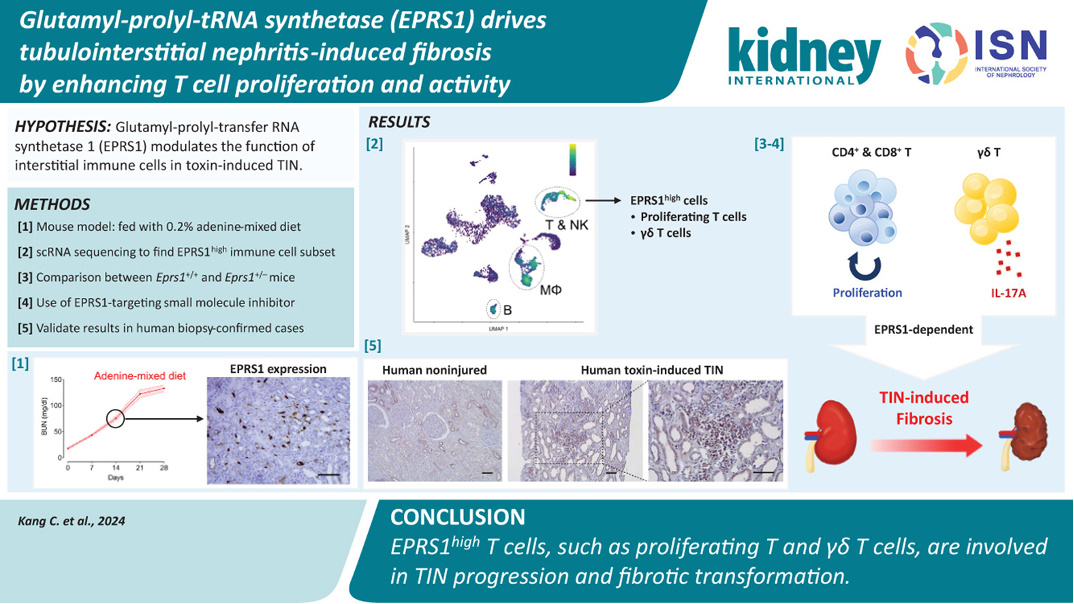
Toxin- and drug-induced tubulointerstitial nephritis (TIN), characterized by interstitial infiltration of immune cells, frequently necessitates dialysis for patients due to irreversible fibrosis. However, agents modulating interstitial immune cells are lacking. Here, we addressed whether the housekeeping enzyme glutamyl-prolyl-transfer RNA synthetase 1 (EPRS1), responsible for attaching glutamic acid and proline to transfer RNA, modulates immune cell activity during TIN and whether its pharmacological inhibition abrogates fibrotic transformation. The immunological feature following TIN induction by means of an adenine-mixed diet was infiltration of EPRS1high T cells, particularly proliferating T and γδ T cells. The proliferation capacity of both CD4+ and CD8+ T cells, along with interleukin-17 production of γδ T cells, was higher in the kidneys of TIN-induced Eprs1+/+ mice than in the kidneys of TIN-induced Eprs1+/- mice. This discrepancy contributed to the fibrotic amelioration observed in kidneys of Eprs1+/- mice. TIN-induced fibrosis was also reduced in Rag1-/- mice adoptively transferred with Eprs1+/- T cells compared to the Rag1-/- mice transferred with Eprs1+/+ T cells. The use of an EPRS1-targeting small molecule inhibitor (bersiporocin) under clinical trials to evaluate its therapeutic potential against idiopathic pulmonary fibrosis alleviated immunofibrotic aggravation in TIN. EPRS1 expression was also observed in human kidney tissues and blood-derived T cells, and high expression was associated with worse patient outcomes. Thus, EPRS1 may emerge as a therapeutic target in toxin- and drug-induced TIN, modulating the proliferation and activity of infiltrated T cells.
Arraystar tRNA Charging Sequencing
Arraystar Charging Sequencing is a novel and powerful tRNA-seq that can simultaneously profile tRNA expression, tRNA modifications, and tRNA charging. It provides comprehensive profiles key to tRNA studies in, for example, cancer drug resistance, cardiac fibrosis, and many other diseases.
Advantages
· Simultaneous tRNA profiles: tRNA expression, tRNA modification, and tRNA charging.
· High yields for full length tRNAs: Highly efficient full length cDNA synthesis to reduce mapping/counting inaccuracy.
· Broad modification coverage: tRNA modifications, e.g. m1A, m1G, m3C, acp3U, are predicted at single nucleotide resolution.
· Seamless integration with translatomics: To correlate tRNA charging with translation activities.
· Rich data and analyses: A wealth of tRNA multi-omics data come with common analyses (e.g. differential analyses) and detailed annotations, for comprehensive insights into the tRNAs.
· Publication-ready graphics and visualization