
The alanyl-tRNA synthetase AARS1 moonlights as a lactyltransferase to promote YAP signaling in gastric cancer
J Clin Invest. 2024 Mar 21;134(10):e174587. [PMID: 38512451]
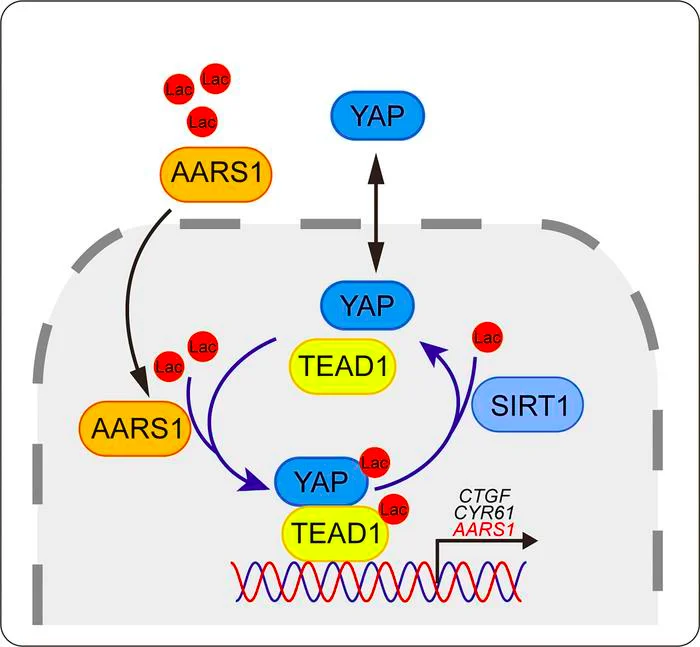
Lactylation has been recently identified as a new type of posttranslational modification occurring widely on lysine residues of both histone and nonhistone proteins. The acetyltransferase p300 is thought to mediate protein lactylation, yet the cellular concentration of the proposed lactyl-donor, lactyl-coenzyme A, is about 1,000 times lower than that of acetyl-CoA, raising the question of whether p300 is a genuine lactyltransferase. Here, we report that alanyl-tRNA synthetase 1 (AARS1) moonlights as a bona fide lactyltransferase that directly uses lactate and ATP to catalyze protein lactylation. Among the candidate substrates, we focused on the Hippo pathway, which has a well-established role in tumorigenesis. Specifically, AARS1 was found to sense intracellular lactate and translocate into the nucleus to lactylate and activate the YAP-TEAD complex; and AARS1 itself was identified as a Hippo target gene that forms a positive-feedback loop with YAP-TEAD to promote gastric cancer (GC) cell proliferation. Consistently, the expression of AARS1 was found to be upregulated in GC, and elevated AARS1 expression was found to be associated with poor prognosis for patients with GC. Collectively, this work found AARS1 with lactyltransferase activity in vitro and in vivo and revealed how the metabolite lactate is translated into a signal of cell proliferation.
Leucine-tRNA-synthase-2-expressing B cells contribute to colorectal cancer immunoevasion
Immunity. 2022 Jun 14;55(6):1067-1081.e8. [PMID: 35659337]
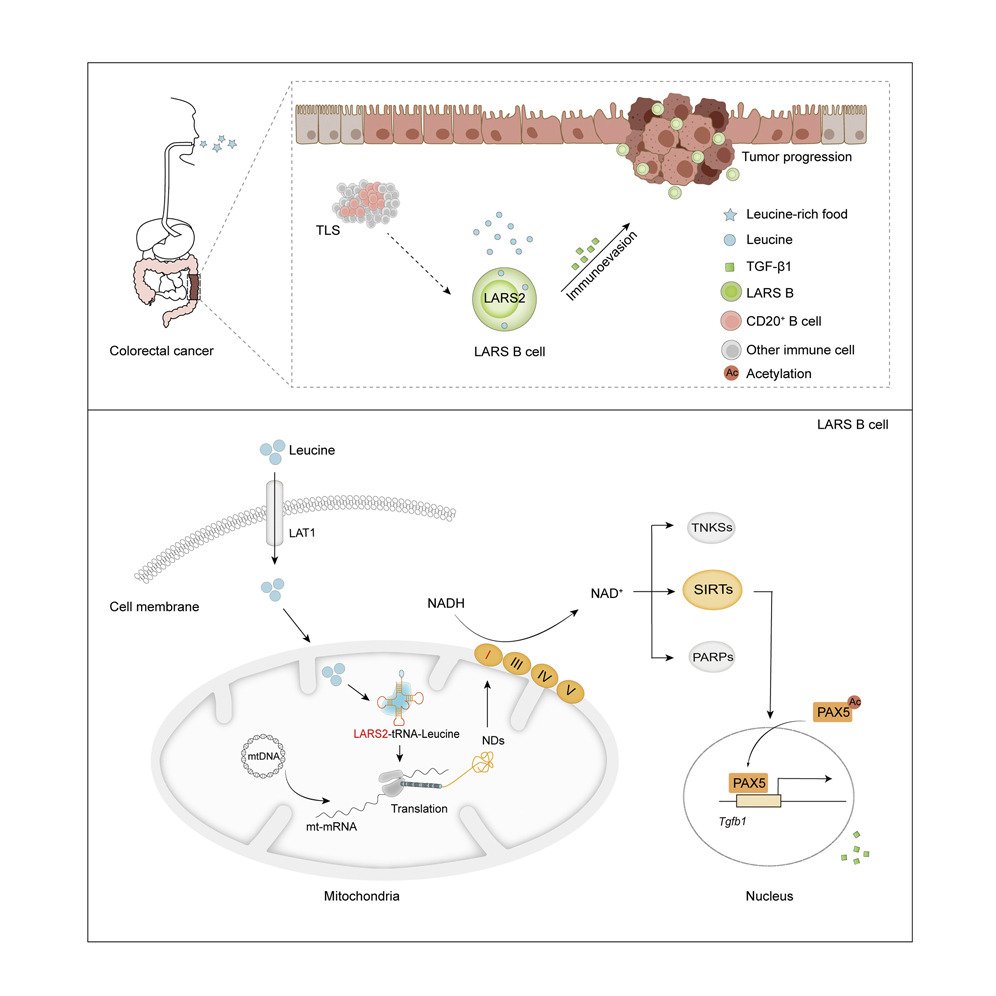
Immunoregulatory B cells impede antitumor immunity through unknown features and mechanisms. We report the existence of leucine-tRNA-synthetase-2 (LARS2)-expressing B cell (LARS B) subset with a transforming growth factor-β1 (TGF-β1)-dominant regulatory feature in both mouse and human progressive colorectal cancer (CRC). Of note, LARS B cells exhibited a leucine nutrient preference and displayed active mitochondrial aminoacyl-tRNA biosynthesis. They were located outside the tertiary lymphoid structure and correlated with colorectal hyperplasia and shortened survival in CRC patients. A leucine diet induced LARS B cell generation, whereas LARS B cell deletion by Lars2 gene ablation or leucine blockage repressed CRC immunoevasion. Mechanistically, LARS2 programmed mitochondrial nicotinamide adenine dinucleotide (NAD+) regeneration and oxidative metabolism, thus determining the regulatory feature of LARS B cells in which the NAD-dependent protein deacetylase sirtuin-1 (SIRT1) was involved. We propose a leucine-dieting scheme to inhibit LARS B cells, which is safe and useful for CRC therapy.
Arraystar tRNA Charging Sequencing
Arraystar tRNA Charging Sequencing is a novel and powerful tRNA-seq that can simultaneously profile tRNA expression, tRNA modifications, and tRNA charging. It provides comprehensive profiles key to tRNA studies in, for example, cancer drug resistance, cardiac fibrosis, and many other diseases.
Advantages
- Simultaneous tRNA profiles: tRNA expression, tRNA modification, and tRNA charging.
- High yields for full length tRNAs: Highly efficient full length cDNA synthesis to reduce mapping/counting inaccuracy.
- Broad modification coverage: tRNA modifications, e.g. m1A, m1G, m3C, acp3U, are predicted at single nucleotide resolution.
- Seamless integration with translatomics: To correlate tRNA charging with translation activities.
- Rich data and analyses: A wealth of tRNA multi-omics data come with common analyses (e.g. differential analyses) and detailed annotations, for comprehensive insights into the tRNAs.
- Publication-ready graphics and visualization