
The work, led by Dr. Rui Su’s group at City of Hope, demonstrates that targeting the METTL1-mediated m7G pathway selectively disrupts leukemic stem cell function while largely sparing normal hematopoietic stem cells, highlighting a promising new therapeutic strategy for AML.
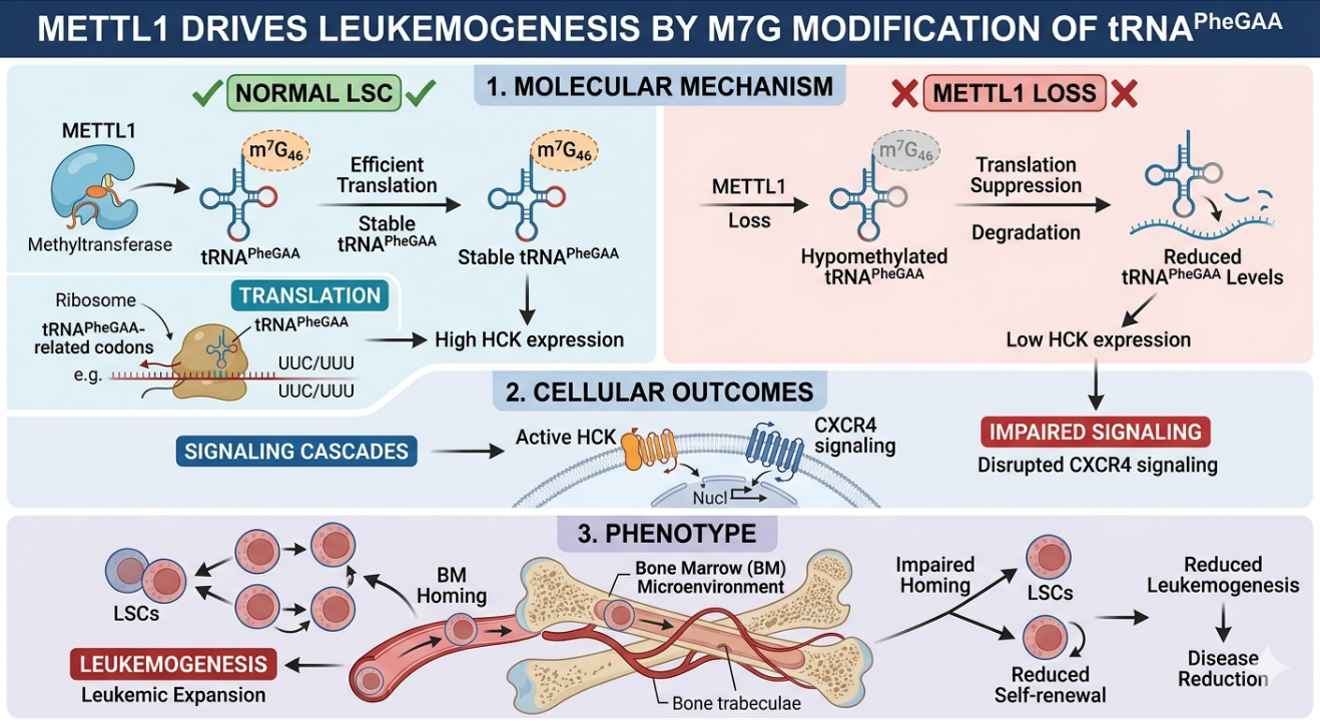
Key Discovery 1. m7G Modification Sustains Leukemia Stem Cell Translation
Although m7G has traditionally been viewed as a structural modification that stabilizes tRNAs, this study uncovers an unexpected role in regulating selective protein translation.
The authors found that:
- LSCs exhibit a strong dependence on METTL1, the methyltransferase responsible for installing m7G on tRNAs.
- tRNA<sup>Phe(GAA)</sup> is one of the most abundant and METTL1-dependent tRNAs in leukemia stem cells.
- Loss of METTL1 dramatically reduces m⁷G-modified tRNAPheGAA, impairing translation of phenylalanine codon-enriched transcripts.
- Ribosome stalling subsequently activates the No-Go Decay (NGD) pathway, leading to degradation of incompletely translated mRNAs.
These findings demonstrate that tRNA m7G modification directly regulates translation efficiency and transcript stability in leukemia stem cells.
Key Discovery 2. Disrupting m7G Prevents Leukemia Stem Cell Homing
Perhaps the most surprising finding is that tRNA m7G modification controls the ability of leukemia stem cells to home to the bone marrow.
The study identified HCK, a Src-family kinase involved in CXCR4-mediated signaling, as a critical downstream target.
Following METTL1 inhibition:
- Translation of HCK is markedly reduced.
- CXCR4 signaling becomes impaired.
- Leukemia stem cells lose their ability to migrate toward CXCL12-rich bone marrow niches.
- Without microenvironmental protection, LSC self-renewal declines and leukemic progression is significantly suppressed.
These results establish m7G-dependent translation as an essential regulator of leukemia stem cell fitness and niche adaptation.
Key Discovery 3. First-in-Class METTL1 Inhibitor Targets the m7G Axis
Building on these mechanistic insights, the investigators identified M1i (NSC137443) through high-throughput screening.
M1i functions by directly inhibiting METTL1, leading to:
- Reduced intracellular m7G levels
- Selective depletion of leukemia stem cells
- Suppression of AML progression in multiple mouse and patient-derived xenograft (PDX) models
- Minimal effects on normal hematopoietic stem cells
These findings position the METTL1–m7G pathway as an attractive therapeutic target for AML.
Research Spotlight: Why Analyze tRNA m7G Modification?
This study highlights how tRNA modifications can selectively regulate protein synthesis, ribosome dynamics, stem cell biology, and disease progression.
Comprehensive profiling of m7G modification is becoming increasingly important for understanding:
- Cancer stem cell biology
- Translational regulation
- RNA modification-mediated gene expression
- Precision oncology and drug discovery
Accelerate Your m7G Research with Arraystar TRAC-seq
Arraystar TRAC-seq (tRNA Reduction and Alkylation Coupled Sequencing) enables transcriptome-wide, single-nucleotide profiling of tRNA m7G modifications, providing a powerful solution for investigating METTL1-dependent translational regulation.
Key Advantages
- Transcriptome-wide profiling of tRNA m7G modifications
- Single-nucleotide resolution
- Quantitative comparison across biological conditions
- Publication-ready bioinformatics analysis