
DMS rG4 Sequencing Service maps and quantifies RNA G-quadruplex (rG4) structures inside living cells. Cultured cells are treated with dimethyl sulfate (DMS) in vivo, which methylates adenosine, cytidine, and guanosine in unfolded, solvent-exposed regions, while the guanines that form the rG4 tetrads stay protected. The methylation pattern therefore records the rG4 structures that were present at the moment of treatment.
The service combines in vivo DMS treatment, in vitro RNA refolding, specific enrichment of rG4-containing RNA with the high-affinity anti-G4 antibody BG4, and demethylation of the DMS byproducts with the Arraystar rtStar™ tRNA Pretreatment & First-Strand cDNA Synthesis Kit before library construction, sequencing, and bioinformatics analysis.
Benefits
In vivo structure, captured before lysis: DMS treatment of living cells followed by in vitro refolding reproduces the rG4 structures present in the cell.
rG4-specific enrichment: the high-affinity BG4 antibody specifically enriches RNA containing rG4 structures.
Demethylation-controlled readout: the Arraystar rtStar™ tRNA Pretreatment & First-Strand cDNA Synthesis Kit removes the m1A and m3C byproducts generated by DMS treatment, eliminating this source of interference.
Broad species compatibility: the workflow is compatible with a wide range of species.
Information-rich output: analysis delivers a complete set of tables and figures, from rG4 peak detection through distribution, differential, and functional enrichment analyses.
Sample Requirement: Cells treated by DMS or Total RNA extracted from DMS treated cells.
| Service Name | Price |
|---|---|
| DMS rG4 Sequencing Service |
Background
RNA G-quadruplexes are four-stranded structures formed by guanine-rich sequences. Their folding is dynamic, and this structural switching participates in the regulation of RNA transcription, mRNA stability, and translation. rG4s also act together with RNA modifications such as m7G, o8G, and m6A to regulate gene expression, while dysregulated rG4 formation affects the development of cancer and neurodegenerative diseases.
rG4 structures are difficult to detect with standard RNA-seq because folding is dynamic and many rG4s are low in abundance. In the Arraystar DMS rG4 Sequencing Service, DMS methylates adenosine, cytidine, and guanosine in unfolded regions of RNA, whereas guanines engaged in an rG4 tetrad are protected from methylation (Figure 1). After in vivo DMS treatment, total RNA is extracted and refolded in vitro in the presence of potassium, rG4-containing RNA is enriched with the high-affinity BG4 antibody, and the DMS byproducts m1A and m3C are removed by demethylation before library construction and sequencing.
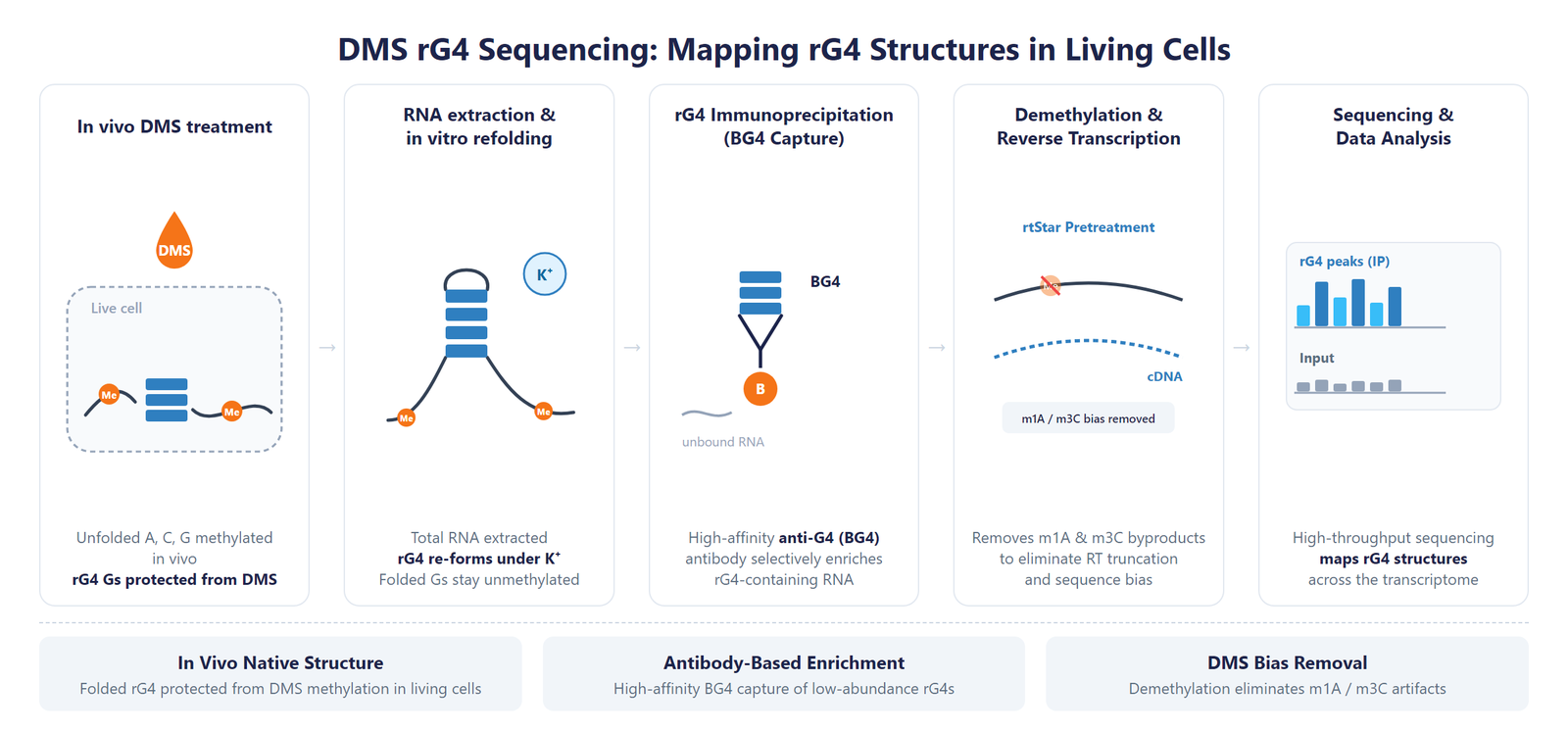
Figure 1. DMS rG4 sequencing scheme. Living cells are treated with DMS in vivo, which methylates A, C, and G in unfolded regions but not the guanines engaged in an rG4 tetrad. After RNA extraction, the RNA is refolded in vitro in the presence of potassium so that rG4 structures re-form. rG4-containing RNA is captured with the anti-G-quadruplex antibody BG4, and the DMS byproducts m1A and m3C are removed by demethylation before reverse transcription, library construction, and sequencing.
Key concept: DMS rG4 sequencing footprints rG4 structures inside living cells with DMS, enriches rG4-containing RNA with the BG4 antibody, and removes DMS byproducts by demethylation, so that the sequencing readout reports rG4 structures as they were folded in the cell.
Workflow
Six steps from living cells to transcriptome-wide rG4 maps:
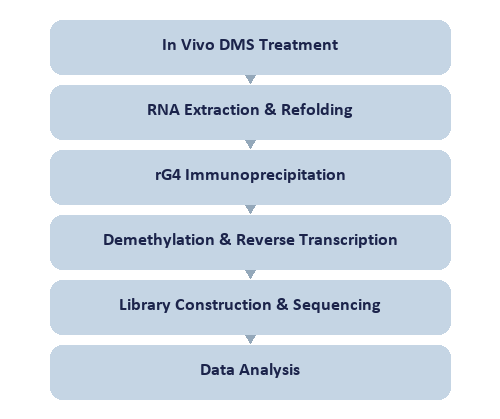
Figure 2. DMS rG4 sequencing workflow.
1. In vivo DMS treatment: cultured cells are grown under the experimental condition and treated with DMS, which methylates the RNA bases in unfolded regions.
2. RNA extraction and in vitro refolding: total RNA is extracted, denatured, and renatured in vitro in the presence of potassium so that rG4 structures re-fold.
3. rG4 immunoprecipitation: RNA containing rG4 structures is enriched with the high-affinity anti-G4 antibody BG4.
4. Demethylation and reverse transcription: the DMS byproducts m1A and m3C are removed with the Arraystar rtStar™ tRNA Pretreatment & First-Strand cDNA Synthesis Kit, and the enriched RNA is reverse transcribed.
5. Library construction and sequencing: sequencing libraries are constructed from the enriched cDNA and sequenced.
6. Data analysis: reads are mapped to the reference genome and rG4 peaks are identified, annotated, and compared between samples and groups.
Bioinformatics
Sequencing reads are aligned to the reference genome and rG4-enriched peaks are called and annotated by transcript region. Peak-level comparison between groups identifies differentially enriched rG4 sites, and functional enrichment analysis of the associated genes is provided together with genome-browser visualization of individual loci.
Deliverables
- Raw sequencing data files, formatted for GEO/SRA public database submission.
- Sample and sequencing QC reports with alignment and mapping statistics.
- rG4 peak detection tables (XLSX) with peak coordinates, transcripts, genes, and peak regions.
- rG4 peak distribution figures summarizing peak regions across the transcriptome (Fig. 3).
- Differential rG4 peak tables (XLSX) with fold change and significance metrics (Fig. 4).
- Volcano plots of differentially enriched rG4 peaks.
- Gene Ontology (GO) enrichment analysis of genes associated with differential rG4 peaks (Fig. 5).
- Genome-browser track files and peak visualization plots for individual rG4 loci (Fig. 6).
- A complete analysis project report covering the workflow and results.
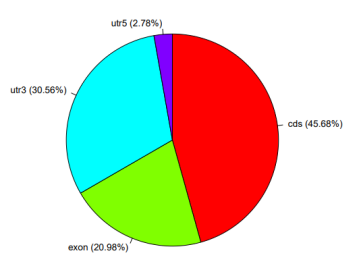
Fig. 3 Distribution of rG4-enriched peaks across transcript regions.

Fig. 4 Differential rG4 peak results between experimental groups.
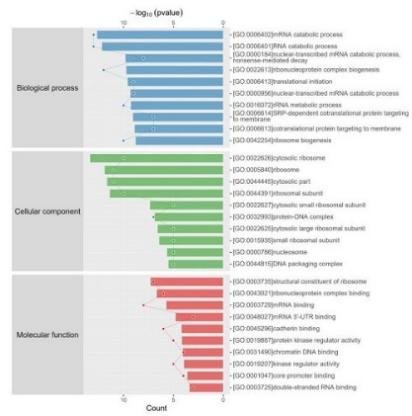
Fig. 5 Gene Ontology (GO) enrichment of genes associated with differential rG4 peaks.
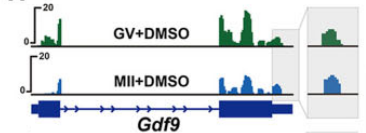
Fig. 6 Visualization of individual rG4 peaks at a candidate locus.
Research Applications
- Gene expression regulation: investigate how rG4 folding contributes to the regulation of RNA transcription, mRNA stability, and translation.
- RNA modification crosstalk: explore how rG4 structures act together with m7G, o8G, and m6A modifications in the control of gene expression.
- Cancer research: compare rG4 peak profiles between normal and tumor-related samples to study rG4 changes associated with cancer.
- Neurodegenerative disease research: profile rG4 structures in models of rG4-related neurodegenerative disease.
- Candidate rG4 discovery: screen for condition-specific rG4 sites that can be followed up with locus-level validation.
References
[1] Kwok CK, Marsico G, Sahakyan AB, et al. rG4-seq reveals widespread formation of G-quadruplex structures in the human transcriptome. Nature Methods 2016;13(10):841-844. DOI: 10.1038/nmeth.3965. PMID: 27571552.
[2] Guo JU, Bartel DP. RNA G-quadruplexes are globally unfolded in eukaryotic cells and depleted in bacteria. Science 2016;353(6306):aaf5371. DOI: 10.1126/science.aaf5371. PMID: 27708011.
[3] Yang SY, Lejault P, Chevrier S, et al. Transcriptome-wide identification of transient RNA G-quadruplexes in human cells. Nature Communications 2018;9(1):4730. DOI: 10.1038/s41467-018-07224-8. PMID: 30413703.
[4] Biffi G, Tannahill D, McCafferty J, Balasubramanian S. Quantitative visualization of DNA G-quadruplex structures in human cells. Nature Chemical Biology 2013;9(5):295-299. DOI: 10.1038/nchem.1548. PMID: 23422559.
[5] Ding Y, Tang Y, Kwok CK, et al. In vivo genome-wide profiling of RNA secondary structure reveals novel regulatory features. Nature 2014;505(7485):696-700. DOI: 10.1038/nature12756. PMID: 24270811.
[6] Matsuo K, Asamitsu S, Hasegawa M, et al. RNA G-quadruplexes form scaffolds that promote neuropathological α-synuclein aggregation. Cell 2024;187(24):6835-6848. DOI: 10.1016/j.cell.2024.09.037. PMID: 39426376.
Sample Requirements
Storage Guidelines
Cells and Tissues: Preserve in TRIzol or an RNA stabilization solution; snap freeze in liquid nitrogen and store at −80 °C.
RNA: Resuspend in ethanol or RNase-free ultrapure water; store at −80 °C and avoid multiple freeze-thaw cycles.
DMS-treated cells: Lysis in TRIzol should be performed immediately after DMS treatment. RNAlater is not recommended for cells, and storing or shipping unpreserved frozen cell pellets is not recommended.
Shipping Instructions
Place the sample in a 1.5 mL RNase-free microcentrifuge tube.
Seal the tube with parafilm or a cap lock to ensure sample integrity.
Ship the package on dry ice with adequate insulation to maintain the required temperature.
| Sample Type | Notes |
|---|---|
| Cultured cells treated with DMS | Submit 1 × 10⁷ DMS-treated cells per sample. Lysing the cells in TRIzol immediately after DMS treatment is recommended. |
| Total RNA extracted from DMS-treated cells | Total RNA extracted from 1 × 10⁷ DMS-treated cells. Maintain an OD 260/280 ratio ≥ 1.8 and RIN ≥ 7 with no visible degradation. |
| Tissue | Provide fresh or frozen specimens, ensuring that necrotic material is strictly avoided. |
FAQ
What is an rG4?
An rG4 is an RNA G-quadruplex, a four-stranded structure formed by guanine-rich sequences in RNA. rG4 folding is dynamic and participates in the regulation of RNA transcription, mRNA stability, and translation, and rG4s also act together with modifications such as m7G, o8G, and m6A to regulate gene expression.
How does DMS rG4 sequencing detect rG4 structures in living cells?
Cells are treated with DMS in vivo, which methylates adenosine, cytidine, and guanosine in unfolded regions while the guanines of an rG4 tetrad remain protected. The extracted RNA is refolded in vitro, rG4-containing RNA is enriched with the BG4 antibody, DMS byproducts are removed by demethylation, and the enriched RNA is sequenced.
Why is a demethylation step included?
DMS treatment also generates m1A and m3C, and these byproducts would otherwise interfere with rG4 detection. Treating the enriched RNA with the Arraystar rtStar™ tRNA Pretreatment & First-Strand cDNA Synthesis Kit removes them before reverse transcription, which improves the accuracy and reliability of the rG4 analysis.
What samples can be submitted?
Projects start from cultured cells treated with DMS, or from total RNA extracted from DMS-treated cells. Cells should be lysed in TRIzol immediately after treatment and shipped on dry ice, and total RNA should show no visible degradation. Please contact us to confirm the design before submission.
Is the service limited to human samples?
No. The DMS rG4 sequencing workflow is compatible with a broad range of species. The same in vivo DMS treatment, in vitro refolding, BG4 enrichment, demethylation, and sequencing procedure is applied, so rG4 profiles from different organisms can be generated and compared.
What does the analysis include?
Analysis includes rG4 peak detection tables with coordinates, transcripts, genes, and peak regions; peak distribution figures; differential peak tables with fold change and significance; volcano plots; Gene Ontology (GO) enrichment of the associated genes; and genome-browser visualization of individual rG4 peaks, together with sequencing quality control data.