
Article
Mitochondrial translational defect extends lifespan in C. elegans by activating UPRmt
Published in
Redox Biology
Abstract
This study investigated the role of mitochondrial threonyl-tRNA synthetase (TARS-1) in regulating mitochondrial translation and organismal aging in Caenorhabditis elegans. The authors discovered that a single tars-1 gene generates both cytoplasmic and mitochondrial threonyl-tRNA synthetases through translational reinitiation. Deficiency of mitochondrial TARS-1 reduced mitochondrial tRNAThr charging, impaired mitochondrial protein translation, and compromised respiratory function. Surprisingly, these defects activated the mitochondrial unfolded protein response (UPRmt), which promoted lifespan extension despite causing developmental and locomotor abnormalities. The findings reveal a direct connection between tRNA charging, mitochondrial translation, stress signaling, and longevity.
Results
• A single tars-1 gene produces both cytoplasmic and mitochondrial threonyl-tRNA synthetases through translational reinitiation
• Mitochondrial TARS-1 deficiency decreases mitochondrial tRNAThr charging efficiency
• Reduced tRNA charging impairs mitochondrial protein translation and respiratory chain function
• Mitochondrial tars-1 knockdown lowers oxygen consumption rate and complex I activity
• Defective mitochondrial translation activates the mitochondrial unfolded protein response (UPRmt)
• Mitochondrial tars-1 deficiency delays development, reduces reproductive capacity, and impairs locomotion
• Despite these physiological defects, activation of UPRmt significantly extends lifespan in C. elegans
• Deficiency of multiple additional mitochondrial aminoacyl-tRNA synthetases similarly activates UPRmt, suggesting a conserved link between mitochondrial tRNA charging and stress signaling.
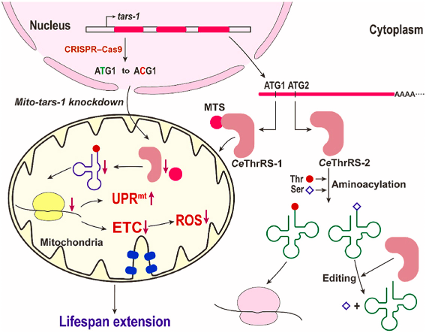
Fig. 1. Reduced mitochondrial tRNAThr charging impairs mitochondrial translation, activates UPRmt, and promotes lifespan extension in C. elegans.
Conclusion
The study demonstrated that mitochondrial tRNA charging is a critical regulator of mitochondrial function and aging. Loss of mitochondrial TARS-1 decreases tRNAThr aminoacylation and mitochondrial translation, leading to respiratory defects that trigger the protective UPRmt pathway. Activation of this stress-response program promotes longevity despite impaired mitochondrial performance. These findings establish tRNA charging as an important regulatory layer connecting mitochondrial protein synthesis, cellular stress adaptation, and lifespan control, highlighting aminoacyl-tRNA synthetases as key modulators of organismal aging.
Arraystar tRNA Charging Sequencing
Arraystar tRNA Charging Sequencing is capable of profiling tRNA charging, expression,and modifications simultaneously. It provides comprehensive tRNA profiles key to tRNA studies in cancer drug resistance, cardiac fibrosis, and many other diseases.
Advantages
• Simultaneous tRNA profiles: tRNA expression, tRNA modification, and tRNA charging.
• High yields for full length tRNAs: Highly efficient full length cDNA synthesis to reduce mapping/counting inaccuracy.
• Broad modification coverage: tRNA modifications, e.g. m1A, m1G, m3C, acp3U, are predicted at single nucleotide resolution.
• Seamless integration with translatomics: To correlate tRNA charging with translation activities.
• Rich data and analyses: A wealth of tRNA multi-omics data come with common analyses (e.g. differential analyses) and detailed annotations, for comprehensive insights into the tRNAs.
• Publication-ready graphics and visualization