
Article
Valine aminoacyl-tRNA synthetase promotes therapy resistance in melanoma
Published in
Nature Cell Biology
Abstract
This study identified valine aminoacyl-tRNA synthetase (VARS), a key enzyme in the tRNA charging machinery, as a critical regulator of resistance to MAPK-targeted therapy in melanoma. MAPK inhibitor–resistant melanoma cells exhibited increased expression and activity of VARS, accompanied by enrichment of valine-containing proteins and valine cognate tRNAs. Mechanistically, VARS selectively enhanced translation of valine-rich transcripts, including hydroxyacyl-CoA dehydrogenase (HADH), a key enzyme involved in fatty acid oxidation. Depletion of VARS restored sensitivity to MAPK inhibitors in resistant melanoma models both in vitro and in vivo, demonstrating that altered tRNA charging contributes directly to metabolic adaptation and therapy resistance in cancer.
Results
• MAPK inhibitor–resistant melanoma cells display increased VARS expression and activity
• Resistant melanoma proteomes are enriched in valine-containing proteins and transcripts with high valine codon usage
• VARS selectively promotes translation of valine-enriched mRNAs rather than globally increasing protein synthesis
• VARS regulates expression of HADH, a key enzyme required for fatty acid oxidation
• Resistant melanoma cells depend on fatty acid oxidation for survival during MAPK inhibitor treatment
• VARS depletion reduces fatty acid oxidation and re-sensitizes resistant melanoma cells to targeted therapy
• Knockdown of HADH phenocopies VARS depletion, confirming that the VARS–HADH axis supports metabolic adaptation and drug resistance.
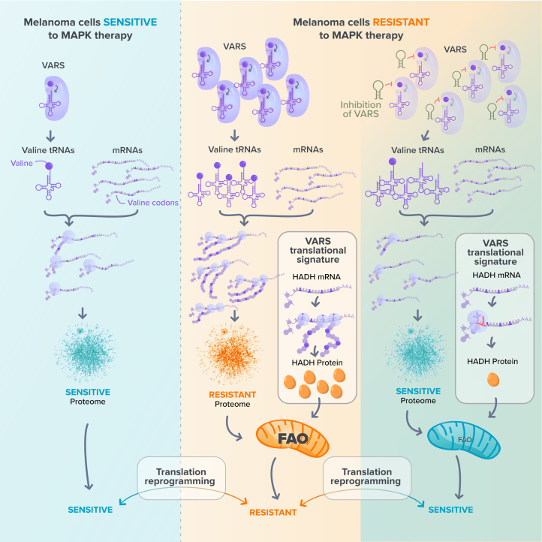
Fig. 1. VARS-mediated tRNA charging promotes translation of valine-rich metabolic genes and supports fatty acid oxidation–dependent therapy resistance in melanoma.
Conclusion
The study demonstrated that valine-specific tRNA charging plays a central role in melanoma adaptation to targeted therapy. Increased VARS activity enables selective translation of valine-rich transcripts that support fatty acid oxidation and survival under MAPK inhibition. These findings expand the role of aminoacyl-tRNA synthetases beyond canonical protein synthesis and highlight tRNA charging as a key regulatory mechanism linking translational control, metabolic reprogramming, and cancer therapy resistance. Targeting VARS may therefore represent a promising strategy for overcoming drug resistance in melanoma.
Arraystar tRNA Charging Sequencing
Arraystar tRNA Charging Sequencing is capable of profiling tRNA charging, expression,and modifications simultaneously. It provides comprehensive tRNA profiles key to tRNA studies in cancer drug resistance, cardiac fibrosis, and many other diseases.
Advantages
• Simultaneous tRNA profiles: tRNA expression, tRNA modification, and tRNA charging.
• High yields for full length tRNAs: Highly efficient full length cDNA synthesis to reduce mapping/counting inaccuracy.
• Broad modification coverage: tRNA modifications, e.g. m1A, m1G, m3C, acp3U, are predicted at single nucleotide resolution.
• Seamless integration with translatomics: To correlate tRNA charging with translation activities.
• Rich data and analyses: A wealth of tRNA multi-omics data come with common analyses (e.g. differential analyses) and detailed annotations, for comprehensive insights into the tRNAs.
• Publication-ready graphics and visualization