
Article
Cross-talks between Metabolic and Translational Controls during Beige Adipocyte Differentiation
Published in
Nature Communications
Abstract
This study uncovered previously unrecognized interactions between cellular metabolism and translational regulation during beige adipocyte differentiation. By integrating transcriptomic, translatomic, and proteomic analyses, the authors identified selective translational remodeling that shapes thermogenic adipocyte metabolism. A key finding was that altered glutamate metabolism reduced the availability of glutamate for tRNA charging, leading to increased ribosome pausing at glutamate codons. This translational slowdown decreased the synthesis and stability of glutamate codon-rich transcripts, particularly genes involved in actin cytoskeleton organization. The results demonstrate that amino acid availability and tRNA charging can directly influence translation elongation and cellular differentiation programs.
Results
• Beige adipocyte differentiation is accompanied by extensive remodeling of translation and protein expression programs
• Oxidative phosphorylation (OXPHOS) component genes are selectively downregulated at the translational level, whereas TCA cycle genes show enhanced translation
• High-resolution ribosome profiling revealed increased ribosome pausing specifically at glutamate codons during adipocyte differentiation
• Enhanced ribosome stalling results from altered glutamate metabolism that lowers intracellular glutamate availability for charging of cognate tRNAGlu molecules
• Reduced tRNAGlu charging impairs translation elongation and decreases protein synthesis efficiency
• Glutamate codon-rich transcripts, including actin cytoskeleton-associated genes, exhibit reduced translation and decreased mRNA stability
• Manipulation of glutamate metabolism alters cytoskeletal organization and influences adipocyte differentiation, linking metabolic state directly to translational control.
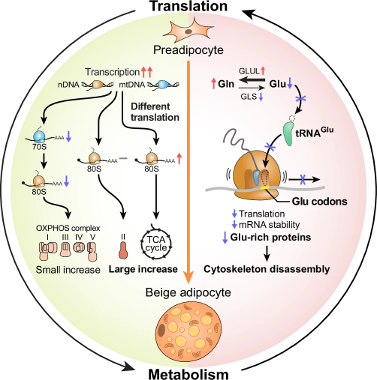
Fig. 1. Altered glutamate metabolism reduces tRNAGlu charging, increases ribosome pausing at glutamate codons, and suppresses translation of glutamate-rich genes during beige adipocyte differentiation.
Conclusion
The study demonstrated that tRNA charging serves as a mechanistic link between metabolism and translational regulation during cellular differentiation. Metabolic remodeling in differentiating adipocytes reduces glutamate availability, limiting tRNAGlu aminoacylation and promoting ribosome pausing at glutamate codons. These translational effects selectively reshape protein synthesis and gene expression programs required for adipocyte development. The findings highlight tRNA charging as an important regulatory layer through which metabolic states can influence cell fate decisions, thermogenic adipocyte function, and energy metabolism.
Arraystar tRNA Charging Sequencing
Arraystar tRNA Charging Sequencing is capable of profiling tRNA charging, expression,and modifications simultaneously. It provides comprehensive tRNA profiles key to tRNA studies in cancer drug resistance, cardiac fibrosis, and many other diseases.
Advantages
• Simultaneous tRNA profiles: tRNA expression, tRNA modification, and tRNA charging.
• High yields for full length tRNAs: Highly efficient full length cDNA synthesis to reduce mapping/counting inaccuracy.
• Broad modification coverage: tRNA modifications, e.g. m1A, m1G, m3C, acp3U, are predicted at single nucleotide resolution.
• Seamless integration with translatomics: To correlate tRNA charging with translation activities.
• Rich data and analyses: A wealth of tRNA multi-omics data come with common analyses (e.g. differential analyses) and detailed annotations, for comprehensive insights into the tRNAs.
• Publication-ready graphics and visualization