
Article
Aging-induced tRNA(Glu)-derived fragment impairs glutamate biosynthesis by targeting mitochondrial translation-dependent cristae organization
Published in
Cell Metabolism
Abstract
This study identified a novel role for a tRNA-derived fragment generated from tRNA(Glu) during aging. The aging-associated tRNA(Glu)-derived fragment (tRF-Glu) accumulated in multiple tissues and disrupted mitochondrial function by impairing mitochondrial translation and cristae organization. Increased tRF-Glu levels reduced glutamate biosynthesis and altered cellular metabolic homeostasis. Mechanistically, the fragment interfered with the expression of mitochondrial proteins required for proper respiratory chain function, leading to defects in energy metabolism. These findings demonstrate that tRNA-derived molecules can function as regulatory factors linking aging to mitochondrial dysfunction and metabolic decline.
Results
• Aging induces accumulation of a specific tRNA(Glu)-derived fragment (tRF-Glu) in multiple tissues
• Elevated tRF-Glu levels impair mitochondrial translation
• tRF-Glu disrupts mitochondrial cristae organization and respiratory chain integrity
• Mitochondrial dysfunction reduces glutamate biosynthesis and alters cellular metabolism
• Restoration of mitochondrial function rescues glutamate production defects
• Suppression of tRF-Glu improves mitochondrial activity and metabolic homeostasis in aging models
• The study identifies tRNA-derived fragments as important regulators of age-associated metabolic remodeling and mitochondrial health.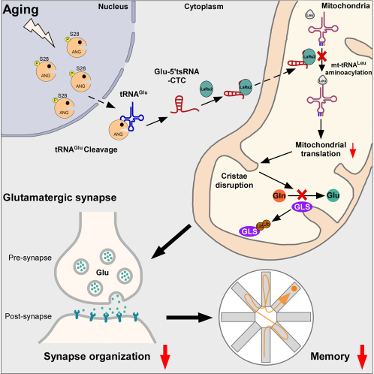
Fig. 1. Aging-induced tRF-Glu impairs mitochondrial translation and cristae organization, resulting in reduced glutamate biosynthesis and metabolic dysfunction.
Conclusion
The study demonstrated that tRNA biology influences aging beyond its canonical role in protein synthesis. An aging-associated tRNA(Glu)-derived fragment acts as a regulatory RNA that disrupts mitochondrial translation and architecture, leading to impaired glutamate biosynthesis and metabolic decline. These findings highlight a previously unrecognized connection between tRNA-derived molecules, mitochondrial function, and aging, emphasizing the importance of tRNA-related pathways as potential therapeutic targets for age-associated metabolic disorders.
Arraystar tRNA Charging Sequencing
Arraystar tRNA Charging Sequencing is capable of profiling tRNA charging, expression,and modifications simultaneously. It provides comprehensive tRNA profiles key to tRNA studies in cancer drug resistance, cardiac fibrosis, and many other diseases.
Advantages
• Simultaneous tRNA profiles: tRNA expression, tRNA modification, and tRNA charging.
• High yields for full length tRNAs: Highly efficient full length cDNA synthesis to reduce mapping/counting inaccuracy.
• Broad modification coverage: tRNA modifications, e.g. m1A, m1G, m3C, acp3U, are predicted at single nucleotide resolution.
• Seamless integration with translatomics: To correlate tRNA charging with translation activities.
• Rich data and analyses: A wealth of tRNA multi-omics data come with common analyses (e.g. differential analyses) and detailed annotations, for comprehensive insights into the tRNAs.
• Publication-ready graphics and visualization