Single-Base tRNA Modification Sequencing

Single-Nucleotide tRNA Pseudouridine (Ψ) Modification Seq(BID-seq)

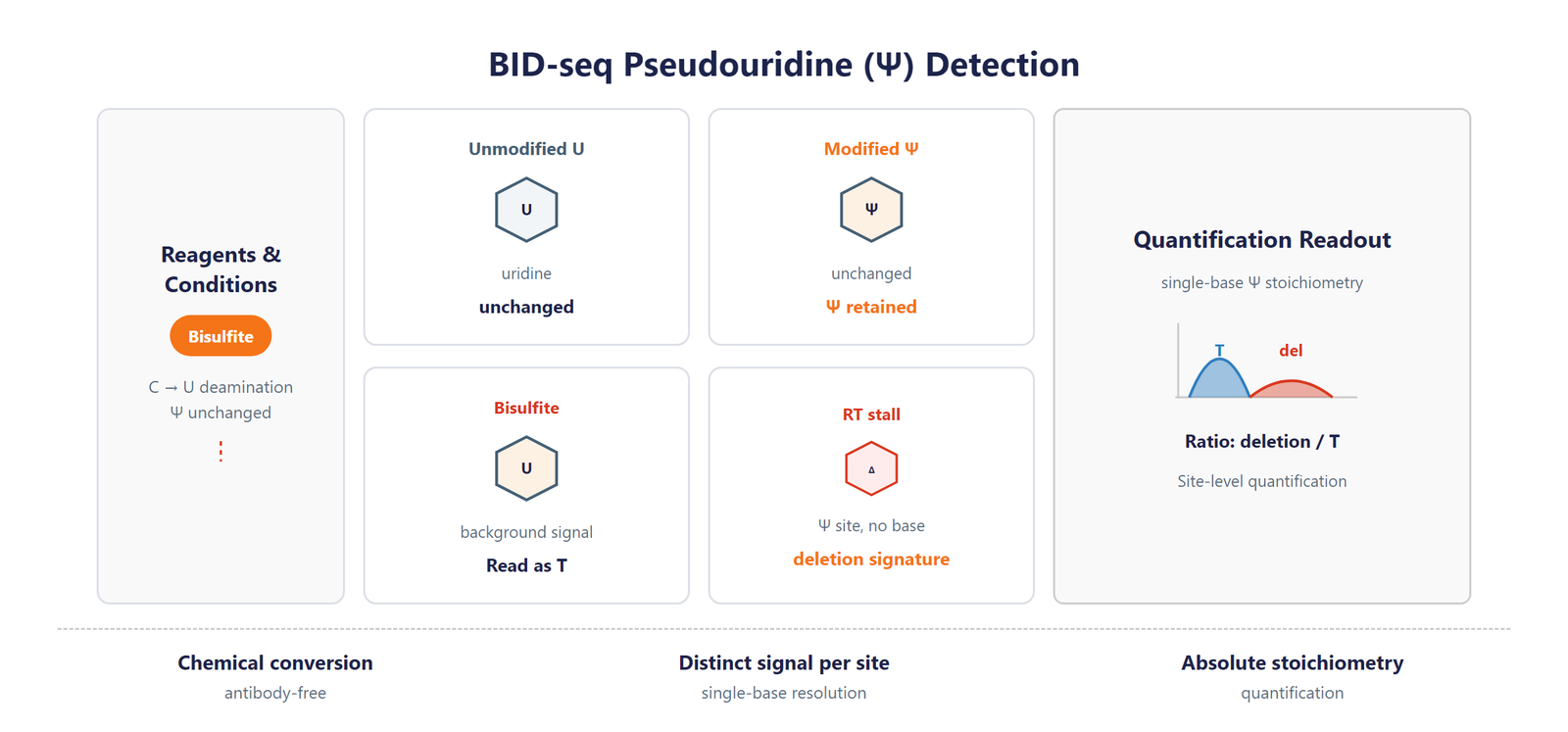
BID-seq is an antibody-free, base-resolution approach that quantifies pseudouridine on tRNA. It exploits bisulfite resistance to generate a deletion signature at Ψ, resolving each site at single-base resolution.

Arraystar Single-Nucleotide tRNA Pseudouridine (Ψ) Modification Seq(BID-seq) is an end-to-end sample-to-data service for tRNA, from RNA sample QC and tRNA treatment through library construction, sequencing, and bioinformatics. Sites are localized within mature tRNA transcripts with relative coordinates, tRNA gene attribution, anticodon and isotype, and structural-domain localization.

Benefits

In tRNA, pseudouridine contributes to structure and decoding, so site-level mapping is valuable. Bisulfite resistance creates a deletion signature at Ψ, resolving each site at base resolution.

Single-base resolution: pinpoints Ψ sites in tRNA.

Quantitative measurement: the conversion read-out yields reliable modification fractions.

No antibody dependence: eliminates enrichment bias and cross-reactivity concerns.

Functional annotation: Sites are localized within mature tRNA transcripts with relative coordinates, tRNA gene attribution, anticodon and isotype, and structural-domain localization.

Application-ready: supports decoding fidelity, codon use, aminoacylation, and tRNA structural biology across tRNA isotypes.

Service NamePrice
Single-Nucleotide tRNA Pseudouridine (Ψ) Modification Seq(BID-seq)

Background

In tRNA, the modification stabilizes the folded L-shaped structure and fine-tunes anticodon–codon decoding, so base-resolution mapping within maturation loops and the anticodon is what distinguishes it. Bisulfite-induced deletion sequencing exploits the resistance of pseudouridine to bisulfite deamination, so reverse transcription creates a deletion signature at each Ψ site while unmodified positions read normally. This antibody-free readout maps each Ψ site at single-base resolution.

The method was validated for tRNA, sites are localized within mature tRNA transcripts with relative coordinates, tRNA gene attribution, anticodon and isotype, and structural-domain localization. (Dai Q, et al. He C. Nature Biotechnology 2023;41(3):344-354., DOI: 10.1038/s41587-022-01505-w).

Key concept: Single-Nucleotide tRNA Pseudouridine (Ψ) Modification Seq(BID-seq) is a base-resolution method in which bisulfite-induced deletion sequencing exploits the resistance of pseudouridine to bisulfite to create a deletion signature, mapping and quantifying Ψ at single-base resolution.
Single-Nucleotide tRNA Pseudouridine (Ψ) Modification Seq scheme

Figure 1. BID-seq pseudouridine detection scheme. Bisulfite treatment produces a deletion signature at each Ψ site while unchanged positions read normally, mapping and quantifying pseudouridine at base resolution.

Workflow

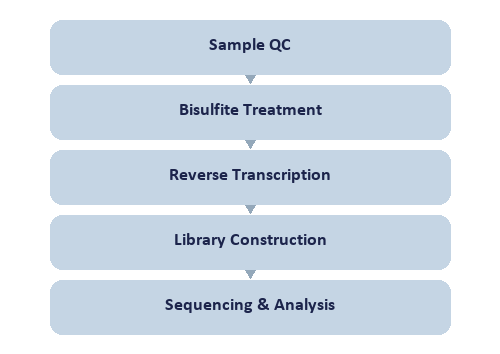
A streamlined workflow carries the sample to base-resolution pseudouridine (Ψ) datasets:
Single-Nucleotide tRNA Pseudouridine (Ψ) Modification Seq workflow

Figure 2. Single-Nucleotide tRNA Pseudouridine (Ψ) Modification Seq workflow.

Bioinformatics

Downstream analysis maps reads to a curated reference, calls deletion-type signatures, and reports Ψ stoichiometry per position with motif, distribution, differential, enrichment, and genome-browser outputs.

Deliverables

  • Raw Ψ tRNA sequencing FASTQ data files, formatted for GEO/SRA public database submission.
  • QC report with BAM alignment files and key mapping metrics.
  • High-confidence single-base Ψ tRNA site tables (XLSX) with coordinates, anticodon, isotype, and stoichiometry.
  • Single-base Ψ distribution plots across tRNA domains and consensus Ψ motif logos (PDF/PNG).
  • Single-base resolution differential Ψ tRNA site tables (XLSX) with fold change and significance.
  • Genome browser-compatible Ψ signal track files (bigWig/bedGraph) and a structured tRNA report.

Research Applications

  • tRNA decoding fidelity: maps the modification within anticodon and wobble regions.
  • Codon use & aminoacylation: relates base-resolution modification to charging and translation.
  • tRNA structural biology: localizes sites within D-loop, anticodon, TΨC, and acceptor stem.
  • Isotype-resolved analysis: compares modification across tRNA isotypes and isoacceptors.
  • Disease-oriented studies: finds differentially modified tRNA sites as biomarkers.

References

[1] Dai Q, Zhang LS, Sun HL, et al. He C. Quantitative sequencing using BID-seq uncovers abundant pseudouridines in mammalian mRNA at base resolution. Nature Biotechnology 2023;41(3):344-354. DOI: 10.1038/s41587-022-01505-w.

Sample Requirements

Sample Storage

For cells/tissue: use TRIzol or an RNA-stabilizing reagent, quick-freeze in liquid nitrogen, and keep at –80 °C.

For RNA: dissolve in ethanol or RNase-free water, store at –80 °C, and limit freeze–thaw cycles.

Dispatch Guidelines

Transfer each sample into a 1.5 mL nuclease-free tube.

Close the tube securely with parafilm or a cap lock to preserve integrity.

Send on dry ice with sufficient insulation to sustain the required temperature.

Sample TypeNotes
Whole bloodUse EDTA tubes only, as heparin is not compatible with subsequent analytical procedures.
Cultured cellsSubmission of cell pellets is preferred to ensure high-quality material for processing.
TissueProvide fresh or frozen specimens, ensuring that necrotic material is strictly avoided.
Total RNAMaintain an OD 260/280 ratio ≥ 1.8 and RIN ≥ 7 with no visible degradation. Submit at least 10 µg total RNA.

FAQ

Which tRNA features are annotated?

Sites are localized within mature tRNA transcripts with relative coordinates, tRNA gene attribution, anticodon and isotype, and structural-domain localization. This lets you interpret each site in the context of its host tRNA isotype and structural domain. The method supports both mRNA and tRNA workflows, so you can choose the readout that matches your study.

Does this method measure the modification at single-base resolution?

Yes. Bisulfite-induced deletion sequencing exploits the resistance of pseudouridine to bisulfite deamination, so reverse transcription creates a deletion signature at each Ψ site while unmodified positions read normally. This provides single-base resolution and absolute stoichiometry for each site in tRNA.

How does this method differ from antibody-based tRNA profiling?

Antibody-based methods rely on enrichment and offer limited resolution with intrinsic motif bias. This method is antibody-free and delivers base-resolution, quantitative calling in tRNA, avoiding cross-reactivity and enrichment bias. This suits projects needing quantitative site-level mapping rather than region-level enrichment, and it pairs well with orthogonal validation.

How does this service support pseudouridine research?

By profileping Ψ at single-base resolution, the service helps researchers explore its roles in RNA structure and function, strengthening the evidence for impactful studies.

Why is high-resolution pseudouridine detection valuable?

Accurate Ψ profileping provides robust position-level evidence, making it a valued asset for advancing RNA biology.

!This assay is provided for research applications only and is not intended for clinical diagnosis, treatment, or personal health evaluation.