Single-Base tRNA Modification Sequencing

Single-Nucleotide tRNA m1A Modification Seq(m1A-Quant-seq)

tRNA m1A is a base modification that organises the folded tRNA architecture and stabilises codon–anticodon pairing. m1A-quant-seq passes an engineered reverse transcriptase across N1-methyladenosine in tRNA, so each m1A-bearing position emits a discrete mutation signature that pinpoints and quantifies the site at single-base resolution without disturbing the surrounding tRNA sequence.

Arraystar delivers this as a complete tRNA workflow, from sample QC and tRNA enrichment through reverse transcription, library prep, sequencing and tRNA-aware bioinformatics, returning per-site m1A values and absolute stoichiometry so that laboratories can interpret the biology rather than assemble the assay.

Benefits

Single-base resolution in tRNA: locates m1A across the tRNA transcriptome by reading through every base.

Absolute stoichiometry: derives the m1A fraction at a site from the ratio of reverse-transcription signatures.

Read-through in structured tRNA: the engineered enzyme progresses through modified, tightly folded tRNA regions.

Low sample input: nanogram quantities of tRNA are sufficient, suiting precious or restricted materials.

Antibody-free: bypasses enrichment, removing pull-down bias and cross-reactivity inside compact tRNAs.

Functional annotation: sites are mapped within mature tRNA with anticodon, isotype and isodecoder assignment.

Service NameRNA ClassPrice
Single-Nucleotide tRNA m1A Modification Seq(m1A-Quant-seq)tRNA

Background

The N1-methyladenosine mark at conserved tRNA positions (for example nucleotide 9, 14 or 58) stabilises the L-shaped fold and tunes aminoacylation and decoding fidelity. Loss or gain of these sites disturbs translation and has been linked to developmental defects and cancer phenotypes.

Antibody-capture strategies provide only coarse resolution and contend with the dense structure of tRNA. m1A-quant-seq instead relies on an engineered reverse transcriptase whose processivity survives m1A; as it crosses the modified base it leaves a reproducible mismatch, and the mutation proportion at that position reflects the m1A level.
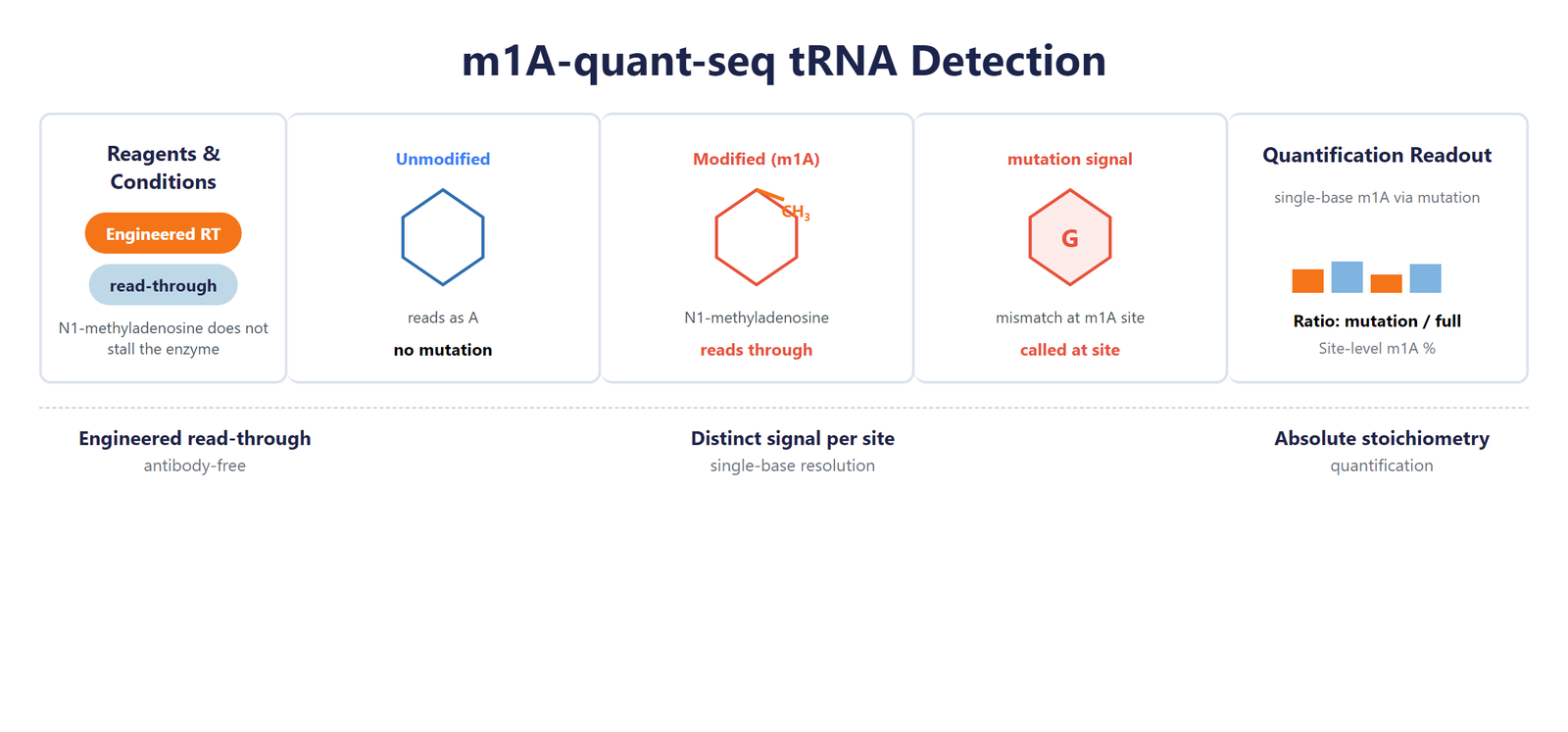
Single-Nucleotide tRNA m1A Modification Seq scheme

Figure 1. m1A-quant-seq scheme for tRNA. The engineered reverse transcriptase reads through the N1-methyladenosine base and produces a characteristic mutation signature; the mutation rate at that base equals m1A%.

Key concept: Single-Nucleotide RNA m1A Modification Seq(m1A-Quant-seq) is an antibody-free method in which an engineered reverse transcriptase reads through m1A and records a reproducible mutation signature, enabling base-resolution mapping and absolute stoichiometry of m1A.

Workflow
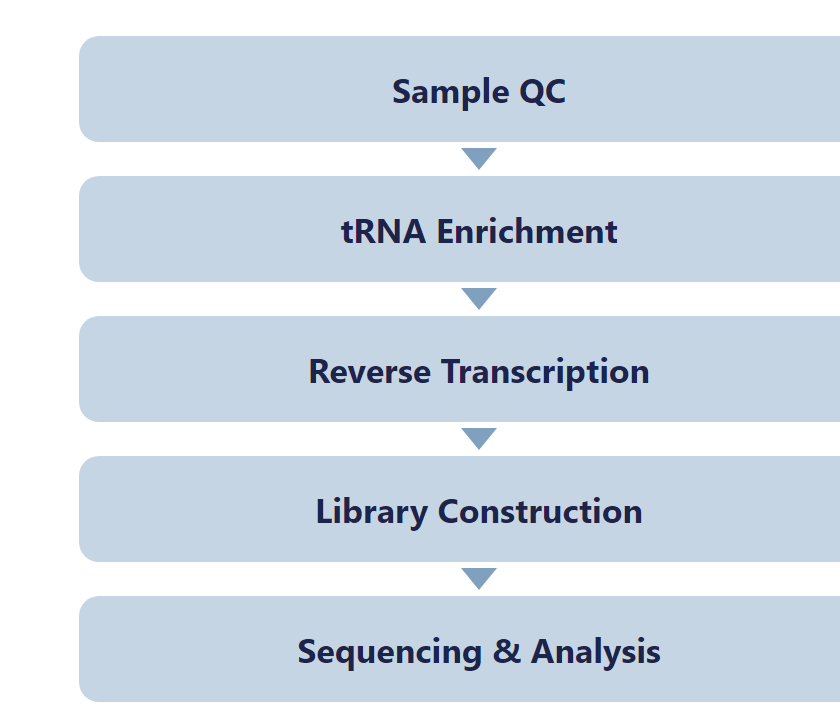
m1A-quant-seq workflow for tRNA

Figure 2. m1A-quant-seq workflow for tRNA. Total RNA is depleted of ribosomal and messenger transcripts, fragmented, and divided into a background-control arm and an untreated arm; both arms are copied by the engineered reverse transcriptase, converted into libraries, sequenced and mapped so that m1A is scored and quantified.

tRNA enrichment: total RNA is cleared of ribosomal and messenger RNA by established tRNA isolation.

Fragment sizing: tRNA is broken into uniform pieces to allow efficient reverse transcription.

Background control: one aliquot is demethylated with AlkB as a baseline; the partner aliquot is left native.

Reverse transcription: both aliquots are transcribed by the engineered enzyme into sequencing libraries.

Sequencing and analysis: reads are aligned to a reference tRNA set and m1A is reported as a mutation signature with background correction.

Bioinformatics

The tRNA-aware analysis maps m1A at base resolution, quantifies per-site stoichiometry and flags differential modification. Every site is assigned to the reference tRNA library with anticodon, isodecoder, isotype and structural-domain context, and results are provided as tables, distribution and motif figures, and browser-ready tracks.

Deliverables

  • Raw tRNA m1A sequencing reads (FASTQ) for repository deposition.
  • Sample and sequencing QC reports with sorted BAM alignment files and mapping statistics.
  • High-confidence single-base m1A site tables (XLSX) listing coordinates, tRNA identity and m1A stoichiometry.
  • tRNA feature distribution figures and m1A consensus motif logos (PDF/PNG).
  • Differential m1A analysis tables (XLSX) with fold-change and significance values.
  • Gene Ontology enrichment for the host genes of m1A-modified tRNAs (HTML/PDF/PNG).
  • Genome-browser tracks (bigWig/bedGraph) and a structured project report.

Research Applications

  • m1A is an adjustable tRNA decoration that influences translational output and tRNA turnover. Since m1A-quant-seq delivers absolute modification levels, it is suited to tying shifts at specific tRNA positions to codon usage, protein synthesis and stress or disease states.
  • Translation control: profiling m1A occupancy on particular tRNAs and comparing it with codon-biased translation.
  • tRNA structure and stability: linking m1A levels at conserved positions to folding and turnover.
  • Cancer and development: mapping m1A changes on tRNA isotypes that participate in tumour or developmental programmes.

References

[1] Li, X., Xiong, X., Zhang, M., Wang, C., Qian, S. B., & Yi, C. (2017). Base-resolution mapping reveals distinct m1A methylome in nuclear- and mitochondrial-encoded transcripts. Molecular Cell, 68(5), 993-1005. DOI: 10.1016/j.molcel.2017.10.019.

[2] Wang, Y., & Zhang, J. (2024). Methyladenosine m1A RNA modification and cancer: Methodologies and clinical perspectives. MDPI Life, 14(10), 1230. DOI: 10.3390/life14101230.

[3] Zhao, Y., et al. (2024). Chemical manipulation of m1A mediates its high-sensitivity detection in human small RNA sequencing. RNA Journal, 30(5), 580-592.

Sample Requirements

Purified total RNA is preferred; the service also offers RNA extraction from cells, tissues, blood or other sources. If the material amount is below the recommended level, contact support@arraystar.com for guidance.

Storage Guidelines

Cells and Tissues: preserve in TRIzol (cells or tissues) or RNAlater (tissues); store at -80 C.

RNA: resuspend in ethanol or RNase-free water; store at -80 C and avoid repeated freeze-thaw.

Shipping Instructions

Place sample in a 1.5 mL RNase-free tube.

Seal with parafilm or a cap lock to protect integrity.

Ship on dry ice with adequate insulation.

Sample TypeNotes
Whole bloodUse EDTA tubes only, as heparin is not compatible with subsequent analytical procedures.
Cultured cellsSubmission of cell pellets is preferred to ensure high-quality material for processing.
TissueProvide fresh or frozen specimens, ensuring that necrotic material is strictly avoided.
Total RNAMaintain an OD 260/280 ratio ≥ 1.8 and RIN ≥ 7 with no visible degradation. Submit at least 10 µg total RNA.

FAQ

Can m1A-quant-seq identify m1A in tRNA at single-base resolution?

Yes. During reverse transcription the engineered enzyme records a mutation at the m1A position, so every site is located and quantified to a single nucleotide.

What data will I receive?

You receive raw reads, QC and mapping reports, single-base m1A tables with tRNA annotation and stoichiometry, distribution and motif plots, and a project report.

How does this differ from antibody-based tRNA m1A profiling?

No enrichment is used, so the assay avoids pull-down bias and can interrogate compact, structured tRNA; it delivers quantitative site-level m1A rather than broad regional signal.

What sample type is suitable?

Purified total RNA is preferred, and RNA extraction is available. Nanogram-to-microgram inputs are typical, with options on request.

Why is high-resolution tRNA m1A detection valuable?

Precise positions reveal which isotypes and anticodons carry the mark, giving a clearer link between m1A and translation or disease.

How long does the service take?

Turnaround depends on sample type and scope; contact info@arraystar.com for an estimate.

!This assay is provided for research applications only and is not intended for clinical diagnosis, treatment, or personal health evaluation.