Single-Base RNA Modification Sequencing

Single-Nucleotide RNA m6A Modification Seq(GLORI2-seq)

Single-Nucleotide RNA m6A Modification Seq(GLORI2-Seq) is an antibody-free chemical method developed by the Chengqi Yi and Xiu-Jie Wang laboratories and published in Nature Methods (2025, DOI: 10.1038/s41592-025-02680-9). A one-pot reaction combining glyoxal, boric acid, and sodium nitrite selectively deaminates unmethylated adenosine to inosine, while m6A remains intact and is read as adenine. Because deaminated A is read as guanine, each m6A site is absolutely quantified at single-base resolution.

Arraystar Single-Nucleotide RNA m6A Modification Seq(GLORI2-Seq) is provided as an end-to-end sample-to-data service, from RNA sample QC and one-pot chemical treatment through library construction, sequencing, and bioinformatics analysis. The RNA-friendly chemistry preserves transcript integrity

Benefits

Unmatched precision: Single-base m6A site identification and absolute quantification.

Absolute stoichiometry: Accurate m6A modification fractions at individual sites.

RNA-friendly streamlined chemistry: No dedicated guanosine-protection step, keeping RNA intact throughout the workflow.

High reproducibility and sensitivity: Consistent m6A stoichiometry across replicates with sensitive detection of modification sites.

Service NameRNA ClassPrice
Single-Nucleotide RNA m6A Modification Seq(GLORI2-Seq)mRNA
Single-Nucleotide RNA m6A Modification Seq(GLORI2-Seq)mRNA & lncRNA

Background

The original GLORI method achieved absolute m6A quantification, but its dedicated guanosine-protection step caused severe RNA degradation and required 50,000–100,000 cells as starting material. The same workflow extends to long non-coding RNAs (lncRNAs), enabling researchers to profile this modification on lncRNA transcripts in parallel with mRNA in a single assay.

Our Single-Nucleotide RNA m6A Modification Seq(GLORI2-Seq) removes that step by combining glyoxal, boric acid, and sodium nitrite in a single one-pot reaction that converts unmethylated adenosine (A) to inosine (I), while m6A remains intact and is read as adenine (Fig. 1). This antibody-free, RNA-friendly chemistry preserves transcript integrity and enables absolute m6A quantification at single-base resolution.
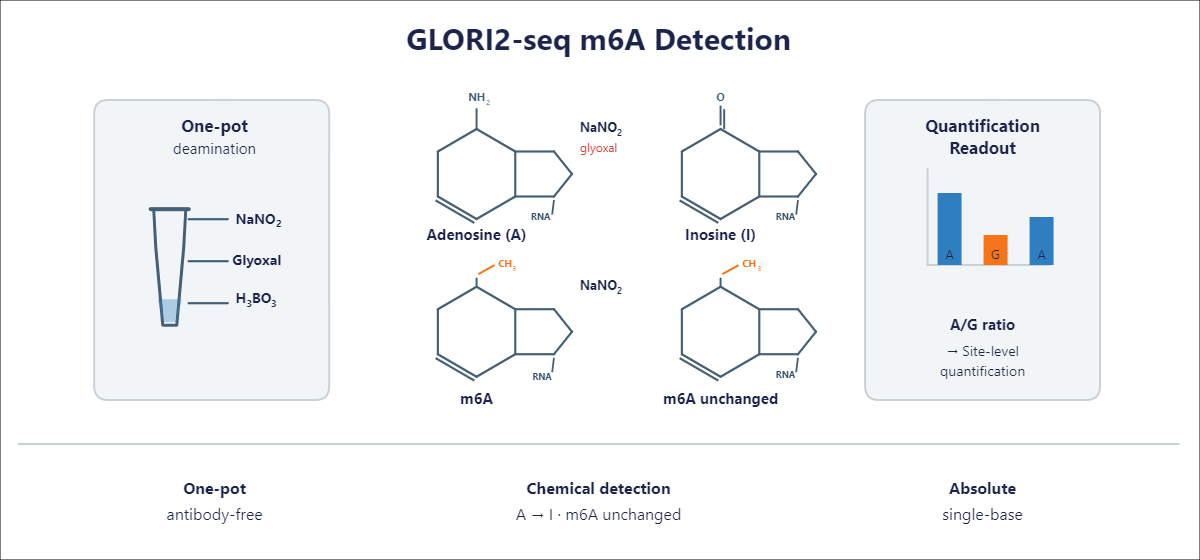
Single-Nucleotide RNA m6A Modification Seq scheme

Figure 1. GLORI2-seq m6A detection scheme. The one-pot glyoxal, boric acid, and sodium nitrite reaction deaminates unmethylated adenosine (A) to inosine (I), read as G, while m6A remains unchanged and is read as A. The A/G ratio yields absolute m6A stoichiometry at single-base resolution.

Key concept: Single-Nucleotide RNA m6A Modification Seq(GLORI2-seq) is an antibody-free one-pot chemical method that deaminates unmodified adenosine to inosine while m6A resists, enabling absolute single-base m6A quantification.

Workflow

Five steps from RNA sample to single-base m6A data:
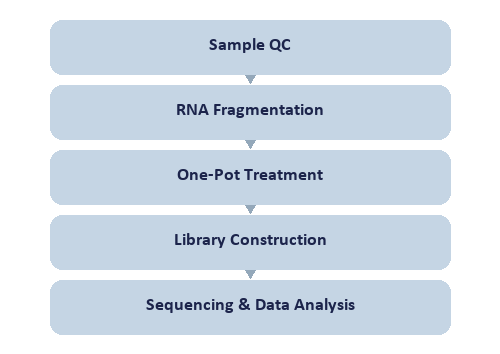
Single-Nucleotide RNA m6A Modification Seq workflow

Figure 2. Single-Nucleotide RNA m6A Modification Seq workflow.

Bioinformatics

The bioinformatics pipeline maps reads to an A-to-G-converted reference genome, identifies unconverted A signals, and quantifies absolute m6A stoichiometry at single-nucleotide resolution. Analyses include DRACH motif characterization, metagene distribution, differential methylation, gene-set enrichment, and genome-browser visualization, delivering a complete quantitative m6A methylome.

Deliverables

  • Raw m⁶A mRNA sequencing FASTQ data files, formatted for GEO/SRA public database submission.
  • Sample and sequencing QC reports with sorted BAM alignment files and core mapping statistics.
  • High-confidence single-base m⁶A site annotation tables (XLSX) with coordinates, genes, and modification stoichiometry.
  • Single-base m⁶A transcript feature distribution figures and consensus m⁶A motif logos (PDF/PNG format).
  • Single-base resolution differential m⁶A methylation tables (XLSX) with fold change and significance metrics.
  • Gene Ontology (GO) enrichment analysis reports for m⁶A-modified genes, provided in HTML/PDF/PNG formats.
  • Genome browser-compatible track files (bigWig/bedGraph) and a full structured m⁶A analysis project report.

Research Applications

  • Neuroscience: Synaptic and cytoplasmic m6A methylomes of mouse dorsal hippocampus; synapse-related genes show higher m6A levels.
  • Cancer drug-target research: METTL3 inhibitor (STM2457) treatment maps m6A loss at ~99% of sites, supporting evaluation of m6A writers as therapeutic targets.
  • Disease and clinical research: GLORI-Sanger and amplicon assays provide absolute m6A quantification at individual candidate loci for validation in clinical samples.
  • Immunology research: Map single-base m6A in immune cell subsets to investigate epitranscriptomic control of immune activation and inflammatory responses.
  • Functional epitranscriptomics: High-confidence single-base m6A maps with absolute modification fractions support dissection of m6A-dependent gene regulation.

References

[1] Sun H, Lu B, Zhang Z, et al. Mild and ultrafast GLORI enables absolute quantification of m6A methylome from low-input samples. Nature Methods 2025. DOI: 10.1038/s41592-025-02680-9.

[2] Liu C, et al. Absolute quantification of single-base m6A methylation in the mammalian transcriptome using GLORI. Nature Biotechnology 2023;41:355-366. DOI: 10.1038/s41587-022-01537-2.

Sample Requirements

Storage Guidelines

Cells and Tissues: Preserve in TRIzol or an RNA stabilization solution; snap freeze in liquid nitrogen and store at –80 °C.

RNA: Resuspend in ethanol or RNase-free ultrapure water; store at –80 °C and avoid multiple freeze-thaw cycles.

Shipping Instructions

Place the sample in a 1.5 mL RNase-free microcentrifuge tube.

Seal the tube with parafilm or a cap lock to ensure sample integrity.

Ship the package on dry ice with adequate insulation to maintain the required temperature.

Sample TypeNotes
Whole bloodUse EDTA tubes only, as heparin is not compatible with subsequent analytical procedures.
Cultured cellsSubmission of cell pellets is preferred to ensure high-quality material for processing.
TissueProvide fresh or frozen specimens, ensuring that necrotic material is strictly avoided.
Total RNAMaintain an OD 260/280 ratio ≥ 1.8 and RIN ≥ 7 with no visible degradation. Submit at least 2 µg total RNA.

FAQ

What sample types are compatible with Single-Nucleotide RNA m6A Modification Seq(GLORI2-Seq)?

We accept total RNA extracted from cells, tissues, blood, or other biological sources.

Can GLORI2-seq quantify m6A at single-base resolution?

Yes. Unmethylated adenosines are deaminated to inosines and read as guanines, while m6A sites remain as adenines. This conversion signature provides single-base resolution and absolute m6A stoichiometry, validated by spike-in RNAs with known modification ratios across a wide dynamic range.

How does GLORI2-seq compare with the original GLORI or other methods?

The original GLORI caused severe RNA degradation from a dedicated G-protection step and required 50,000–100,000 cells as starting material. GLORI2-seq removes this step, preserves RNA integrity, and detects about 42% more m6A sites with high reproducibility.

Does this service also profile lncRNA?

Yes. We provide two service options: mRNA modification, and mRNA plus long non-coding RNA (lncRNA) modification. Both transcript types can be analyzed together in a single experiment, so there is no need to split them into two projects, and the scope of your study opens up accordingly.

!This assay is provided for research applications only and is not intended for clinical diagnosis, treatment, or personal health evaluation.