Single-Base RNA Modification Sequencing
Related Products
Related Services
Related Reviews
Single-Nucleotide RNA m1A Modification Seq(m1A-Quant-seq)
m1A-quant-seq is an advanced profiling technology engineered for highly accurate m1A epitranscriptomic mapping with absolute modification stoichiometry quantification at single-nucleotide resolution. In m1A-quant-seq, the engineered reverse transcriptase is not stopped by m1A modification like other common reverse transcriptases. Instead, the RT highly efficiently reads through the m1A site while inducing characteristic mutation signatures. m1A-quant-seq overcomes the limitations of classic m1A-MeRIP-seq to significantly reduce RNA input requirements, maximize base-calling accuracy, and increase workflow throughput.
Arraystar m1A-quant-seq is provided as an end-to-end sample-to-data service, from RNA sample QC, library construction, high-throughput sequencing, bioinformatics analyses/annotation, to final project report. The service ensures best possible results for the researchers to focus on the m1A epitranscriptomics data, without the burden of complex setups and tasks.
Benefits
Unmatched Precision: Pinpoints individual m1A modification sites at near single-base resolution, compared with ~100 nt resolution in traditional MeRIP-seq.
Absolute Stoichiometry: Quantifies the precise percentage of m1A modification at each site by calculating the ratio of mutation signatures.
Superior Read-Through Efficiency: The engineered RT enzyme reads through m1A modification without premature truncation.
Low Sample Input: Low required RNA sample amount in nanogram range, allowing applications broadened to where sample amounts are limited (e.g. rare clinical specimens).
Zero Antibody Bias: Eliminates the non-specific binding, cross-reactivity, and batch-to-batch variations of immunoprecipitation in MeRIP-seq.
| Service Name | RNA Class | Price |
|---|---|---|
| Single-Nucleotide RNA m1A Modification Seq(m1A-Quant-seq) | mRNA | |
| Single-Nucleotide RNA m1A Modification Seq(m1A-Quant-seq) | mRNA & lncRNA |
Background
Classic antibody-based methods (like m1A-MeRIP-seq) suffer from poor resolution (~100–200 nt peaks) and the severe reverse transcription (RT) arrest, making absolute quantification impossible and creating a massive blind spot in RNA epitranscriptomic research.
Our m1A-quant-seq Service has revolutionized m1A epitranscriptomics which overcomes these traditional technological barriers. By combining engineered reverse transcriptase and optimized chemical conditions, this advanced platform efficiently reads through m1A modified bases and converts m1A sites into precise, reproducible mismatch mutation signatures (Fig.1). This delivers absolute modification stoichiometry quantification at true single-nucleotide resolution using low-nanogram RNA inputs.
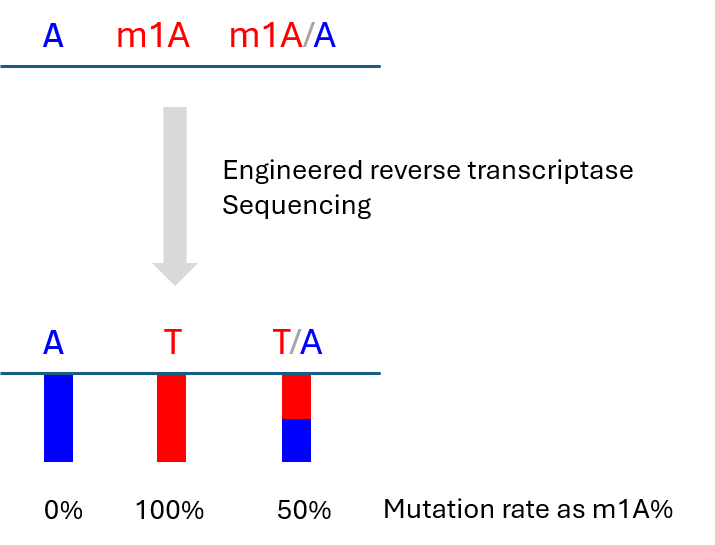
Figure 1. m1A-quant-seq scheme. The example RNA sequence is “A-m1A-m1A/A”, where m1A/A is 50-50% mixed population of m1A and unmodified A at that base position. The RNA is reverse transcribed by the engineered reverse transcriptase, which induces mutations (primarily T in sequencing) at the m1A site. The mutation rate is quantified as m1A%.
Workflow
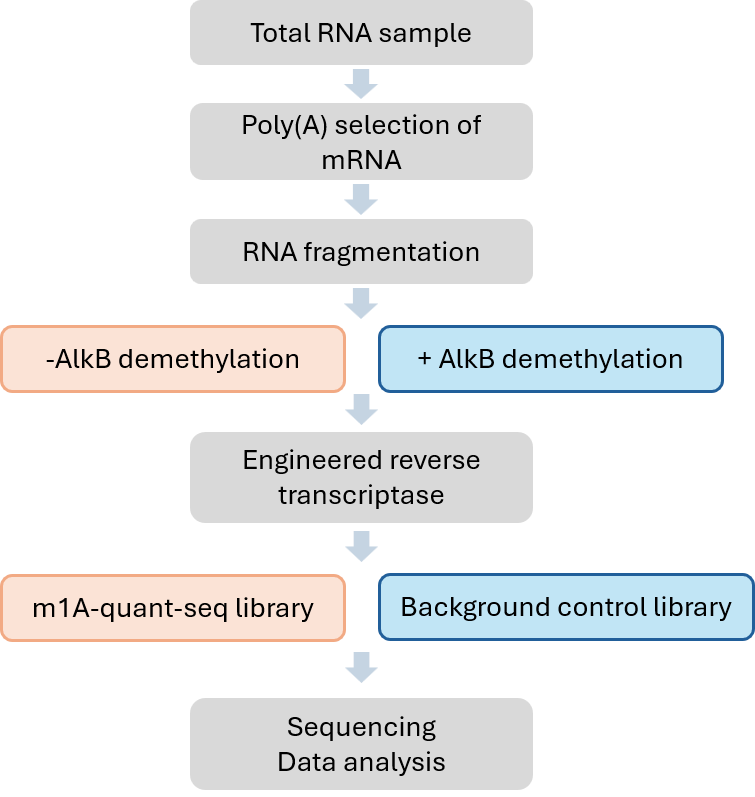
Figure 2. m1A-quant-seq workflow. Total RNA sample is selected for mRNA by poly(A) selection. The selected RNA is fragmented to optimal sizes. One aliquot is demethylated (including m1A) with AlkB for use as background control. The other aliquot remains untreated. Both aliquots are reverse transcribed by a special engineered reverse transcriptase and constructed into sequencing libraries. The sequencing reads are mapped to the reference genome. m1A modification is detected as mutation signature and quantified with the background control correction.
RNA sample prep: Purified total RNA is selected for mRNA by poly(A) selection.
RNA fragmentation: The selected RNA is fragmented to optimal sizes.
Background control preparation: One aliquot is demethylated (including m1A) with AlkB for use as background control; the other aliquot remains untreated.
Reverse transcription: Both aliquots are reverse transcribed by a special engineered reverse transcriptase and constructed into sequencing libraries.
Sequencing & Data analysis: Sequencing reads are mapped to the reference genome. m1A modification is detected as mutation signature and quantified with the background control correction.
Bioinformatics
The bioinformatics analysis pipeline maps m1A modification at single nucleotide resolution, quantifies the m1A methylome, and analyzes differential modification to better understand the biology and facilitate biomarker applications.
m1A-quant-seq service includes detailed bioinformatics analyses and annotations for you to study the m1A epitranscriptomics and gain biological/disease insights in your research. Most analyzed data, tables, and graphics are accessible directly with common office software on a PC. Raw datasets are also provided for your own bioinformatic/computational analysis or data repository uses.
Deliverables
- Raw sequencing data files (FASTQ format)
- Sample & sequencing QC reports, plus sorted alignment files (BAM format) with core mapping statistics
- High-confidence single-base m¹A site tables (XLSX format) with genomic coordinates, host gene information, absolute modification stoichiometry (m1A%), detailed codon positions, corresponding encoded amino acids, and evolutionary conservation scores
- Transcript feature distribution figures (PDF/PNG format) and motif logo (PDF/PNG format)
- Differential methylation analysis tables (XLSX format)
- Gene Ontology enrichment reports (HTML/PDF/PNG format)
- Genome browser compatible track files (bigWig / bedGraph format) and full structured project report
Advanced data analysis & Multi-Omic Integration (Optional)
- Transcript Expression Correlation: Quantitatively assesses how m1A modification levels correlate with the expression of their transcripts.
- Translation Efficiency Inference: Explores how m¹A modification levels affect the translation efficiencies of their target mRNAs to reveal the functional impacts at multi-omic level.
- RNA Stability Inference: Evaluates how m1A modification levels affects the half-life or stability of target mRNAs.
- Conserved m1A Sites: Identify m1A sites that are evolutionarily conserved across multiple species, which may indicate essential conserved biological functions.
- Global Distribution Heatmaps: Provide scatterplots and heatmaps showing the relationship between transcript abundance (half-life) and modification levels.
Research Applications
m1A is a highly dynamic post-transcriptional modification critical for RNA stability, structural folding, and translational control. Because m1A carries a positive charge under physiological conditions, it blocks standard Watson-Crick base pairing and forces distinct structural changes in mRNA, tRNA, and rRNA. Dysregulation of dynamic m1A pathways is heavily implicated in almost any biological areas and diseases such as cancers, metabolic syndromes, and neurological disorders.
Oncogenesis
Dynamic m1A methylation on mRNA regulates the expression of key oncogenes and tumor suppressors. [1]
- Biomarker Discovery: Scientists use m1A-quant-seq to profile tumor tissue biopsies against healthy margins. Because the tool measures absolute stoichiometry, specific high-percentage m1A sites serve as highly reproducible, digital biomarkers for cancer staging. [1, 2, 3]
- Metabolic Rewiring: Research application in hepatocellular carcinoma and glioblastoma shows that altered m1A levels on metabolic transcripts directly modulate glycolytic enzyme translation. This drives the Warburg effect and helps tumors adapt to hypoxic microenvironments. [1, 2]
- Splicing Variations: Because single-nucleotide resolution can map modifications right at intron-exon junctions, researchers use it to show how aberrant m1A masking blocks splicing machinery, generating tumor-specific neoantigens. [1, 2]
Neurological Disorders
The mammalian brain exhibits highly dynamic expression of both m1A writing enzymes (such as TRMT6/61A) and erasers (such as ALKBH3/ALKBH1). [1, 2]
- Neural Stem Cell Differentiation: Using m1A-quant-seq protocols, neuroscientists trace m1A fluctuations during early embryonic neurogenesis. Shifts in modification stoichiometry on critical neurodevelopmental mRNAs dictate whether stem cells self-renew or differentiate.
- Neurodegenerative Mechanisms: In Alzheimer’s and Parkinson’s disease models, the platform maps precise modifications on transcripts governing mitochondrial function and proteasome clearance. This reveals how a breakdown in m1A homeostasis accelerates neurotoxicity and synaptic loss. [1, 2, 3]
Immunological and Viral Epitranscriptomics
RNA viruses exploit host epitranscriptomic machinery to protect their genetic material and control replication cycles. [1]
- Viral Lifecycle Mapping: Applied to viral genomes (such as HIV-1, Zika, or Influenza), m1A-quant-seq identifies structural modifications that prevent host-cell pattern recognition receptors from detecting viral RNA.
- Host Immune Evasion: Quantitative mapping demonstrates that low-level m1A updates on host interferon-stimulated genes modulate the kinetics of the antiviral response, proving that viruses actively alter host stoichiometry to evade immunity. [1]
References
[1] Li, X., Xiong, X., Zhang, M., Wang, C., Qian, S. B., & Yi, C. (2017). Base-resolution mapping reveals distinct m1A methylome in nuclear- and mitochondrial-encoded transcripts. Molecular Cell, 68(5), 993-1005. PMID: 29107537
[2] Wang, Y., & Zhang, J. (2024). Methyladenosine m1A RNA modification and cancer: Methodologies and clinical perspectives. MDPI Life, 14(10), 1230.
[3] Zhao, Y., et al. (2024). Chemical manipulation of m1A mediates its high-sensitivity detection in human small RNA sequencing. RNA Journal, 30(5), 580-592.
Sample Requirements
We prefer purified total RNA samples. We also provide RNA extraction service from cells, tissues, blood, or other biological sources. If you cannot practically obtain that amount, let us know how much you can actually obtain for us to make informed suggestions. If you have sample questions, please contact us at support@arraystar.com.
| Sample Type | Notes |
|---|---|
| Whole blood | Use EDTA tubes only, as heparin is not compatible with subsequent analytical procedures. |
| Cultured cells | Submission of cell pellets is preferred to ensure high-quality material for processing. |
| Tissue | Provide fresh or frozen specimens, ensuring that necrotic material is strictly avoided. |
| Total RNA | Maintain an OD 260/280 ratio ≥ 1.8 and RIN ≥ 7 with no visible degradation. Submit at least 10 µg total RNA. |
Storage Guidelines
- Cells and Tissues: Preserve the samples in TRIzol (cells or tissues) or RNAlater (tissues); Store at –80 °C.
- RNA: Resuspend the RNA in ethanol or RNase-free ultrapure water; store the resulting solution at –80 °C and avoid multiple freeze-thaw cycles.
Shipping Instructions
- Place the sample in a 1.5 mL RNase-free microcentrifuge tube.
- Seal the tube with parafilm or a cap lock to ensure sample integrity.
- Ship the package on dry ice with adequate insulation to maintain the required temperature.
FAQ
Can m1A-quant-seq identify m1A at single-base resolution?
Yes. m1A-quant-seq detects m1A through modification induced signature at that base position during reverse transcription, enabling precise localization and quantification at individual nucleotide positions.
What kind of data will I receive?
You will receive a complete dataset and a structured project report that includes identified m1A sites with modification stoichiometry, transcript annotations, differential analysis tables, visualization files such as IGV tracks, heatmaps and motif plots, and optional comparative analysis across samples or conditions:
- Identified m1A sites
- m1A modification percentage stoichiometry (m1A%)
- Transcript annotations (CDS, UTR, stop codons, etc.)
- Visualization and graphics: IGV tracks, heatmaps, motif plots
- Optional comparative analysis across samples or conditions
Can you help explain my data or technical questions?
Yes, please contact us at support@arraystar.com.
How long does the service take?
Turnaround time varies depending on sample type and project complexity. Please contact us at info@arraystar.com for a time estimate based on your needs.