Single-Base RNA Modification Sequencing

Single-Nucleotide RNA 2'-O-Me Modification Seq(NM-seq)

Single-Nucleotide RNA 2'-O-Methylation Modification Seq(NM-Seq) maps 2'-O-methylation (Nm) sites with base precision across mRNA and lncRNA. The method exploits the differential reactivity of periodate toward 2'-hydroxyl versus 2'-O-methylated nucleotides, running repeated oxidation-elimination-dephosphorylation (OED) cycles to enrich Nm-containing fragments before sequencing.

Arraystar provides an end-to-end sample-to-data workflow, from RNA QC and OED enrichment through library construction, sequencing, and bioinformatics, delivering an Nm landscape across the transcriptome.

Benefits

Single-base resolution: chemically resolves each 2'-O-methylation site at nucleotide precision.

High-throughput: profiles Nm genome-wide across mRNA and lncRNA in parallel.

Broad RNA coverage: detects Nm on mRNA, lncRNA, pri-miRNA, tRNA, and rRNA.

Chemical method: antibody-free periodate chemistry avoids enrichment bias.

Robust enrichment: repeated OED cycles concentrate methylated fragments.

One-stop service: RNA extraction, preprocessing, library, sequencing, and analysis.

Service NameRNA ClassPrice
Single-Nucleotide RNA 2'-O-Methylation Modification Seq(NM-Seq)mRNA
Single-Nucleotide RNA 2'-O-Methylation Modification Seq(NM-Seq)mRNA & lncRNA

Background

2'-O-methylation (Nm) is an abundant modification at the 2'-hydroxyl of the RNA ribose, deposited by 2'-O-methyltransferases (such as the spoUT family) or C/D-box snoRNPs. It is found in rRNA, snRNA, mRNA, tRNA, snoRNA, and siRNA, and regulates RNA stability, structure, biogenesis, splicing, and translation.

In mammals, 2'-O-methylation also marks self versus non-self mRNA and is important in innate immune sensing.

Key concept: Single-Nucleotide RNA 2'-O-Methylation Modification Seq(NM-Seq) is a chemical sequencing method that uses periodate-based oxidation-elimination-dephosphorylation (OED) cycles to selectively degrade unmodified nucleotides, so 2'-O-methylated sites resist cleavage and are mapped at single-base precision.
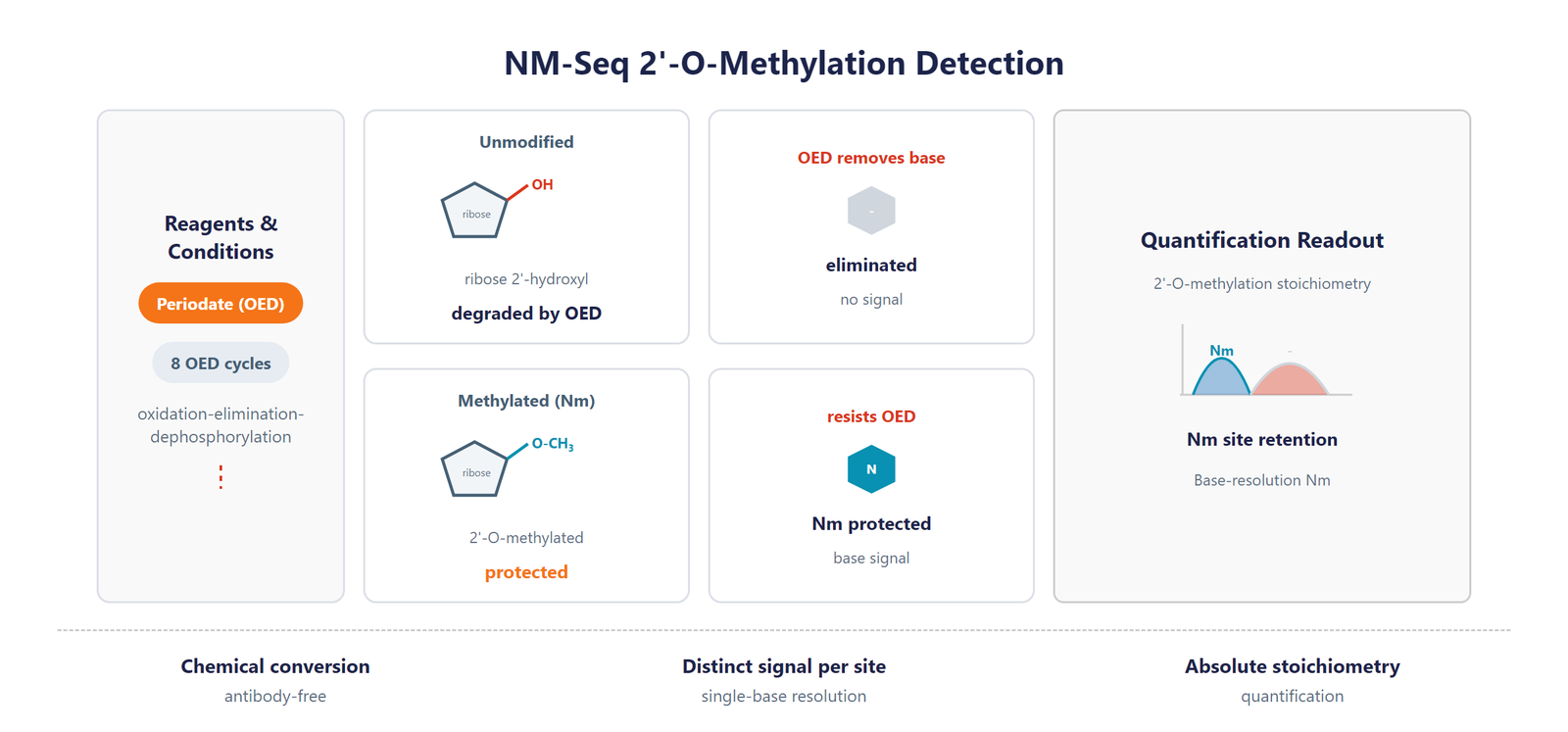
Single-Nucleotide RNA 2'-O-Me Modification Seq scheme

Figure 1. Single-Nucleotide RNA 2'-O-Me Modification Seq scheme.

Workflow

Five steps from RNA sample to single-base 2'-O-methylation data:

Sample QC: assess RNA integrity, purity, and input amount.

OED enrichment: run oxidation-elimination-dephosphorylation cycles to remove unmodified nucleotides.

Library construction: ligate adapters at the exposed 3' end of methylated fragments.

Sequencing: sequence on an Illumina platform to a depth sufficient for Nm calling.

Bioinformatics: align and quantify Nm sites at single-base resolution.
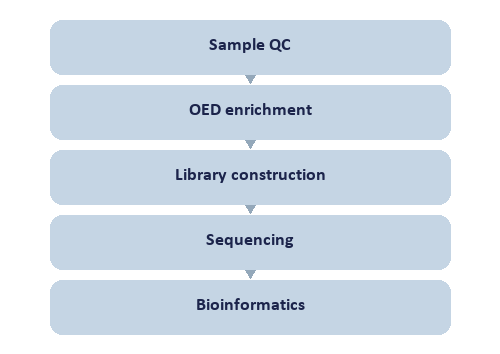
Single-Nucleotide RNA 2'-O-Me Modification Seq workflow

Figure 2. Single-Nucleotide RNA 2'-O-Me Modification Seq workflow.

Bioinformatics

The pipeline maps reads to the transcriptome and identifies positions where 2'-O-methylation protects the nucleotide from OED degradation, reporting Nm stoichiometry at base resolution. Analyses include motif characterization, differential modification, and genome-browser visualization.

Deliverables

  • Raw FASTQ data files, ready for GEO/SRA public database submission.
  • QC report with BAM alignment files and core mapping statistics.
  • Single-base 2'-O-methylation site tables (XLSX) with coordinates and stoichiometry.
  • Nm distribution and motif figures across mRNA and lncRNA (PDF/PNG).
  • Differential Nm modification tables (XLSX) with fold change and significance.
  • Functional enrichment reports for Nm-bearing transcripts.
  • Genome-browser track files (bigWig/bedGraph) and a structured project report.

Research Applications

  • mRNA function: link Nm to transcript stability, splicing, and translation.
  • Immune response: study Nm as a self/non-self signal in innate immunity.
  • Viral RNA: profile Nm on viral transcripts and host immune evasion.
  • Development and differentiation: track Nm dynamics across cell states.
  • Disease research: identify differentially methylated Nm sites as biomarkers.
  • LncRNA biology: assess Nm on long non-coding RNAs and their regulators.

References

[1] Nm-seq maps 2'-O-methylation sites in human mRNA with base precision. Nature Methods 2019; DOI: 10.1038/nmeth.4294.

[2] FTSJ3 is an RNA 2'-O-methyltransferase recruited by HIV to avoid innate immune sensing. Nature 2019; DOI: 10.1038/s41586-018-0841-4.

Sample Requirements

Storage Guidelines

Cells and Tissues: Preserve in TRIzol or an RNA stabilization solution; snap freeze in liquid nitrogen and store at -80 C.

RNA: Resuspend in ethanol or RNase-free ultrapure water; store at -80 C and avoid multiple freeze-thaw cycles.

Shipping Instructions

Place the sample in a 1.5 mL RNase-free microcentrifuge tube.

Seal the tube with parafilm or a cap lock to ensure sample integrity.

Ship the package on dry ice with adequate insulation to maintain the required temperature.

Sample TypeNotes
Whole bloodUse EDTA tubes only, as heparin is not compatible with subsequent analytical procedures.
Cultured cellsSubmission of cell pellets is preferred to ensure high-quality material for processing.
TissueProvide fresh or frozen specimens, ensuring that necrotic material is strictly avoided.
Total RNAMaintain an OD 260/280 ratio ≥ 1.8 and RIN ≥ 7 with no visible degradation. Submit at least 100–300 µg total RNA.

FAQ

What is 2'-O-methylation?

2'-O-methylation (Nm) is a modification at the 2'-hydroxyl of the ribose, deposited by methyltransferases or C/D-box snoRNPs, regulating RNA stability, structure, splicing, and translation.

How does NM-Seq achieve single-base resolution?

Periodate differential reactivity degrades unmodified nucleotides through OED cycles while 2'-O-methylated sites resist cleavage, mapping Nm at base precision.

What RNA types are covered?

The service profiles Nm across mRNA and lncRNA primarily, and also detects Nm on pri-miRNA, tRNA, and rRNA within the same assay.

How does this differ from antibody-based methods?

NM-Seq is antibody-free chemical sequencing, avoiding enrichment bias and providing base-resolution Nm calling across the transcriptome.

Does the service provide interpretations?

The pipeline reports Nm site tables, CDS/splice-site distribution, motif analysis, differential modification, and enrichment of Nm-bearing transcripts.

!This assay is provided for research applications only and is not intended for clinical diagnosis, treatment, or personal health evaluation.