
tRNAs are the fundamental component of mRNA decoding and protein translation. tRNAs undergo by far the greatest number of and the most chemically diverse post-transcriptional modifications. These modifications are critical for all core aspects of tRNA function, such as folding, stability and decoding[1]. Typically, modifications in the main body of tRNA are crucial for tRNA structure folding, stability, rigidity and flexibility, whereas modifications in the anticodon loop affect decoding by open loop structure, codon-anticodon pairing, wobbling, and preventing translational frameshifts. Additionally, modified nucleosides serve as identity determinants for aminoacyl-tRNA synthetase (AARS) for extra amino acid recognition accuracy[2]. In general, hypomodified tRNAs are targeted for degradation. Studying tRNA modification is perhaps just as important as tRNA expression profiling.
Defects in tRNA modifications and modification enzymes are linked with human diseases such as cancers, diabetes, neurological syndromes, cardiac conditions, and mitochondrial-linked disorders (Fig. 1)[3]. Analysis of tRNA modification profiles is key to establish the link with the disease, tRNA modification enzymes, and tRNA molecular functioning.
Arraystar LC-MS tRNA Modification Analysis Service offers the sample-to-data solution for simultaneous profiling of 55 nucleosides modifications important to tRNA, using total RNA as the starting material. The service includes tRNA isolation from the total RNA, complete hydrolysis, and dephosphorylation to prepare single nucleosides. The state of the art, ultra high performance LC-MS system delivers a new level of sensitivity, precision, accuracy, dynamic range, and robustness of the quantification results.
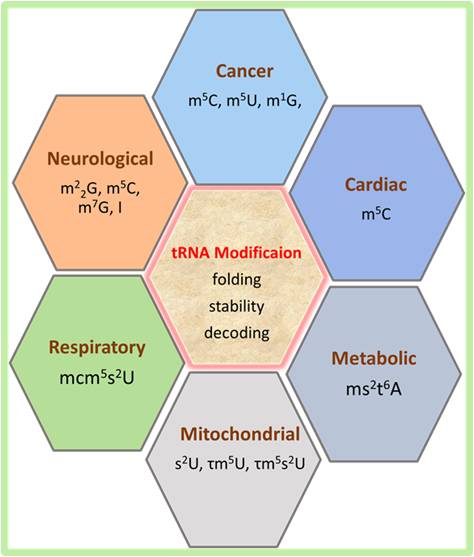
Figure 1. tRNA modifications in human diseases
References
1. Kirchner S. and Z. Ignatova (2015) “Emerging roles of tRNA in adaptive translation, sig-nalling dynamics and disease.” Nat. Rev. Genet. 16(2):98-112 [PMID: 25534324]
2. El Yacoubi B. et al. (2012) “Biosynthesis and function of posttranscriptional modifications of transfer RNAs.” Annu. Rev. Genet. 46:69-95 [PMID: 22905870]
3. Torres A.G. et al. (2014) “Role of tRNA modifications in human diseases.” Trends Mol Med 20(6):306-14 [PMID: 24581449]
Table1. Nucleoside modifications profiled by Arraystar LC-MS tRNA Modification Analysis
| Number | Nucleoside | Symbol | Number | Nucleoside | Symbol |
| 1 | 3′-O-methyladenosine | 3′-OMeA | 2 | 3′-O-methyluridine | 3′-OMeU |
| 3 | 2′-O-methylcytidine | Cm | 4 | 5-methyl-2-thiouridine | m5s2U |
| 5 | 3-methylcytidine | m3C | 6 | 5-methoxyuridine | mo5U |
| 7 | 5-methylcytidine | m5C | 8 | pseudouridine |  |
| 9 | N6-isopentenyladenosine | i6A | 10 | 2′-O-methylinosine | Im |
| 11 | 5,2′-O-dimethylcytidine | m5Cm | 12 | 3-methyluridine | m3U |
| 13 | 1-methyladenosine | m1A | 14 | 1-methylpseudouridine | m1 |
| 15 | 2-thiocytidine | s2C | 16 | 5-hydroxymethylcytidine | hm5C |
| 17 | N2, N2, 7-trimethylguanosine | m2,2,7G | 18 | 5,2′-O-dimethyluridine | m5Um |
| 19 | N4-acetyl-2′-O-methylcytidine | ac4Cm | 20 | N6-threonylcarbamoyladenosine | t6A |
| 21 | N6-methyladenosine | m6A | 22 | 2-methylthio-N6-threonylcarbamoyladenosine | ms2t6A |
| 23 | 3′-O-methylcytidine | 3′-OmeC | 24 | 5-carboxymethyluridine | cm5U |
| 25 | 2′-O-methyladenosine | Am | 26 | 5-methoxycarbonylmethyl-2-thiouridine | mcm5s2U |
| 27 | N2, N2-dimethylguanosine | m22G | 28 | 5-Methoxycarbonylmethyluridine | mcm5U |
| 29 | 5′-O-methylthymidine | 5′-OMeT | 30 | 2-methylthio-N6-isopentenyladenosine | ms2i6A |
| 31 | 2′-O-methyluridine | Um | 32 | Peroxywybutosine | o2w |
| 33 | inosine | I | 34 | 5-taurinomethyl-2-thiouridine | tm5s2U |
| 35 | 2′-O-methylguanosine | Gm | 36 | 5-oxyacetic acid uridine | cmo5U |
| 37 | 1-methylguanosine | m1G | 38 | 5-carbamoylmethyuridine | ncm5U |
| 39 | 7-methylguanosine | m7G | 40 | Queuosine | Q |
| 41 | N2-methylguanosin | m2G | 42 | 5-taurinomethyluridine | tm5U |
| 43 | 3′-O-methylinosine | 3′-OMeI | 44 | 5-formyl-2′-O-methylcytidine | f5Cm |
| 45 | 2-thiouridine | s2U | 46 | dihydrouridine | D |
| 47 | 4-thiouridine | s4U | 48 | 5-formylcytidine | f5c |
| 49 | 5-methyluridine | m5U | 50 | wybutosine | W |
| 51 | N4-acetylcytidine | ac4C | 52 | 5-methoxycarbonylmethyl-2′-o-methyluridine | mcm5Um |
| 53 | N6, O2′-methyladenosine | m6Am | 54 | 5-methylaminomethyl-2-thiouridine | mnm5s2U |
| 55 | 5-hydroxyuridine | ho5U |
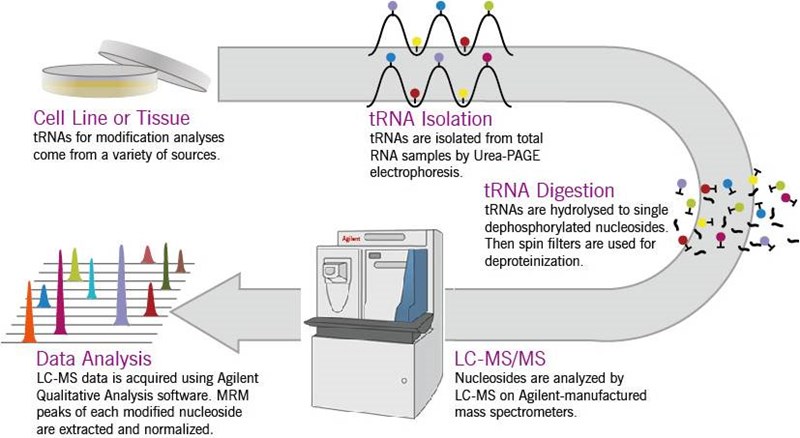
Workflow of Arraystar LC-MS tRNA Modification Analysis.
• Raw and normalized peak data

• Total Ion Current chromatogram of nucleosides
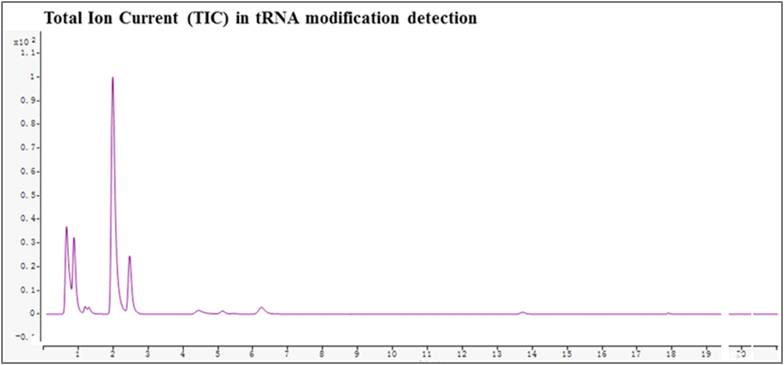
• Differential modification of nucleosides among samples

References
1. Kirchner S, Ignatova Z. Emerging roles of tRNA in adaptive translation, signalling dynamics and disease. Nature reviews Genetics 2015;16:98-112.
2. El Yacoubi B, Bailly M, de Crecy-Lagard V. Biosynthesis and function of posttranscriptional modifications of transfer RNAs. Annual review of genetics 2012;46:69-95.
3. Torres AG, Batlle E, Ribas de Pouplana L. Role of tRNA modifications in human diseases. Trends in molecular medicine 2014;20:306-14.